
EU Entry/Exit System Triggers 5-Hour Border Delays at Schiphol, Frankfurt, and Major European Hubs 2026
The rollout of the EU Entry/Exit System (EES) has caused severe passport-control bottlenecks across Europe, with waiting times hitting five hours at key gateways including Amsterdam Schiphol and Frankfurt.

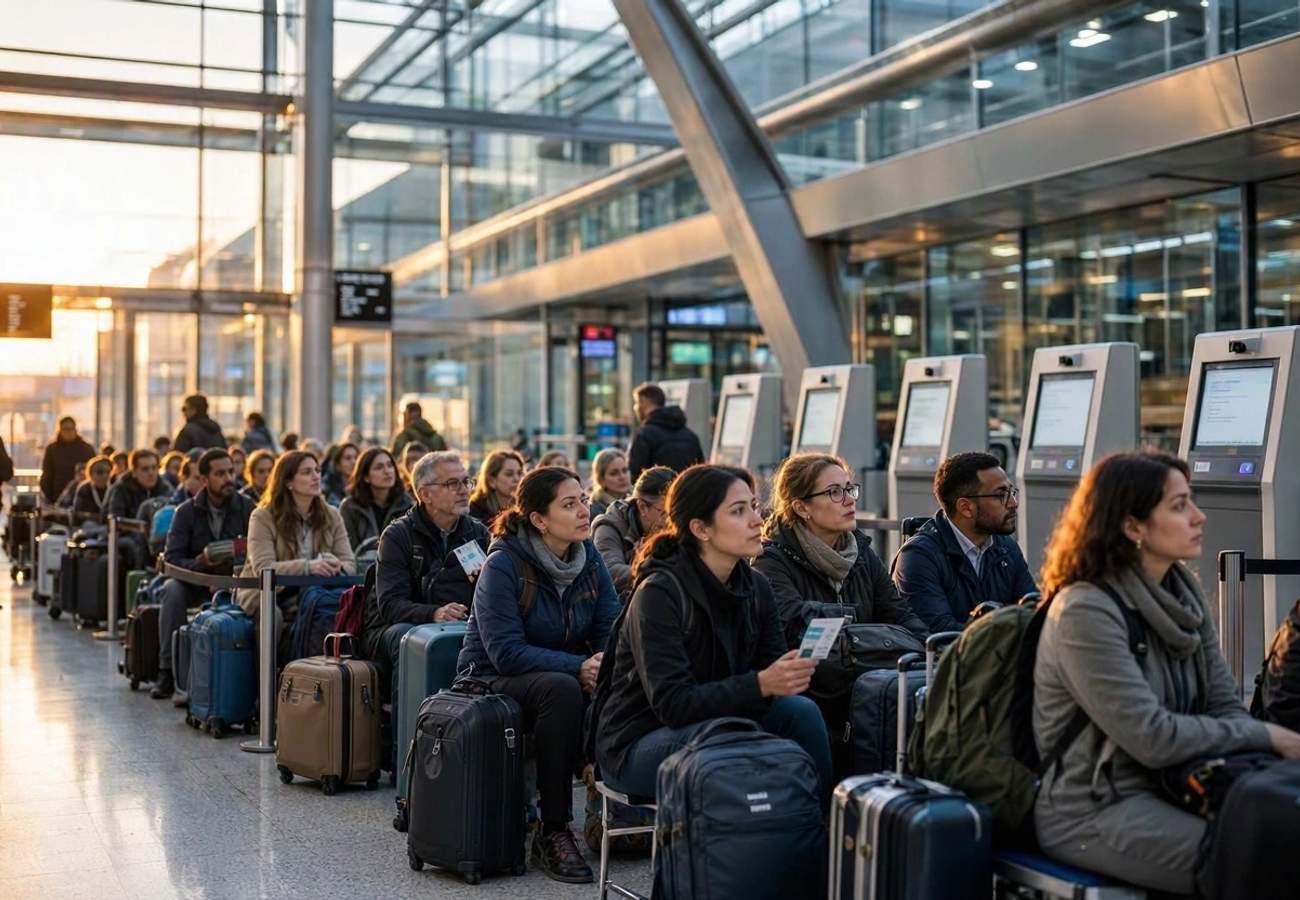
Image generated by AI
Waiting times of up to five hours have been recorded at European border checkpoints, signaling a systemic failure in the initial rollout of the European Union’s Entry/Exit System (EES). This biometric mandate, designed to modernize the Schengen Area borders, has instead created severe operational bottlenecks at some of the continent's most critical aviation gateways, including Amsterdam Schiphol and Frankfurt.
The Biometric Bottleneck: EES Implementation
The current congestion is the direct result of the Entry/Exit System (EES), which replaces manual passport stamping with a digital record. Eligible non-EU travelers must now provide fingerprints and facial images upon entry. While the European Commission intended this to tighten security and automate tracking, the practical reality has been a clash between high-volume passenger flows and slow biometric registration.
The friction is most acute for first-time registrants. When automated kiosks fail or demand exceeds the number of available border officers, the system reverts to manual processing, which is significantly slower. This is compounded during "peak waves"—when multiple long-haul flights land simultaneously—forcing thousands of passengers into a narrow processing funnel.
Documented Border Congestion Data 2026
Data from Qsensor and official airport warnings reveal a stark disparity between planned processing times and actual passenger experiences. The following table outlines the most affected hubs:
| Airport | Country | Peak Wait Time | Evidence Date | Primary Passenger Impact |
|---|---|---|---|---|
| Frankfurt (FRA) | Germany | 120 Minutes | Sept 29, 2026 | Heavy delays for non-EU arrivals/departures |
| Amsterdam Schiphol (AMS) | Netherlands | 120 Minutes | Oct 18, 2026 | Transfer and arrival congestion; technical failures |
| Munich (MUC) | Germany | 60 Minutes | August 2026 | Increased wait vs. previous 31-minute average |
| Milan Linate (LIN) | Italy | "Hours-long" | April 12, 2026 | 122 passengers missed easyJet flight to Manchester |
| Nice Côte d’Azur (NCE) | France | Not Verified | October 2026 | Terminal circulation and international congestion |
Expert Analysis: The High Cost of Digital Transition
For the modern traveler, the implementation of EES transforms the "minimum connection time" (MCT) from a guideline into a gamble. The data from Milan Linate, where 122 passengers missed a single flight due to passport queues, proves that border delays are no longer just an inconvenience—they are a logistical risk.
The pricing pressure created by these delays will likely shift toward airlines. As passengers miss connections due to state-mandated border checks, airlines face the cost of rebooking and hotel vouchers, even though the delay is caused by government infrastructure. For travelers booking routes through Schiphol or Frankfurt, the direct consequence is a mandatory need to increase layover buffers. A standard two-hour connection is now insufficient; a four-to-six hour window is the only way to mitigate the risk of a missed flight.
Furthermore, the October 18 technical malfunction at Schiphol demonstrates a dangerous dependency on the digital layer. When the biometric system fails, the lack of redundant manual staffing creates an immediate crisis. The transition to a "paperless" border has removed the fail-safes that previously kept passenger flow moving during technical glitches.
Key Takeaways
- Extreme Wait Times: Peak delays have reached 5 hours, with hubs like Frankfurt and Schiphol routinely seeing 120-minute queues.
- Missed Departures: Border bottlenecks are causing significant flight misses, notably at Milan Linate.
- Biometric Friction: The EES requires fingerprints and facial scans, which significantly slow down first-time registrants.
- Technical Fragility: System outages at major hubs like Schiphol can instantly paralyze passport control, regardless of staffing levels.
- Regional Spread: While hubs are worst hit, congestion is also reported in Spain (Alicante, Málaga), Portugal (Lisbon), and Belgium.
FAQ: European Border Delays 2026
How long should I allow for passport control in Europe now? Given that peak waits at hubs like Frankfurt and Schiphol have hit 120 minutes, and some extreme cases reach 5 hours, travelers should add at least 3 hours to their usual passport control estimates, especially for first-time EES registration.
What is the EES and why is it causing delays? The Entry/Exit System (EES) is a digital border tool that replaces passport stamps with biometric data (fingerprints and facial images). Delays occur because first-time registration is slow and automated systems often fail under high volume.
Will I miss my connection because of EES queues? There is a significant risk. In April 2026, 122 passengers at Milan Linate missed their flight due to border queues. It is highly recommended to book longer layovers when transferring between Schengen and non-Schengen zones.
Which airports are currently the most congested? Amsterdam Schiphol and Frankfurt are reporting the most consistent high-volume delays, though Munich, Milan Linate, and Nice Côte d’Azur have also issued warnings or experienced major incidents.
The digital border is open, but the gates are barely moving.
Related Travel Guides
Disclaimer
This article is for informational and educational purposes only. It does not constitute legal, financial, or professional advice. While we strive to provide accurate and up-to-date information, travel policies, regulations, and conditions change rapidly. Always verify information with official sources before making travel decisions. Nomad Lawyer makes no representations about the accuracy, reliability, completeness, or suitability of the information provided. Readers should consult qualified professionals for advice specific to their circumstances. The views expressed in this article are those of the author and do not necessarily reflect the views of Nomad Lawyer.
Naina Thakur
Contributor & Travel Specialist
Travel enthusiast and legal writer covering visa regulations, responsible tourism, and cultural journeys across global destinations.
Learn more about our team →