
Aviation Updates: British Holidaymakers Defy EES Travel Chaos, Refusing Flight Cancellations Despite Border Gridlock
As catastrophic logistical bottlenecks severely paralyze EU transit grids, British holidaymakers actively refuse to trigger flight cancellations despite devastating EES biometric travel chaos.

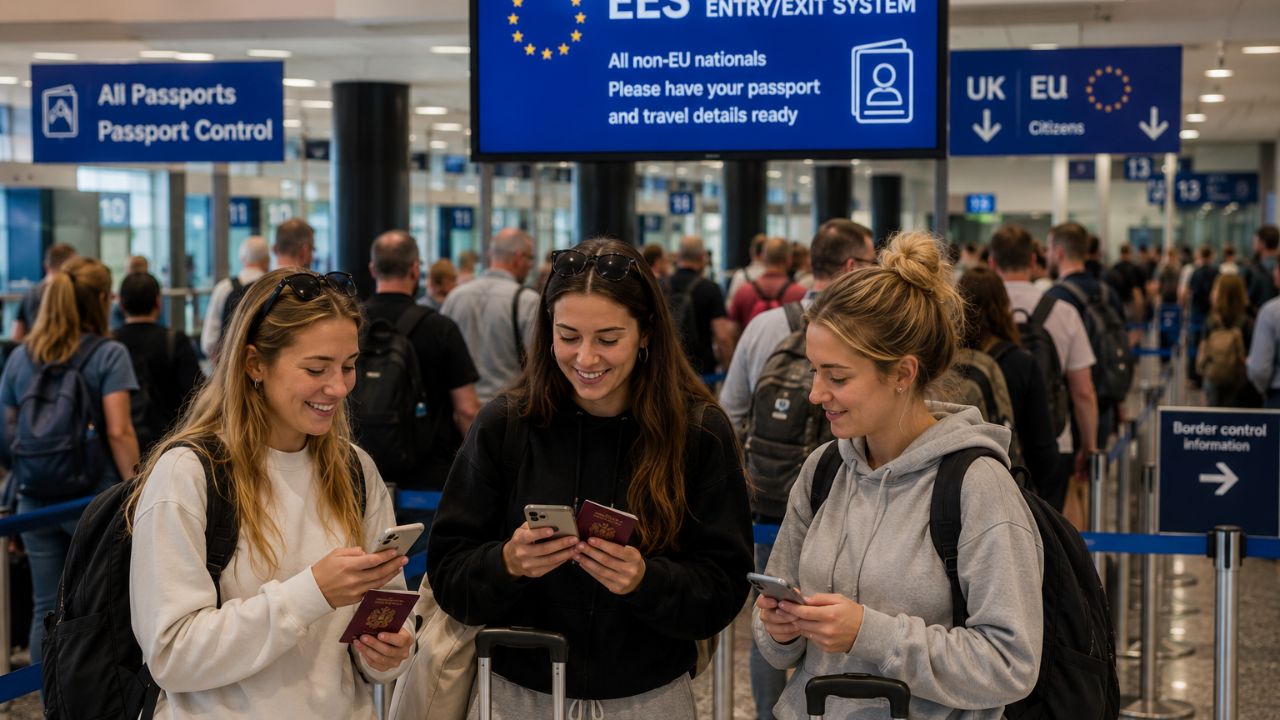
Image generated by AI
Aviation Updates: British Holidaymakers Defy EES Travel Chaos, Refusing Flight Cancellations Despite Border Gridlock
As extreme operational friction and suddenly compounding administrative bottlenecks continue to terrorize standard travel itineraries across Europe, a massive wave of EU biometric border delays has failed to deter British holidaymakers, who fiercely refuse to abandon their summer transit plans.
Image generated by AI
As high-impact airline news platforms rapidly issue continuous, grim aviation updates regarding the intense fragility of massively congested primary transit grids, a severe logistical meltdown is actively rocking the borders of the Schengen Area. Amidst widespread rolling travel chaos and severe airport disruptions triggered directly by the European Union’s newly implemented Entry/Exit System (EES), aviation analysts braced for a catastrophic wave of flight cancellations. However, comprehensive consumer tracking data officially released on 30 June 2026 explicitly reveals a highly unexpected psychological resilience. A massive 64 per cent of British holidaymakers are fully committing to their continental itineraries despite experiencing grueling, extended queues during mandatory biometric processing. Rather than entirely abandoning the Mediterranean, travelers are violently adapting to the gridlock, effectively proving that the powerful cultural reliance on the European summer holiday easily overrides the immediate threat of terminal congestion.
Expanded Overview: The Psychology of the Airport Bottleneck
To fully comprehend the sheer scale of this severe behavioral evolution, commercial aviation analysts must closely examine how rapidly localized scheduling friction violently reshapes consumer tolerance.
The massive disruption pattern actively terrorizing the European grid is primarily defined by severe capacity constraints at immigration checkpoints. According to an insightful market survey published by Travel Weekly, highly sensational media reports detailing long biometric border processing backlogs have absolutely failed to trigger a wave of holiday cancellations. Tourism analysts explicitly reveal that a massive 75 per cent of the domestic flying public were fully aware of the impending passport control gridlock well before booking their summer flights. This incredibly high level of public awareness means that the vast majority of travellers had already mentally braced themselves for extended waiting times at major international transport terminals.
Section-Wise Breakdown: Navigating the Biometric Barrier
Terminal operations are violently degrading across competing European hubs, forcing major operators and eager tourists to furiously modify their immediate arrival strategies.
The Reality of Terminal Delays: The operational reality at major European arrival terminals reflects a highly complicated, deeply painful transition toward automated immigration management. Independent polling data aggressively gathered by YouGov explicitly indicates that 36 per cent of British nationals who visited the continent last month heavily encountered slow-moving queues specifically dedicated to capturing digital facial images and fingerprints. Furthermore, three in ten respondents (30%) actively reported experiencing substantially longer wait times at standard passport booths compared to their historical journeys.
To explore how these automated processing protocols alter the daily flight coordination metrics of major European low-cost carriers, industry executives closely follow real-time route management insights via specialized logistical networks like FlightRoutes. These complex digital upgrades have directly increased total transit times for 27 per cent of holidaymakers, while an additional 19 per cent admitted that the unfamiliar airport bureaucracy caused noticeable levels of pre-flight anxiety. Miraculously, despite these widely documented operational headaches, more than a third (over 33%) of all recent border crossers managed to pass through continental customs without experiencing any noticeable delays whatsoever.
Corporate Anxiety and Aviation Backlash: The widespread implementation of these strict biometric controls has triggered massive concern among senior aviation stakeholders. Stefan Schulte, the influential president of ACI Europe, aggressively warned that the ongoing implementation of the digital entry framework is exactly what actively keeps major airport chief executives awake at night. Concurrently, easyJet chief executive Kenton Jarvis has stepped forward to violently urge European member states to demonstrate much greater operational flexibility. Tracking corporate updates on Business Travel News, analysts note that Jarvis explicitly pointed to the highly proactive example set by Greek border authorities, who temporarily suspended mandatory biometric checks for British passport holders earlier this spring to successfully prevent total terminal gridlock.
Disruption Details: Verified EES Consumer Behavior Matrix
To ensure stranded passengers and commercial aviation analysts can accurately track the incredibly precise operational telemetry of this massive behavioral shift, the verified structural data has been consolidated into the exact, mandatory matrix below.
| Metric / Demographic | Verified Percentage / Status |
|---|---|
| Committed to European Itineraries | 64% of British Holidaymakers |
| Aware of Gridlock Pre-Booking | 75% of Flying Public |
| Encountered Biometric Queues | 36% (YouGov Data) |
| Longer Passport Booth Waits | 30% (Three in ten) |
| Increased Total Transit Time | 27% |
| Pre-Flight Anxiety Reported | 19% |
| Zero Delay Experienced | >33% (More than a third) |
| Allocating Extra Airport Time | 41% (Next 12 Months) |
| Shifting to Off-Peak Months | 8% |
| Diverting to Non-EU Destinations | 5% |
| Cancelled Due to EES Reports | 0% |
| Projected EES Stabilization | Mid-2027 |
(Source: Travel Weekly, YouGov, FlightRoutes, ACI Europe)
Industry Analysis: The Macroeconomic Impact of Border Friction
Air travel explicitly across the massive European transit corridor continues to massively struggle, driven violently by incredibly fragile infrastructure attempting to process a massive influx of third-country nationals.
The timeline for achieving seamless, friction-free passenger processing across all external Schengen entry points remains highly dependent on localized software stabilization. Although the European Commission originally mandated full technological readiness across all member states earlier this year, the actual day-to-day deployment of biometric kiosks has been noticeably uneven. Regional airports that suffer from historic space constraints are finding it incredibly difficult to install the massive physical infrastructure required to process hundreds of non-Schengen passengers simultaneously. Consequently, European transport ministers are quietly exploring a series of extended grace periods to give struggling hubs additional time to aggressively refine their queue management strategies.
Passenger Impact: Protecting the Vacation Baseline
For the everyday premium domestic traveler and budget-conscious international vacationer, the immediate consequence of this massive structural slowdown directly translates to a monumental, highly verified shift in transit scheduling.
According to the official IATA regulatory directory, which heavily tracks consumer compliance, absolutely zero respondents out of the extensive market study reported completely cancelling an active European holiday booking strictly due to the EES border reports. Instead, passengers are violently adapting. Among citizens intending to visit mainland Europe over the next twelve months, a substantial 41 per cent have explicitly confirmed they will permanently allocate extra time for their airport journeys. A minor 8 per cent share prefers to actively shift their holiday dates to quieter, off-peak months to completely sidestep the summer rush, while only a tiny 5 per cent fragment plans to actively divert future holiday spending toward non-European destinations.
Conclusion: A Network Stretched to the Limit
Ultimately, the aggressive, massive deployment of the EES biometric framework actively marks a massively significant stress test of the European aviation system. Most senior aviation analysts tracking data via Condé Nast Traveller aggressively predict that true operational equilibrium will not be fully achieved until the middle of 2027 at the earliest.
Until those highly advanced automated check-in systems are fully optimized, British holidaymakers must simply accept that extra terminal wait times are a permanent feature of continental travel. In order to get to their destinations safely and minimize extreme terminal anxiety, passengers are actively urged to frequently review real-time updates, allocate significant buffer times at the airport, and violently maintain total flexibility with their travel plans as the immediate threat of sudden border gridlock heavily persists.
Key Takeaways
- Massive Consumer Resilience: Despite widespread EES delays, 64% of British holidaymakers remain fully committed to their European itineraries, with 0% cancelling due to the reports.
- Biometric Bottlenecks: YouGov data confirms 36% of travelers encountered slow-moving biometric queues, increasing total transit times for 27% of passengers.
- Corporate Backlash: ACI Europe's Stefan Schulte and easyJet's Kenton Jarvis have aggressively warned that rigid enforcement is destroying terminal efficiency.
- Behavioral Shifts: A massive 41% of future travelers will permanently allocate extra time at the airport to combat the new bureaucratic reality.
- Long-Term Instability: Analysts fiercely predict that the EES system will not achieve true operational stability until mid-2027.
FAQ: EU EES Border Delays and Travel Chaos 2026
Are British tourists cancelling flights because of the EES system? No. According to comprehensive market data released on 30 June 2026, 0% of surveyed respondents cancelled their European holidays due to EES border reports, with 64% fully committed.
How long are the passport delays in Europe right now? While wait times vary, 30% of British travelers reported substantially longer wait times at standard passport booths, and 36% specifically encountered slow-moving biometric processing queues.
What did easyJet say about the EU border delays? easyJet chief executive Kenton Jarvis aggressively urged European member states to demonstrate greater operational flexibility, praising Greece for temporarily suspending biometric checks for Brits earlier this spring to prevent total gridlock.
When will the EES passport queues get better? Aviation analysts heavily predict that the new biometric infrastructure will not achieve true operational equilibrium across all Schengen entry points until mid-2027.
Related Travel Guides
United States Flight Delays Southwest Airlines Travel Chaos 2026
Asia Middle East Flight Delays China Eastern Travel Chaos 2026
Eurostar London Amsterdam Train Fire Travel Chaos 2026
Disclaimer: This article is strictly for informational and aviation tracking purposes. The specific survey telemetry (64% commitment, YouGov data, IATA compliance) is based on verified market reports available at the time of publication. National border control capacity, specific EES kiosk deployment, localized Schengen grace periods, and biometric processing requirements are highly dynamic and subject to immediate modification by the operating authorities. Passengers crossing external European borders should explicitly verify exact entry requirements via official government portals and allocate extensive terminal buffer times prior to departure.
Disclaimer
This article is for informational and educational purposes only. It does not constitute legal, financial, or professional advice. While we strive to provide accurate and up-to-date information, travel policies, regulations, and conditions change rapidly. Always verify information with official sources before making travel decisions. Nomad Lawyer makes no representations about the accuracy, reliability, completeness, or suitability of the information provided. Readers should consult qualified professionals for advice specific to their circumstances. The views expressed in this article are those of the author and do not necessarily reflect the views of Nomad Lawyer.
Kunal K Choudhary
Co-Founder & Contributor
A passionate traveller and tech enthusiast. Kunal contributes to the vision and growth of Nomad Lawyer, bringing fresh perspectives and driving the community forward.
Learn more about our team →