
Etihad A380 Diverts to Hong Kong Following In-Flight Medical Emergency: Passenger Protocol and Operational Breakdown

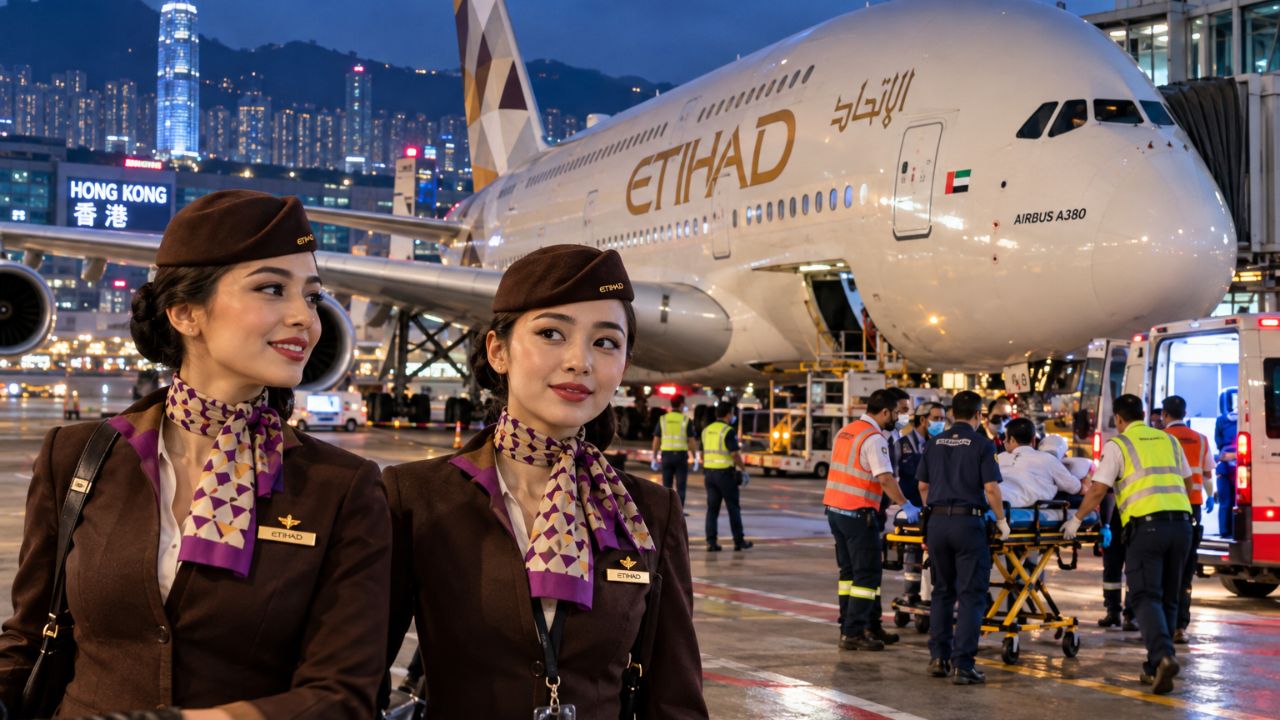
When an Airbus A380 carrying 500 passengers diverts mid-flight, landing a fully fuelled 560-tonne double-decker aircraft presents one of the most demanding operational challenges in modern civil aviation. On September 24, 2026, Etihad Airways flight EY801 en route from Tokyo Narita to Abu Dhabi initiated an immediate descent into Hong Kong after an 81-year-old passenger exhibited acute stroke symptoms while cruising over mainland China. The decision averted catastrophic medical consequences, with the superjumbo touching down safely before completing its trans-Asian journey nearly four hours behind schedule.
Mid-Air Emergency Over Wuhan: The EY801 Timeline
Etihad flight EY801 departed Tokyo Narita International Airport around 6:00 PM local time on September 24, operating its scheduled daily non-stop service across the 8,100-kilometer corridor to Zayed International Airport in Abu Dhabi. The flight operates with a standard block time of 11 hours and 20 minutes, utilizing an Airbus A380-800 registered as A6-APJ equipped with four cabin classes, including The Residence private suites.
While cruising near Wuhan in central China, cabin crew identified an 81-year-old male passenger displaying severe neurological impairment consistent with an acute stroke. In accordance with emergency protocols defined by the World Health Organization, where rapid clinical intervention directly determines patient survival and recovery, the crew immediately alerted the flight deck.
Evaluating weather minimums, runway length capabilities, and medical infrastructure on the ground, the flight crew selected Hong Kong International Airport as the optimal emergency landing site. Hong Kong air traffic controllers received initial notification at approximately 9:50 PM local time, clearing the superjumbo for an immediate approach to HKIA's centre runway. The aircraft touched down at 10:00 PM, where airport medical teams and specialized emergency vehicles met the plane directly at the stand. First aid was administered before the patient was transported to a regional hospital facility. Following refueling and paperwork clearance, EY801 departed Hong Kong at 12:21 AM on September 25, touching down in Abu Dhabi three hours and 58 minutes behind schedule.
What Makes Ultra-Long-Haul A380 Diversions Different
Diverting a narrow-body jet involves relatively straightforward routing, but diverting a fully boarded A380 mid-route introduces complex aeronautical calculations:
- Heavy Fuel Weight Management: Because EY801 was early in its long-haul flight path toward the Middle East, the jet carried substantial kerosene tonnage. Approaching near maximum structural landing weight requires precise flare maneuvers and precautionary ground fire service deployment along the runway.
- Specialized Gate and Runway Capabilities: Only select international hubs possess Code F taxiways, dual-level aerobridges, and runway widths designed to receive double-decker A380 aircraft without disrupting regional air corridors.
- Comprehensive Airport Medical Infrastructure: Hong Kong maintains a round-the-clock Airport Medical Centre capable of rapid tarmac triage, critical stabilization, and direct ambulance coordination with acute care trauma units.
- Fleet Rotation and Crew Duty Rest: Managing 500 passengers through an unscheduled intermediate stop requires airlines like Etihad Airways to balance crew legal flight duty limits against onward connection delays in Abu Dhabi.
Passenger Insider Tips for Long-Haul Medical Preparedness
- Keep Daily Prescriptions in Hand Luggage: Never stow time-critical medications, blood pressure records, or doctor notes in checked baggage. Maintain essential pills in your seatback pouch for immediate access.
- Know the FAST Signs: If traveling with elderly family or companion passengers, monitor for facial drooping, arm weakness, and speech slurring. Inform flight attendants instantly, as in-flight tele-medical advisory lines connect flight decks with ground physicians in real time.
- Review Travel Insurance Delay Clauses: Unscheduled medical diversions are classified as non-controllable disruptions under standard passenger rights frameworks. Verify that your insurance covers onward missed flight connections and emergency layover expenses.
- Rebook Transit Connections Ahead: During unscheduled transit delays, use in-flight Wi-Fi portals or airport ground desks to request automatic rebooking for secondary flight sectors before reaching hub terminals.
Aviation Safety Frameworks and Emergency Preparedness
In March 2026, Hong Kong International Airport executed a comprehensive full-scale crash and emergency rescue exercise involving more than 1,000 personnel across 20 distinct government departments and hospital agencies. That preparedness proved instrumental during the EY801 incident, ensuring emergency ground units took positions without delaying air traffic on adjacent runways.
Aviation safety regulations mandate that commercial pilots always prioritize human life over schedule integrity or fuel burn penalties. While unexpected diversions disrupt onward travel plans and hotel bookings, seamless coordination between dispatchers, flight crews, and ground medical services ensures passenger health remains the ultimate priority in modern air transport.
FAQ: In-Flight Medical Emergencies and Airline Diversions 2026
Why did Etihad flight EY801 divert to Hong Kong?
Flight EY801 diverted to Hong Kong on September 24, 2026, after an 81-year-old passenger developed suspected acute stroke symptoms requiring immediate hospital treatment.
Did the A380 experience any mechanical failure?
No. The aircraft operated without any mechanical faults and safely continued to Abu Dhabi after transferring the ill passenger to medical teams.
Are passengers compensated for delays caused by medical diversions?
Generally no. Airlines treat in-flight medical emergencies as extraordinary, safety-related events exempt from statutory flight delay compensation.
How much was the flight delayed arriving in Abu Dhabi?
The aircraft landed in Abu Dhabi approximately three hours and 58 minutes behind its scheduled timetable.
Related Travel Guides
- Hong Kong International Airport Passenger Transit and Transfer Guide
- Tokyo Narita International Airport Lounge and Flight Connections
- Abu Dhabi Zayed International Airport Layover and Visa Rules
In global aviation, the true measure of operational excellence is not flying without incident, but responding with absolute precision and compassion when human life hangs in the balance.
Disclaimer
This article is for informational and educational purposes only. It does not constitute legal, financial, or professional advice. While we strive to provide accurate and up-to-date information, travel policies, regulations, and conditions change rapidly. Always verify information with official sources before making travel decisions. Nomad Lawyer makes no representations about the accuracy, reliability, completeness, or suitability of the information provided. Readers should consult qualified professionals for advice specific to their circumstances. The views expressed in this article are those of the author and do not necessarily reflect the views of Nomad Lawyer.
Kunal K Choudhary
Co-Founder & Contributor
A passionate traveller and tech enthusiast. Kunal contributes to the vision and growth of Nomad Lawyer, bringing fresh perspectives and driving the community forward.
Learn more about our team →