
Emirates and Flydubai Defy Middle East Crisis — 203 Flights Operating Now
Despite a two-week Middle East conflict involving Israel, the US, and Iran, Emirates and Flydubai are operating 203 combined flights from Dubai on March 12–13, 2026 — connecting New York, London, Tokyo, Sydney, São Paulo, and dozens more cities.

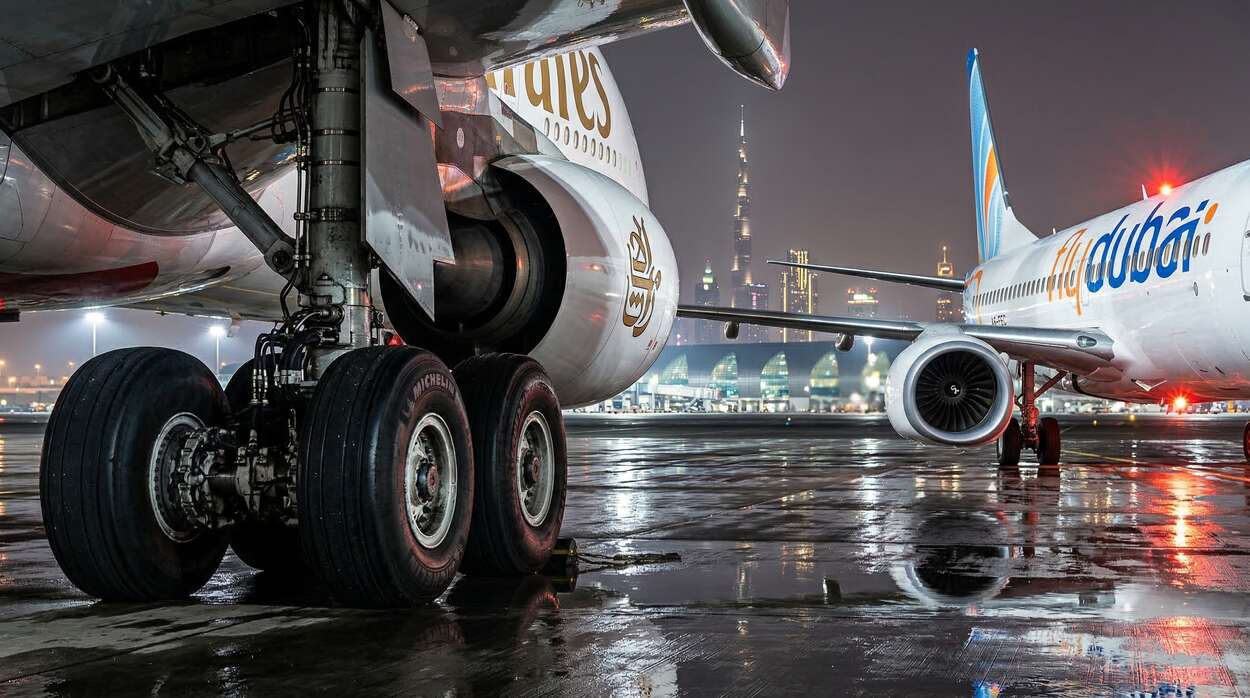
Image generated with AI
**> Quick Summary
- Emirates and Flydubai are operating 203 combined flights from Dubai on March 12–13, 2026, despite a two-week Middle East conflict involving Israel, the US, and Iran
- Emirates scheduled 138 flights on March 12 and 141 on March 13 from Dubai International Airport (DXB); Flydubai operated approximately 65 on March 12 and 64 on March 13
- Destinations actively served include New York JFK, London Heathrow, Paris CDG, Tokyo, Sydney, Beijing, Hong Kong, Seoul, Cape Town, and São Paulo
- Sporadic missile and drone threat alerts are still causing temporary holds and ground waits, adding unpredictability for transit passengers**
Emirates and Flydubai Hold Dubai's Aviation Network Together Amid Regional War
More than two weeks into the Middle East conflict involving Israel, the United States, and Iran — a crisis that has disrupted air travel across the entire Gulf region — Emirates and Flydubai are maintaining sustained flight operations from Dubai, collectively operating 203 flights across March 12 and 13, 2026. The two Dubai-based carriers have stabilised their schedules at a level that aviation tracking data confirms is largely aligned with published departure times, providing critical connectivity for passengers transiting through one of the world's most important aviation crossroads. While the conflict has grounded or rerouted flights across much of the region, Dubai's major carriers have chosen phased restoration over full suspension.
How the Conflict Has Disrupted Middle East Aviation
The outbreak of conflict involving Israel, the US, and Iran introduced immediate and wide-ranging disruptions to civil aviation throughout the Gulf. Temporary airspace closures, security-driven route suspensions, and airline-by-airline risk assessments forced cascading schedule changes across the region.
Dubai International Airport (DXB) and Dubai World Central (DWC) were particularly exposed — both serve as connecting hubs between Europe, Asia, Africa, and the Americas, meaning any instability in their operations has global knock-on effects. Millions of passengers with transit bookings through Dubai faced uncertainty in the early days of the conflict as carriers suspended services, rerouted flights to avoid volatile airspace, and issued travel advisories.
The response from most carriers was a phased restoration strategy: a cautious return to scheduled services as conditions allowed, rather than a binary suspension or full operation.
Emirates: 138 Flights on March 12, 141 on March 13
Emirates, the UAE's flagship long-haul carrier, is operating at close to normal schedule levels according to aviation tracking data for March 12 and 13.
- March 12: 138 scheduled departures from Dubai — primarily from Dubai International Airport (DXB)
- March 13: 141 scheduled departures from DXB
The Emirates network currently active includes some of the world's most strategically important long-haul routes. Confirmed departures are serving destinations including:
- North America: New York JFK
- Europe: London Heathrow (LHR), Paris CDG, Amsterdam (AMS)
- East Asia: Beijing (PEK), Hong Kong (HKG), Seoul Incheon (ICN), Tokyo Haneda (HND)
- Oceania: Sydney (SYD)
- Africa: Cape Town (CPT)
- South America: São Paulo (GRU)
Many of these flights carry codeshare or partner airline identifiers alongside the Emirates flight numbers, reflecting the interline connections that sustain the broader global aviation network even during regional disruption.
Flydubai: 65 Flights on March 12, 64 on March 13
Flydubai, the Dubai-based low-cost carrier, is also maintaining operations across its regional and international network:
- March 12: approximately 65 departures
- March 13: approximately 64 departures
Flydubai is connecting Dubai with a range of regional and mid-range international cities, with confirmed departures observed to Riyadh (RUH), Jeddah (JED), Warsaw (WAW), and Belgrade (BEG), among others. This multi-city connectivity demonstrates Flydubai's focus on maintaining normalcy across its shorter-haul network even as the regional environment remains unsettled.
Is the Stabilisation Holding? What the Data Shows
Aviation tracking data covering both March 12 and 13 indicates that departures and arrivals at DXB and DWC are largely aligned with planned schedules — a notable improvement from the initial days of the conflict when volatility was high.
However, the stabilisation is not complete. Security alerts — including reports of missile or drone threats — have intermittently caused temporary pauses in aircraft movements, leading to:
- Brief holding patterns for inbound aircraft
- Short ground waits before departure clearance
- Sporadic delays on sensitive routing corridors
These events have introduced an element of unpredictability that aviation analysts and travellers are actively monitoring. Some passengers with onward connections through Dubai are hedging by acquiring secondary reservations or selecting flexible booking options to protect against potential schedule gaps.
Key Facts: Emirates and Flydubai Operations, March 12–13, 2026
- Combined flights (March 12): 203 (Emirates 138 + Flydubai 65)
- Combined flights (March 13): 205 (Emirates 141 + Flydubai 64)
- Primary operating hub: Dubai International Airport (DXB); also Dubai World Central (DWC)
- Conflict duration as of March 13: More than two weeks — Israel, US, Iran
- Emirates destinations active: New York JFK, London LHR, Paris CDG, Amsterdam AMS, Beijing PEK, Hong Kong HKG, Seoul ICN, Tokyo HND, Sydney SYD, Cape Town CPT, São Paulo GRU
- Flydubai destinations active: Riyadh RUH, Jeddah JED, Warsaw WAW, Belgrade BEG, and others
- Current status per tracking data: Schedules largely aligned with published times
- Remaining risk factor: Sporadic missile/drone alerts causing temporary holds and ground waits
What This Means for Travelers
Dubai remains one of the most viable options for international transit during the current Middle East crisis — but the situation demands active management from anyone with bookings that route through the UAE.
If you're transiting through Dubai in the coming days:
- Confirm your flight status directly with Emirates or Flydubai on the day of travel — both carriers are updating their systems as conditions evolve
- Build extra connection time into your Dubai transit itinerary — temporary ground waits caused by security alerts can affect tight connections
- Request flexible fares or rebooking options at the time of booking if your travel window coincides with the ongoing conflict period
- Monitor UAE civil aviation authority advisories for any new airspace restrictions that could affect specific routing corridors
- Other airlines — including those operating rescue flights and additional scheduled services — are also contributing to Dubai passenger flows, so checking alternative carriers may provide backup options if Emirates or Flydubai schedules shift
Dubai Holds the Line as the Region Watches Closely
The ability of Emirates and Flydubai to operate a combined 203–205 flights per day from Dubai during an active regional conflict is a meaningful signal of operational resilience. It is not full pre-conflict capacity — but it represents enough activity to sustain global connectivity through one of aviation's most critical hubs. As the conflict continues to shape the regional security environment, both carriers and the authorities managing DXB and DWC are expected to keep adapting their operational posture. Travellers planning journeys through Dubai should treat schedule monitoring as an essential part of their trip preparation for the foreseeable future.
Frequently Asked Questions
Are Emirates flights operating normally during the Middle East conflict? Emirates is currently operating close to scheduled levels, with 138 flights on March 12 and 141 on March 13, 2026, from Dubai International Airport. Aviation tracking data confirms departures are largely on schedule, though sporadic missile and drone alerts have caused some temporary holds and ground delays. Long-haul routes to New York, London, Paris, Tokyo, Sydney, and São Paulo are all active.
Is Dubai airport safe for travel right now? Dubai International Airport (DXB) is currently operational and handling both Emirates and Flydubai flights, along with other carriers. While the broader Middle East conflict has introduced security alerts that occasionally cause brief flight holds, airport operations are continuing. Passengers are advised to monitor their airline's official communications and allow extra connection time for Dubai transits during this period.
How many flights is Flydubai operating during the crisis? Flydubai is operating approximately 65 flights per day as of March 12, 2026, and 64 per day on March 13. The carrier is maintaining connections to regional cities including Riyadh, Jeddah, Warsaw, and Belgrade, among others, from its Dubai base.
Should I book a connecting flight through Dubai right now? Emirates and Flydubai are both operating, and schedules are currently stable. However, the ongoing Middle East conflict means conditions can change. Travellers should book flexible fares where possible, build generous connection times into Dubai transit itineraries, and actively monitor flight status on the day of travel. Having a backup routing option booked — or at least identified — is advisable for time-sensitive journeys.
Disclaimer
This article is for informational and educational purposes only. It does not constitute legal, financial, or professional advice. While we strive to provide accurate and up-to-date information, travel policies, regulations, and conditions change rapidly. Always verify information with official sources before making travel decisions. Nomad Lawyer makes no representations about the accuracy, reliability, completeness, or suitability of the information provided. Readers should consult qualified professionals for advice specific to their circumstances. The views expressed in this article are those of the author and do not necessarily reflect the views of Nomad Lawyer.
Raushan Kumar
Founder & Lead Developer
Full-stack developer with 11+ years of experience and a passionate traveller. Raushan built Nomad Lawyer from the ground up with a vision to create the best travel and law experience on the web.
Learn more about our team →