
Aviation Updates: Emirates, Etihad Airways, Qatar Airways, Cathay Pacific, Turkish Airlines, Singapore Airlines and Air New Zealand Transform Flights Into Live Stadiums With FIFA World Cup 2026 Streaming on Seatback Screens and Personal Devices via Sport 24, Starlink and Official FIFA Broadcast Rights Mid-Air
Emirates, Etihad Airways, Qatar Airways, Cathay Pacific, Turkish Airlines, Singapore Airlines and Air New Zealand are delivering FIFA World Cup 2026 live match streaming to passengers at altitude through the Sport 24 dedicated aviation sports channel, Qatar Airways' Starlink-powered device streaming, and Emirates and Etihad's integrated seatback entertainment systems — transforming long-haul cabins into live football venues at 40,000 feet with official FIFA-licensed broadcasts.

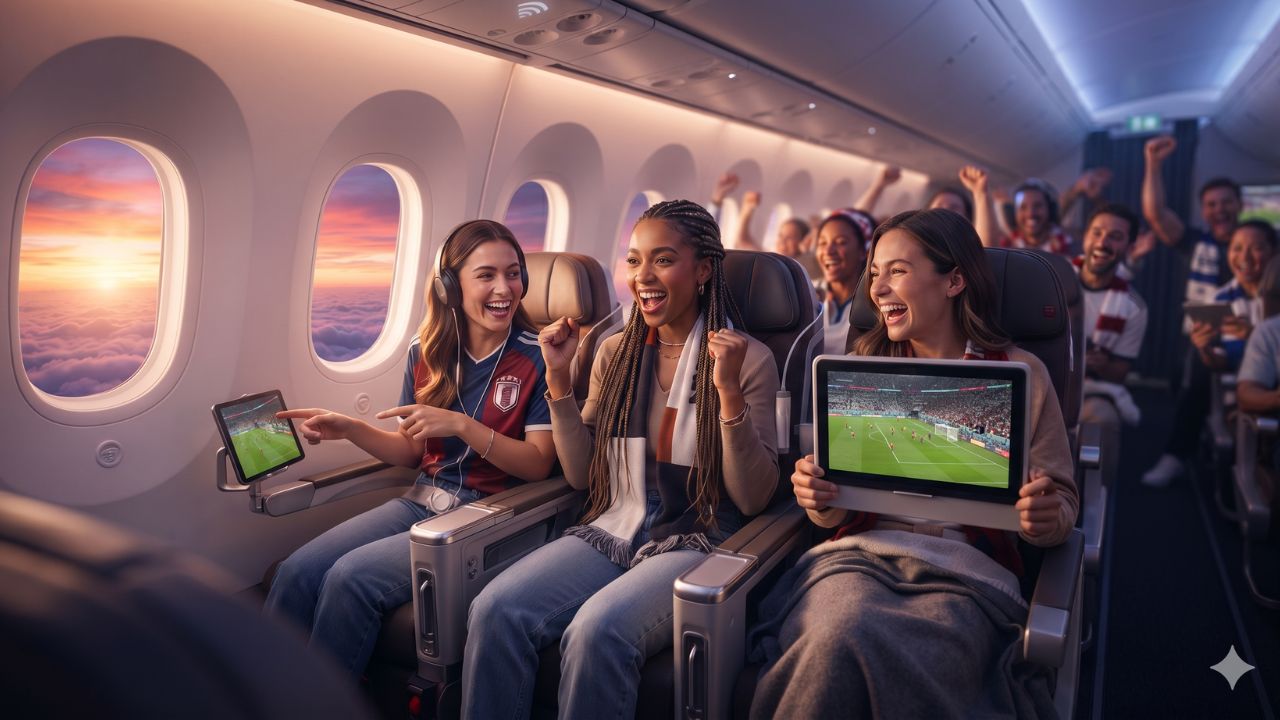
Image generated by AI
Aviation Updates: Emirates, Etihad Airways, Qatar Airways, Cathay Pacific, Turkish Airlines, Singapore Airlines and Air New Zealand Transform Flights Into Live Stadiums With FIFA World Cup 2026 Streaming on Seatback Screens and Personal Devices via Sport 24, Starlink and Official FIFA Broadcast Rights Mid-Air
The boarding gate used to be where the match ended. The phone went into airplane mode, the live score feed went dark, and 13 hours of disconnected cabin time stretched between a passionate football fan and whatever was happening on the pitch. In the summer of 2026, that fundamental travel frustration is becoming a structural relic of the past.
Sweeping airline news confirmed from multiple international carriers reveals that a global wave of aviation's most recognizable long-haul brands — Emirates, Etihad Airways, Qatar Airways, Cathay Pacific, Turkish Airlines, Singapore Airlines, and Air New Zealand — has collectively committed to transforming their aircraft cabins into live FIFA World Cup venues during the 2026 tournament window, delivering officially licensed, real-time match streaming to passengers at altitudes of up to 40,000 feet through a combination of dedicated aviation sports channels, upgraded satellite connectivity systems, and carrier-specific entertainment platform integrations. The coordinated airline response to FIFA World Cup 2026 represents the most ambitious convergence of live sports broadcasting and commercial aviation in the history of both industries — and signals, unmistakably, that in-flight entertainment has entered a new era defined by real-time access to global events rather than pre-loaded content libraries.
At the center of the live sports broadcasting architecture that makes this possible is Sport 24 — a dedicated global sports channel designed specifically for aviation and maritime use, operating under official media licensing agreements that ensure full compliance with FIFA's complex global broadcast rights framework. Unlike consumer streaming services, Sport 24 is built from the ground up for the technical demands of aircraft cabin delivery: continuous live coverage, integration into existing airline entertainment systems, and the resilience required to maintain a live feed through the satellite connectivity environments that commercial aircraft operate within. It is not a workaround or a workaround product — it is the purpose-built infrastructure through which airline live sports broadcasts of this scale are legally and technically possible.
Expanded Overview: Why 2026 Is the Inflection Point for Live Sports at Altitude
The simultaneous FIFA World Cup 2026 streaming deployment across seven of the world's most significant long-haul carriers is not a coincidence — it is the product of years of investment in satellite connectivity infrastructure, content licensing framework development, and aircraft entertainment system modernization that have collectively reached a tipping point in 2026. The combination of low-latency broadband satellite systems — most visibly represented by Starlink but also by other approved connectivity providers — and the maturation of Sport 24's aviation-specific delivery architecture has created, for the first time, a commercial environment in which live sports streaming at altitude is operationally reliable enough to be offered as a consistent passenger product rather than a limited trial.
The FIFA World Cup serves as the definitive test case for this infrastructure because its demand profile is uniquely demanding. Matches are watched in real time by billions of viewers worldwide, with no meaningful appetite for catch-up viewing — a World Cup match that has ended before the passenger lands is a missed experience, not a delayed one. Airlines that can offer live match access are offering something categorically different from airlines that cannot — not a better entertainment library, but a fundamentally different relationship between the passenger, their seat, and the global moment they were previously forced to disconnect from.
Section-Wise Breakdown: How Each Major Carrier Is Delivering the World Cup
Emirates: The Dubai Hub Carrier Goes All-In
Emirates has embedded FIFA World Cup match schedules and real-time score updates into its onboard entertainment platform — extending the tournament experience from the passenger's seatback screen into the broader cabin information environment. The carrier is also screening select matches in Dubai International Airport's extensive lounge network, creating a continuous coverage experience that begins in the terminal and continues at altitude. For a carrier whose hub airport is one of the world's busiest international transit points, the lounge-to-cabin continuity of World Cup coverage is a materially different value proposition than the standard airline approach. A passenger transiting through Dubai on a multi-hour layover followed by a connecting long-haul sector can watch the same match without interruption from the lounge screen to the seatback.
Etihad Airways: Abu Dhabi's Carrier Upgrades for Tournament Season
Etihad Airways has adopted a parallel approach, prioritizing aircraft equipped with upgraded entertainment infrastructure that can support live broadcast delivery during the World Cup window. The carrier's World Cup coverage strategy focuses on ensuring that the technical architecture required for live streaming is consistently available across the fleet segments that carry the highest-density passenger loads on affected routes — maximizing the number of passengers who can access the live match experience rather than those who find themselves aboard an aircraft whose entertainment system cannot support the broadcast.
Qatar Airways: The Starlink-Powered Device Streaming Model
Qatar Airways has taken a distinctly device-centric approach to its World Cup streaming strategy — reflecting the carrier's significant investment in Starlink connectivity on selected aircraft. Rather than relying solely on seatback screens, Qatar Airways' live match streaming is designed to be accessed by passengers on their own phones and tablets, using the aircraft's high-speed Starlink internet to deliver match feeds through onboard Wi-Fi portals with access triggered through QR-code entry systems or onboard login steps.
This approach has specific advantages for the passenger experience. Personal device viewing is independent of seat screen quality or seatback screen availability, enabling passengers traveling in configurations where seatback screens are not standard — including some business class configurations and regional aircraft — to access live match coverage through their own preferred device. For a carrier like Qatar Airways, whose passenger demographic includes a high proportion of technically sophisticated frequent travelers already carrying premium mobile devices, the device-first streaming model is a natural fit.
Cathay Pacific, Turkish Airlines, Singapore Airlines and Air New Zealand
Cathay Pacific, Turkish Airlines, Singapore Airlines, and Air New Zealand are participating in the wider global rollout through their respective Sport 24 integration — each carrier connecting the dedicated aviation sports channel to its existing onboard entertainment infrastructure within the framework of officially licensed airline live sports broadcasts. For passengers aboard these carriers during the tournament window, access to live World Cup matches is available through the standard seatback entertainment interface, subject to the aircraft being equipped with certified connectivity systems and the relevant Sport 24 licensing being active on the specific service.
Verified Airline FIFA World Cup 2026 Streaming Overview
FIFA World Cup 2026 Inflight Streaming — Airline-by-Airline Summary
| Airline | Streaming Model | Key Technology | Viewing Method |
|---|---|---|---|
| Emirates | Seatback + lounge coverage | Licensed broadcast integration | Seatback screens |
| Etihad Airways | Seatback on upgraded aircraft | Enhanced entertainment systems | Seatback screens |
| Qatar Airways | Device-first streaming | Starlink, QR/login portal | Personal devices |
| Cathay Pacific | Sport 24 integration | Certified connectivity systems | Seatback screens |
| Turkish Airlines | Sport 24 integration | Certified connectivity systems | Seatback screens |
| Singapore Airlines | Sport 24 integration | Certified connectivity systems | Seatback screens |
| Air New Zealand | Sport 24 integration | Certified connectivity systems | Seatback screens |
Sport 24 Channel Capabilities
| Feature | Detail |
|---|---|
| Channel Type | Dedicated aviation and maritime sports service |
| Content | Live football, motorsport, tennis and more |
| Licensing | Official media agreements, full FIFA rights compliance |
| Integration | Built directly into airline entertainment systems |
| Coverage | Continuous live sporting event coverage |
Inflight FIFA World Cup Viewing Access Methods
| Viewing Method | Description |
|---|---|
| Seatback screens | Live broadcast feeds on cabin entertainment screens |
| Personal device streaming | Wi-Fi portal access on phones and tablets |
| QR-code access | Direct QR link to live match pages |
| Hybrid systems | Combined seatback and device options |
All data sourced from official airline product announcements and Sport 24 service documentation.
Passenger Impact: What the Live Streaming Experience Means in Practice
For the football fan boarding an Emirates A380 from Dubai, an Etihad flight from Abu Dhabi, or a Qatar Airways service from Doha during a World Cup knockout stage match, the practical impact of inflight live streaming is immediately and viscerally clear: the match is on. The same match that is being watched by stadiums of 80,000 fans and hundreds of millions of television viewers worldwide is visible on the seatback screen or personal tablet, in real time, as the aircraft climbs through 30,000 feet toward its cruising altitude.
The psychological value of this experience extends beyond the content itself. For years, the travel chaos of navigating airports, security queues, and boarding processes during major global sporting events has been amplified by the awareness that landing at the destination will mean a news feed full of goals, eliminations, and tournament outcomes the passenger missed while airborne. The live streaming capability removes that anxiety entirely — the passenger is present, connected, and part of the global viewing moment regardless of their altitude.
For business travelers who use long-haul flights primarily for work or rest, the availability of World Cup coverage in the cabin creates an ambient awareness of match progress that they can engage with during breaks — without requiring the full attention that a sports-specific viewing session would demand. The aviation updates surrounding live sports integration reflect a broader understanding that inflight entertainment flexibility — the ability to access the content you want, when you want it, in the format that suits your journey — is now a core element of the premium travel value proposition.
Industry Analysis: The Permanent Shift Toward Real-Time Cabin Entertainment
The coordinated FIFA World Cup 2026 streaming response from seven of the world's most significant long-haul carriers is the clearest possible signal that real-time live content has moved from a competitive differentiator to a passenger expectation in premium international aviation. Airlines that cannot offer live sports access during major global events will face a measurable experiential gap relative to competitors who can — a gap that is most visible and most commercially consequential precisely when demand for air travel is highest, which is typically during and around major global events.
Wider satellite connectivity adoption across long-haul fleets is the enabling infrastructure. Expanding live sports licensing agreements are the content framework. Personal device streaming models — typified by Qatar Airways' Starlink-powered approach — are lowering the hardware dependency of live access. And Sport 24's aviation-specific architecture is the reliable, rights-compliant delivery channel that makes the entire ecosystem commercially viable at scale.
Conclusion: The Cabin Is Now the Stadium
The FIFA World Cup 2026 is being watched at altitude, on seatback screens and personal devices, through officially licensed broadcasts, by passengers aboard Emirates, Etihad, Qatar Airways, Cathay Pacific, Turkish Airlines, Singapore Airlines, and Air New Zealand flights worldwide. The technology infrastructure that makes this possible — Sport 24, Starlink, dedicated connectivity systems, and years of broadcast licensing negotiation — is not temporary. It will remain in place long after the World Cup final is played, becoming the foundational architecture for the next generation of live-event inflight entertainment.
Flights are no longer just transport. They are, increasingly, part of the viewing experience itself.
Key Takeaways
- Seven Carriers, One Tournament: Emirates, Etihad Airways, Qatar Airways, Cathay Pacific, Turkish Airlines, Singapore Airlines, and Air New Zealand are all delivering FIFA World Cup 2026 live match coverage at altitude through official broadcast partnerships.
- Sport 24 at the Center: The Sport 24 dedicated aviation sports channel — licensed for continuous live coverage of global sporting events on aircraft — is the primary delivery vehicle for most carriers' World Cup streaming.
- Qatar Airways Goes Device-First: Qatar Airways is delivering match access via Starlink-powered personal device streaming through QR-code or login-based Wi-Fi portals — reducing dependency on seatback screen availability.
- Emirates Covers Lounge to Cabin: Emirates provides seamless tournament coverage continuity from Dubai airport lounges to onboard seatback screens — creating an uninterrupted World Cup viewing window from check-in to destination.
- Strict Rights Compliance: All inflight World Cup streaming is delivered through officially licensed FIFA broadcast agreements — ensuring global rights compliance at altitude rather than relying on unlicensed consumer streaming services.
- Industry Inflection Point: The 2026 World Cup deployment confirms that live sports streaming at altitude has moved from a trial feature to a standard passenger expectation for premium long-haul aviation — with permanent infrastructure now in place for future global events.
Related Travel Guides
United Airlines Starlink DIRECTV Live TV FIFA World Cup 2026
Emirates Dubai Airport Summer Travel Chaos Warning 2026
Global Flight Cancellation and Compensation Guide 2026
Disclaimer: This article is strictly for informational purposes only. All inflight streaming availability, channel access, connectivity technology, and carrier-specific entertainment details are sourced from official airline product announcements as of June 25, 2026. Live match availability is subject to aircraft type, route, connectivity system compatibility, and FIFA broadcast licensing terms specific to each carrier. Passengers are advised to verify inflight entertainment options for their specific flight via their airline's official platform before travel.
Disclaimer
This article is for informational and educational purposes only. It does not constitute legal, financial, or professional advice. While we strive to provide accurate and up-to-date information, travel policies, regulations, and conditions change rapidly. Always verify information with official sources before making travel decisions. Nomad Lawyer makes no representations about the accuracy, reliability, completeness, or suitability of the information provided. Readers should consult qualified professionals for advice specific to their circumstances. The views expressed in this article are those of the author and do not necessarily reflect the views of Nomad Lawyer.
Preeti Gunjan
Contributor & Community Manager
A passionate traveller and community builder. Preeti helps grow the Nomad Lawyer community, fostering engagement and bringing the reader experience to life.
Learn more about our team →