
Dominican Republic Sends Arajet Aid Flight to Venezuela Earthquake Zone as 17 Nations Mobilize Relief 2026
The Dominican Republic dispatched an Arajet humanitarian relief flight carrying a mobile hospital, medical personnel, and emergency supplies to Venezuela's earthquake-affected communities, joining 17 nations across the Americas and Europe in one of the region's largest multinational disaster response operations.

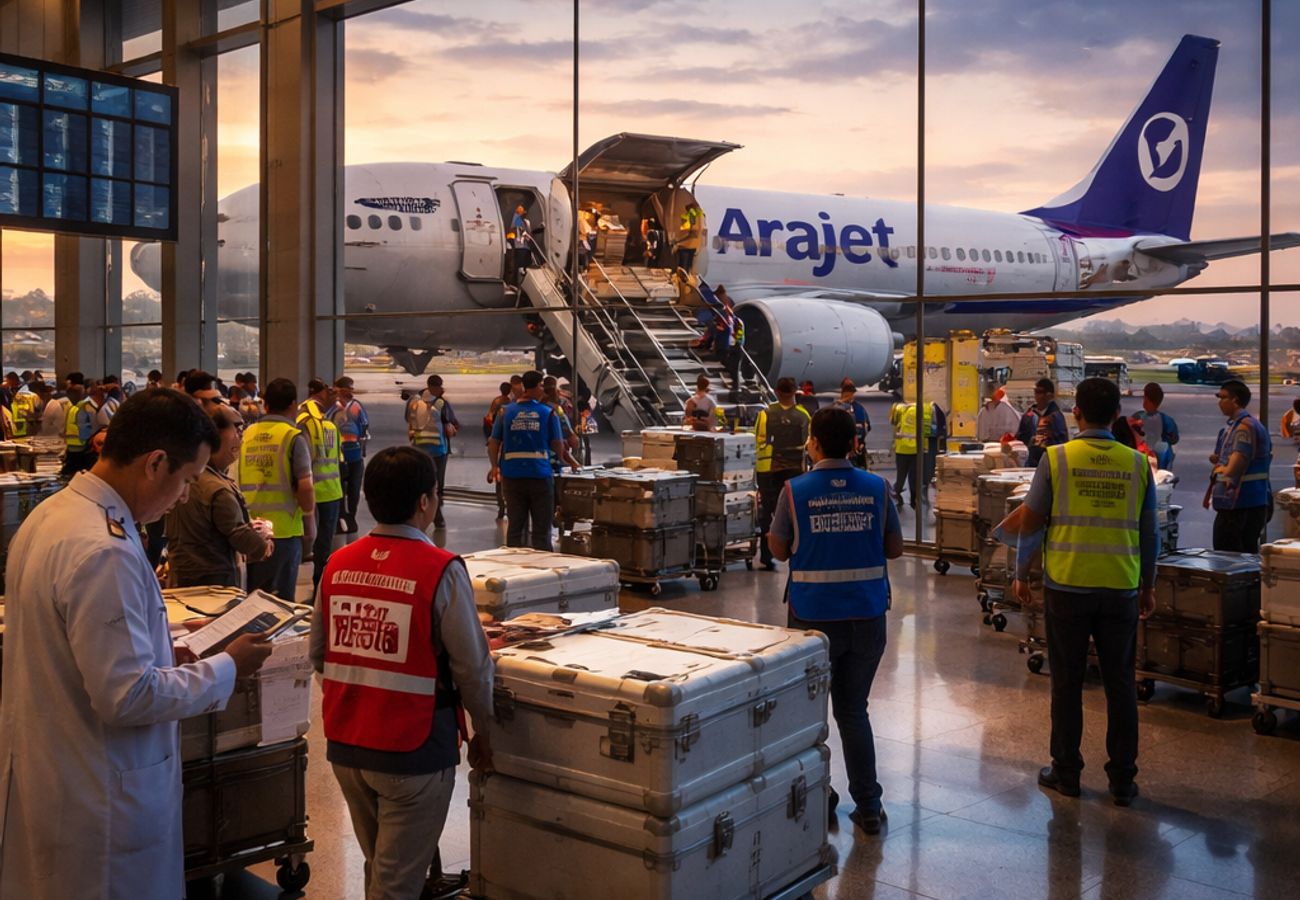
Image generated by AI
The Dominican Republic has dispatched an emergency humanitarian relief flight to Venezuela via Arajet, carrying medical personnel, a mobile hospital, and critical emergency supplies to communities devastated by the recent earthquake. The mission marks the latest contribution to a multinational relief effort now spanning 17 countries across the Americas and Europe.
The operation was coordinated through the Dominican Republic's Ministry of Foreign Affairs (MIREX), with operational leadership from the Ministry of Defence and the Ministry of Public Health. Private logistics firm Caribe Cargo donated cargo handling and ground support services to accelerate the deployment.
Arajet transported healthcare professionals alongside a significant shipment of emergency medical equipment. Medical supplies, medicines, and a fully equipped mobile hospital formed part of the cargo. The aircraft also carried additional humanitarian goods donated by private organisations, ensuring that the relief effort extended beyond government assistance and reflected wider community participation.
Following the successful delivery, the aircraft returned to the Dominican Republic carrying passengers through an operation coordinated by authorities in both countries. This return-leg efficiency demonstrates how airlines can maximise resource utilisation during emergency situations.
Key Operational Facts
- The Dominican Republic dispatched an emergency relief flight via Arajet to Venezuela following the recent earthquake
- Cargo included a fully equipped mobile hospital, medical personnel, medicines, and emergency medical equipment
- The mission was coordinated through MIREX, with operational support from the Ministry of Defence and the Ministry of Public Health
- Caribe Cargo donated cargo handling and ground support services to accelerate the operation
- Additional humanitarian goods from private organisations accompanied the government supplies
- The aircraft returned carrying passengers, demonstrating efficient use of aviation resources during emergencies
- 17 countries have now committed humanitarian assistance to Venezuela
- The United States deployed over 900 military personnel for logistics, airport restoration, engineering, and humanitarian operations
- India launched Operation Amistad with two C-17 aircraft carrying 66 tonnes of aid and a 41-member medical team
- El Salvador sent approximately 300 rescuers and paramedics with 50 tonnes of equipment
- Türkiye deployed a 67-member search-and-rescue, medical, and humanitarian response team
- Colombia dispatched over 60 rescuers and 12 tonnes of supplies due to its shared border with Venezuela
- Multiple EU nations activated the EU Civil Protection Mechanism to channel aid
Multinational Aid Contributions to Venezuela
The breadth of the international relief operation is striking. Governments from Latin America, North America, and Europe have rapidly deployed emergency medical teams, search-and-rescue specialists, mobile hospitals, engineering units, relief supplies, and logistical support. The table below details each country's contribution.
| Country | Type of Assistance |
|---|---|
| Dominican Republic | Medical aid, emergency supplies, mobile hospital, healthcare personnel via Arajet humanitarian flight |
| United States | Search-and-rescue teams, more than 900 military personnel supporting logistics, airport restoration, engineering and humanitarian operations |
| India | Operation Amistad: Two C-17 aircraft carrying 66 tonnes of humanitarian aid, medicines, medical equipment and a 41-member Indian Army medical team |
| Colombia | More than 60 rescuers and 12 tonnes of humanitarian supplies dispatched due to its shared border with Venezuela |
| Mexico | Military rescue teams and medical personnel deployed with additional assistance pledged if required |
| Cuba | Medical personnel mobilised to provide healthcare services in affected communities |
| El Salvador | Approximately 300 rescuers and paramedics along with 50 tonnes of equipment, medicines and relief supplies |
| Türkiye | A 67-member search-and-rescue, medical and humanitarian response team |
| Spain | Government-sponsored search-and-rescue teams and humanitarian aid aircraft |
| Germany | Military transport aircraft and assistance through the EU Civil Protection Mechanism |
| France | Rescue personnel and emergency assistance through the EU Civil Protection Mechanism |
| Italy | Medical team and emergency responders through the EU mechanism |
| Portugal | Rescue personnel and humanitarian assistance via the EU Civil Protection Mechanism |
| Netherlands | Emergency responders and aid through the EU Civil Protection Mechanism |
| Luxembourg | Telecommunications, shelter and energy equipment |
| Czechia | Emergency assistance and responders through the EU Civil Protection Mechanism |
| Switzerland | Humanitarian support and assistance pledged |
How the Dominican Republic Structured Its Response
The humanitarian mission was organised through a three-ministry framework. MIREX handled diplomatic coordination with Venezuelan authorities to facilitate the arrival of assistance. The Ministry of Defence provided operational leadership. The Ministry of Public Health ensured the medical cargo met the needs of affected communities.
This coordinated national response demonstrates how governments can mobilise resources, personnel, and logistics efficiently while maintaining diplomatic channels with the receiving country. Officials worked alongside Venezuelan authorities to ensure medical supplies reached the hardest-hit areas.
The inclusion of a mobile hospital is particularly significant. Earthquake-affected regions often face damaged or destroyed healthcare infrastructure. A mobile hospital enables local authorities to expand emergency treatment capacity immediately, providing a critical bridge until permanent facilities can be restored.
The Scale of International Response
The United States has committed one of the largest assistance packages, deploying more than 900 military personnel to support humanitarian logistics, airport restoration, engineering, and search-and-rescue operations.
India launched Operation Amistad, dispatching two C-17 Globemaster aircraft carrying 66 tonnes of humanitarian aid, medicines, medical equipment, and a 41-member Indian Army medical team. The operation underscores India's growing capacity for rapid long-range humanitarian deployment.
Colombia, sharing a direct border with Venezuela, dispatched more than 60 rescuers and 12 tonnes of humanitarian supplies. Mexico deployed military rescue teams and medical personnel, with additional assistance pledged if required. Cuba mobilised medical personnel to provide healthcare services in affected communities.
El Salvador contributed approximately 300 rescuers and paramedics along with 50 tonnes of equipment, medicines, and relief supplies. Türkiye sent a 67-member search-and-rescue, medical, and humanitarian response team, drawing on extensive earthquake response experience.
Spain deployed government-sponsored search-and-rescue teams and humanitarian aid aircraft. Germany, France, Italy, Portugal, Netherlands, and Czechia all channelled assistance through the EU Civil Protection Mechanism, deploying military transport aircraft, rescue personnel, and emergency responders. Luxembourg contributed telecommunications, shelter, and energy equipment. Switzerland pledged humanitarian support and assistance.
Why This Matters
Our analysis of the relief operations indicates a significant shift in how Latin American and Caribbean carriers are positioning themselves within the humanitarian logistics ecosystem. Arajet's involvement demonstrates that relatively young airlines can serve as critical infrastructure during regional emergencies, bridging gaps that traditional military or government transport cannot fill alone.
The Dominican Republic's decision to route this mission through three separate government ministries signals a maturing approach to disaster diplomacy. By combining MIREX's diplomatic coordination with the Ministry of Defence's operational capacity and the Ministry of Public Health's medical expertise, Santo Domingo has created a template that other mid-sized nations in the region could replicate.
Industry observers note that the participation of private-sector partners like Caribe Cargo reflects an emerging trend. Disaster response is no longer purely a government function. Airlines, logistics firms, and private donors are increasingly embedded in the operational chain, reducing the time between a disaster event and the arrival of life-saving equipment.
The breadth of the international response also underscores Venezuela's strategic position. Countries from the EU Civil Protection Mechanism, South American neighbours, and major powers like the United States and India have all committed resources. This level of multinational coordination represents one of the region's largest disaster response efforts in recent years.
The mobile hospital component deserves particular attention. Market trends suggest that deployable medical infrastructure will become a standard element of international disaster packages, especially in regions where seismic activity threatens existing healthcare facilities. Airlines capable of transporting such oversized equipment hold a distinct operational advantage.
Industry Outlook
The use of commercial aircraft for humanitarian missions is likely to increase across Latin America and the Caribbean. Airlines that can rapidly reconfigure passenger cabins for cargo transport hold a competitive advantage when governments seek emergency logistics partners.
Aviation analysts expect more governments to establish pre-negotiated agreements with regional carriers, similar to the framework used by the EU Civil Protection Mechanism. These standing arrangements would reduce the diplomatic and operational friction that typically delays the first 24 to 48 hours of disaster response.
For Arajet specifically, this mission strengthens the carrier's brand positioning as a regional airline capable of executing complex operations beyond standard commercial service. The return flight carrying passengers demonstrates a model that makes humanitarian missions financially sustainable rather than purely charitable expenditures.
The involvement of multiple EU nations through the Civil Protection Mechanism also signals that European governments are increasingly willing to project disaster relief capacity into the Western Hemisphere. This cross-regional cooperation could establish new precedents for future multinational emergency operations.
As rescue and recovery operations continue, the aviation sector's role as a first responder in natural disasters is becoming structurally embedded rather than ad hoc. Carriers that invest in cargo capacity, rapid turnaround protocols, and government partnerships will be best positioned for the next crisis.
When the ground stops shaking, the runway becomes the lifeline.
Related Travel Guides
Disclaimer
This article is for informational and educational purposes only. It does not constitute legal, financial, or professional advice. While we strive to provide accurate and up-to-date information, travel policies, regulations, and conditions change rapidly. Always verify information with official sources before making travel decisions. Nomad Lawyer makes no representations about the accuracy, reliability, completeness, or suitability of the information provided. Readers should consult qualified professionals for advice specific to their circumstances. The views expressed in this article are those of the author and do not necessarily reflect the views of Nomad Lawyer.
Kunal K Choudhary
Co-Founder & Contributor
A passionate traveller and tech enthusiast. Kunal contributes to the vision and growth of Nomad Lawyer, bringing fresh perspectives and driving the community forward.
Learn more about our team →