
Disney Cruise Line Accelerates Expansion to 13 Ships by 2030 with Singapore and Japan Hubs
Disney Cruise Line is fast-tracking its fleet expansion to 13 vessels by 2030, establishing strategic Asian gateways in Singapore and Japan to reshape global family cruising.

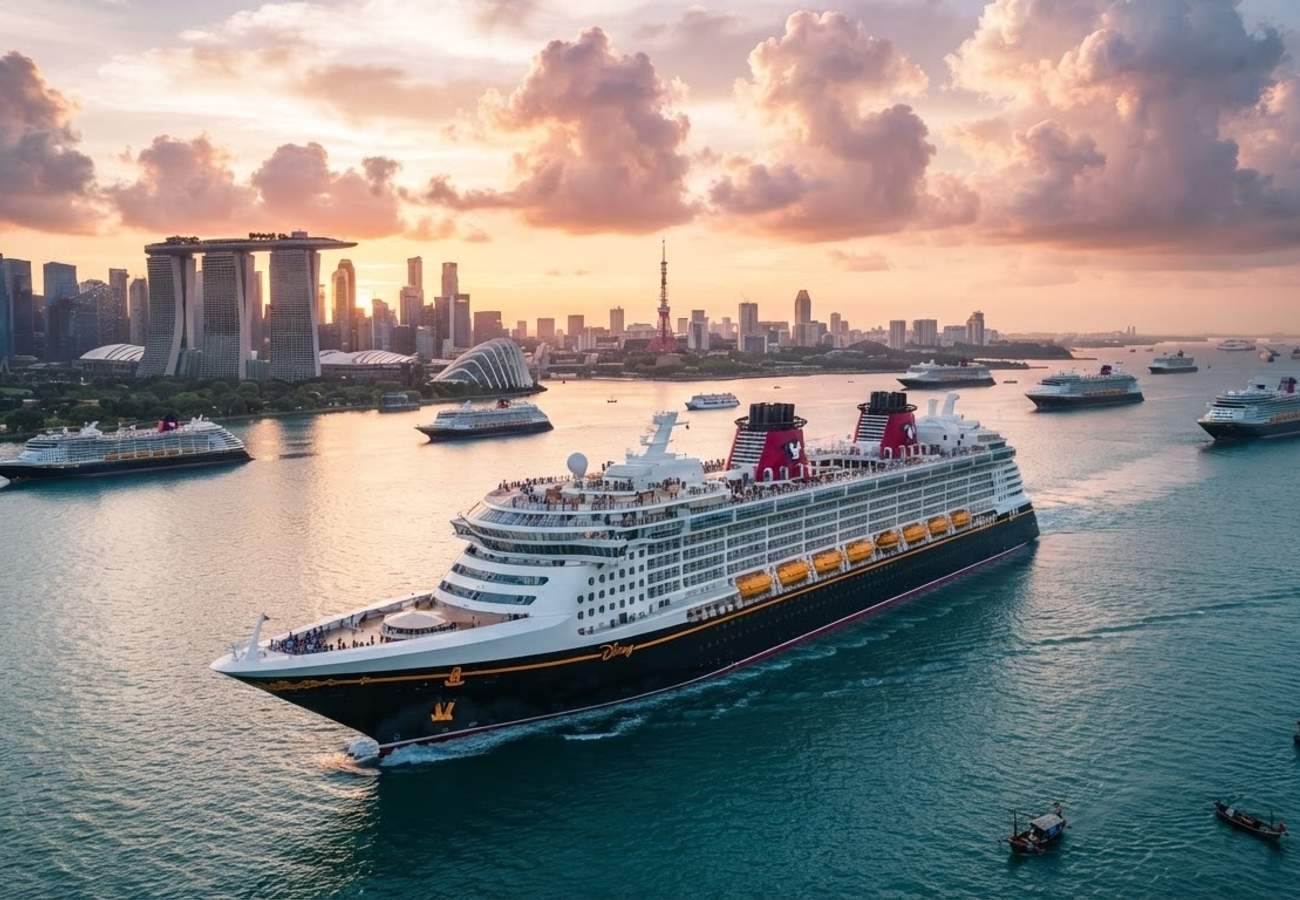
Image generated by AI
Disney Cruise Line is aggressively accelerating its global growth strategy, moving the deadline for its 13-ship fleet target forward to the end of 2030. By establishing critical operational hubs in Singapore and Japan, the company is pivoting toward a massive presence in the Asian market to diversify its family-centric cruise offerings.
The shift in timeline was formally disclosed during The Walt Disney Company’s fiscal 2026 third-quarter financial results. Originally projected to reach full capacity by 2031, the company has now trimmed a year off the schedule, signaling a surge in capital investment toward its "Experiences" business segment. This acceleration means more berths, more diverse itineraries, and a significantly larger footprint in the Eastern Hemisphere.
Accelerated Fleet Growth and the Wish-Class Timeline
The immediate future of the fleet centers on the expansion of the Wish-class vessels. The next ship to join the lineup is the Disney Believe, which is slated for service in late 2027. This vessel will complement the existing Disney Wish, Disney Treasure, and Disney Destiny, cementing the Wish-class as the current gold standard for the brand's storytelling and technological integration.
Beyond the Wish-class, Disney is developing a new, larger class of ships. These upcoming vessels are designed to be approximately 100,000 gross tons, with a passenger capacity of roughly 3,000 guests each. While these were initially scheduled for 2029, 2030, and 2031, the revised plan pulls the second vessel forward to late 2029 and the third to late 2030.
Consequently, 2029 is poised to be a landmark year for the brand, with potentially three Disney-branded ships entering service simultaneously.
Singapore Emerges as the Primary Asian Gateway
The strategic pivot to Asia is already operational via the Disney Adventure. On March 10, 2026, this vessel embarked on its maiden voyage from Singapore, marking the company's eighth ship overall and its first permanent base of operations in Asia.
The formal christening of the Disney Adventure in Singapore earlier in March underscores the city-state's role as a logistical linchpin. For the modern traveler, this removes the necessity of traveling to the Caribbean or Europe to experience a Disney cruise. It allows for a seamless integration of Southeast Asian urban tourism with high-end themed cruising, making the brand accessible to a vast regional demographic.
Japan's Strategic Role via Oriental Land Company
While Singapore serves as the immediate hub, Japan is being developed as a secondary powerhouse for Disney’s maritime ambitions. The Oriental Land Company, the entity responsible for operating the Tokyo Disney Resort, is spearheading a dedicated cruise business within Japan.
Data from official company materials indicates that the planned Japanese vessel will be substantial, featuring approximately 1,250 rooms and a capacity for roughly 4,000 passengers. Scheduled for a 2029 launch, this ship will allow tourists to pair a visit to Tokyo's land-based parks with a sea-based Disney experience, creating a comprehensive tourism ecosystem in East Asia.
Comprehensive Breakdown of the 13-Ship Fleet by 2030
The transition from a boutique fleet to a global powerhouse involves a mix of legacy vessels, modern Wish-class ships, and upcoming unnamed giants. While some ships are already operational, several in the new 100,000-ton class remain unnamed as they move through production.
| No. | Ship | Status | Expected/Actual Service | Key Detail |
|---|---|---|---|---|
| 1 | Disney Magic | Operating | 1998 | First Disney cruise ship |
| 2 | Disney Wonder | Operating | 1999 | Magic-class sister ship |
| 3 | Disney Dream | Operating | 2011 | Dream-class vessel |
| 4 | Disney Fantasy | Operating | 2012 | Dream-class vessel |
| 5 | Disney Wish | Operating | 2022 | First Wish-class ship |
| 6 | Disney Treasure | Operating | 2024 | Wish-class ship |
| 7 | Disney Destiny | Operating | 2025 | Wish-class ship |
| 8 | Disney Adventure | Operating | 2026 | First Disney ship based in Asia |
| 9 | Disney Believe | Planned | Late 2027 | Fourth Wish-class ship |
| 10 | Japan Disney Cruise Ship | Planned | 2029 | Tokyo-area based operation |
| 11 | New unnamed ship | Planned | 2029 | New ship class |
| 12 | New unnamed ship | Planned | 2029 | New ship class |
| 13 | New unnamed ship | Planned | Late 2030 | New ship class |
Legacy and Evolution of the Fleet
The fleet's foundation rests on the Magic-class ships. The Disney Magic (1998) and Disney Wonder (1999) proved that themed entertainment could be successfully scaled to the ocean. These vessels continue to operate, offering a more intimate experience compared to the newer giants.
The evolution continued with the Dream-class, consisting of the Disney Dream (2011) and Disney Fantasy (2012). These ships introduced larger public spaces and expanded youth facilities, specifically targeting the lucrative Caribbean and Bahamas markets.
The current era is defined by the Wish-class, starting with the Disney Wish in 2022, followed by the Disney Treasure in 2024 and the Disney Destiny in 2025. These ships prioritize a blend of storytelling and modern technology, setting the stage for the upcoming 100,000-ton vessels that will define the fleet's capacity by the end of the decade.
Why This Matters: The Impact on Global Travel
For the traveler, this expansion represents more than just "more ships." It is a fundamental shift in how themed vacations are consumed. By placing ships in Singapore and Japan, Disney is reducing the "barrier to entry" for millions of families in Asia who previously faced prohibitively expensive flights to Florida or Texas.
From a logistical standpoint, the move toward 100,000-ton vessels suggests that Disney is preparing for higher demand and potentially more complex itineraries. However, travelers should remain aware that a larger fleet does not guarantee year-round service at every port. Itineraries will likely remain seasonal, requiring careful planning.
The most significant gain for the consumer is flexibility. The ability to link a Tokyo land vacation with a Japanese cruise, or a Singapore city break with a Southeast Asian voyage, creates a "multi-modal" vacation style that was previously unavailable in the Disney ecosystem.
The horizon for family cruising is expanding rapidly as Disney transforms from a regional operator into a global maritime force.
Related Travel Guides
Disclaimer
This article is for informational and educational purposes only. It does not constitute legal, financial, or professional advice. While we strive to provide accurate and up-to-date information, travel policies, regulations, and conditions change rapidly. Always verify information with official sources before making travel decisions. Nomad Lawyer makes no representations about the accuracy, reliability, completeness, or suitability of the information provided. Readers should consult qualified professionals for advice specific to their circumstances. The views expressed in this article are those of the author and do not necessarily reflect the views of Nomad Lawyer.
Raushan Kumar
Founder & Lead Developer
Full-stack developer with 11+ years of experience and a passionate traveller. Raushan built Nomad Lawyer from the ground up with a vision to create the best travel and law experience on the web.
Learn more about our team →