
Delta Flight Investigated for External Impact Event During Final Descent to Chicago Midway Airport Amid Independence Day Fireworks
Delta Flight 1076 experienced a loud sound on final descent to Chicago Midway Airport during Independence Day fireworks.

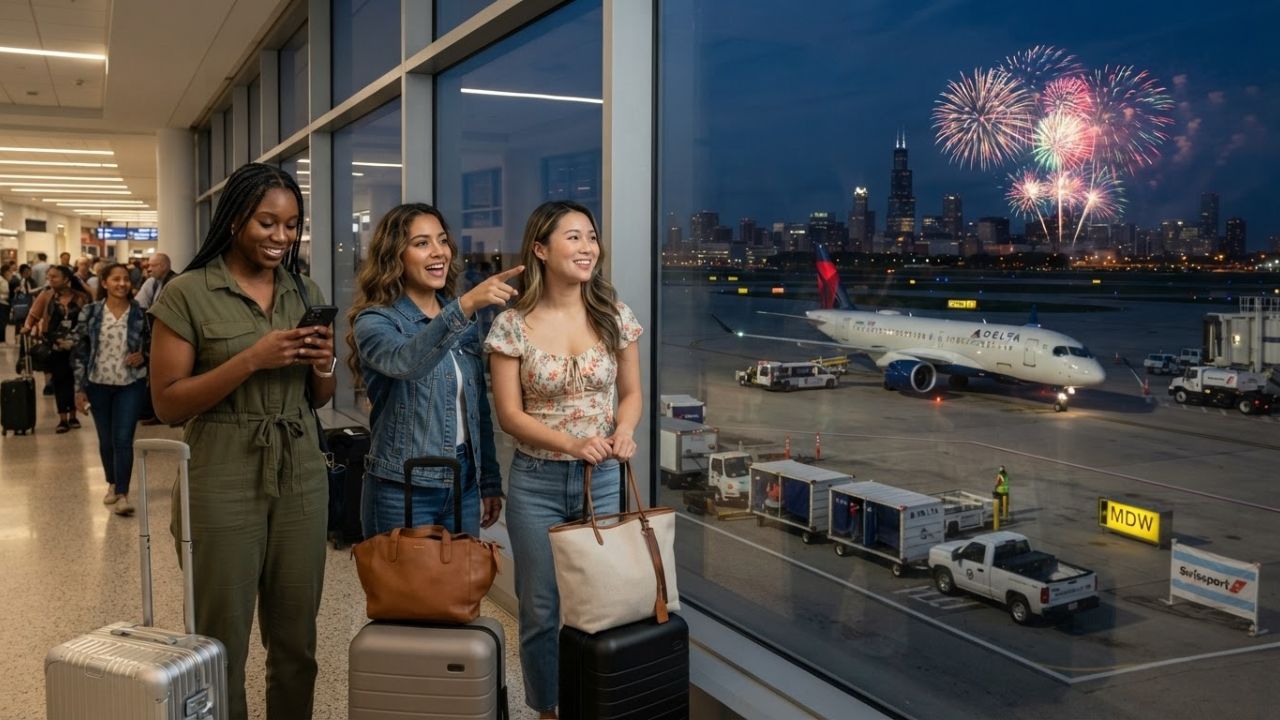
Image generated by AI
[Chicago, July 6, 2026] — The ongoing investigation into the Delta flight firework Chicago incident on July 6, 2026, highlights urban airspace risks after Flight 1076 experienced a loud sound on descent.
Chicago Midway International Airport (MDW) is unique among major US airports due to its square layout and close proximity to dense residential neighborhoods. Unlike suburban hubs surrounded by open fields, Midway's flight paths pass directly over city streets at low altitudes. During holidays like Independence Day, private fireworks are frequently launched from residential backyards directly beneath aircraft approach corridors. When pyrotechnic devices reach altitudes of several hundred feet, they create a physical hazard for commercial passenger aircraft during the critical landing phase.
Low Altitude Noise Reported on Descent to Midway
The crew of Flight 1076 experienced a sudden acoustic event during landing:
- The aircraft was on final approach when the cockpit crew reported a loud impact-like noise.
- Despite the sound, flight systems reported normal pressures and controls.
- Pilots proceeded to land the aircraft without declaring an emergency or requesting priority.
The flight completed landing operations and taxied safely to the gate.
Risks of Amateur Pyrotechnics in Urban Airspace Corridors
Private fireworks present several hazards to commercial flight paths:
- Projectiles can rise high enough to intersect descent paths at low altitudes.
- Exploding debris can strike aircraft surfaces, windshields, or engine inlets.
- Bright flashes can cause temporary night-vision glare for pilots during descent.
These factors make uncoordinated launches near airport fences a persistent safety concern.
FAA Flight Data and Voice Recorder Analysis
Federal aviation inspectors from the Federal Aviation Administration (FAA) are conducting a technical review of the incident:
- Technicians will download and evaluate flight data recorder (FDR) telemetry.
- Cockpit voice logs will be reviewed to verify the timing of the noise.
- Flight paths will be compared with radar data tracking local fireworks activity.
Inspectors seek to clarify if the sound was a direct physical impact or a close proximity blast.
Operational Safeguards and Pilot Response Procedures
Standard training guidelines help pilots manage unexpected low-altitude events:
- Pilots prioritize maintaining a stable flight path over secondary cockpit checks.
- Maintenance crews complete detailed visual checks of panels after landing.
- Local air traffic control alerts inbound flights when nearby fireworks are reported.
These response protocols ensure that unexpected external events do not compromise safety.
Key Facts Breakdown
- Loud Bang: Crew on Delta Flight 1076 reported a loud impact-like noise during descent to Midway.
- Safe Landing: The aircraft landed normally, taxiing to the gate with zero injuries reported.
- Midway Location: The event took place near Chicago Midway, an airport surrounded by dense housing.
- FAA Review: The FAA is checking flight data and cockpit voice recorders to determine the cause.
| Flight Number | Aircraft Type | Departure Airport | Destination Airport | Incident Phase | Safety Outcome |
|---|---|---|---|---|---|
| Delta 1076 | Commercial Passenger Jet | Scheduled Origin | Chicago Midway (MDW) | Final Approach (Low Altitude) | Safe landing, zero injuries |
Why This Matters
Our analysis of the flight data indicates that the Delta flight firework Chicago incident highlights the growing vulnerability of urban airports to uncoordinated low-altitude airspace intrusions. While drone encounters receive significant regulatory attention, seasonal amateur fireworks represent a seasonal hazard that is difficult to monitor or enforce. At Midway, where houses sit directly under the glide slope, a consumer-grade rocket reaching 500 feet can intersect an aircraft's approach path in seconds. Even if a firework fails to cause structural damage, the risk of engine ingestion or pilot distraction during a critical flight phase is extremely high, indicating a need for better coordination between local police and aviation authorities during national holidays.
Industry Outlook
Market trends suggest that aviation safety boards will push for geofenced restriction zones and increased police patrols beneath urban flight paths by 2028 to prevent low-altitude collisions. Long-term projections indicate that airports will install infrared cameras to detect unauthorized pyrotechnic launches near runways in real-time. Expect airlines to update flight deck guidelines, advising pilots to maintain higher approach altitudes when flying over holiday celebrations.
FAQ
Was the Delta aircraft damaged by the firework?
Initial inspections showed no critical structural damage, but a detailed technical inspection is ongoing to rule out micro-damage.
Did the flight crew declare an emergency?
No, the pilots maintained stable flight and landed normally without requesting emergency ground assistance.
Why are fireworks near Midway Airport particularly dangerous?
Midway's runways are surrounded by close residential zones, meaning private fireworks are launched near low-altitude approach paths.
Related Travel Guides
Disclaimer
This article is for informational and educational purposes only. It does not constitute legal, financial, or professional advice. While we strive to provide accurate and up-to-date information, travel policies, regulations, and conditions change rapidly. Always verify information with official sources before making travel decisions. Nomad Lawyer makes no representations about the accuracy, reliability, completeness, or suitability of the information provided. Readers should consult qualified professionals for advice specific to their circumstances. The views expressed in this article are those of the author and do not necessarily reflect the views of Nomad Lawyer.
Kunal K Choudhary
Co-Founder & Contributor
A passionate traveller and tech enthusiast. Kunal contributes to the vision and growth of Nomad Lawyer, bringing fresh perspectives and driving the community forward.
Learn more about our team →