
Delta Air Lines Flight DAL2725 Boeing 737-832 Diverts From San Francisco to Los Angeles Route at Fresno Yosemite International Airport Following Cockpit Engine Warning
Delta Air Lines flight DAL2725, a Boeing 737-832 operating from San Francisco to Los Angeles, diverted to Fresno Yosemite International Airport after a cockpit engine warning indicator activated during cruise.

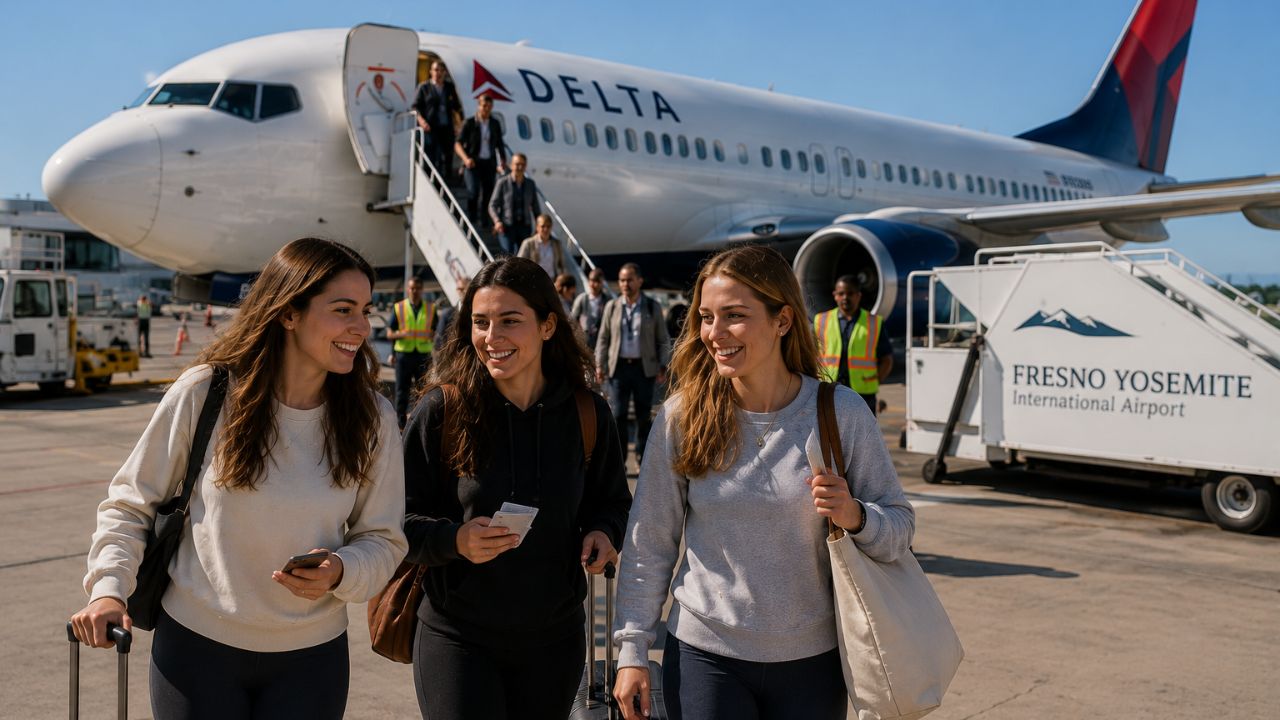
Image generated by AI
[Fresno, July 7, 2026] — Delta Air Lines flight DAL2725, a Boeing 737-832 operating the San Francisco (SFO) to Los Angeles (LAX) corridor, diverted to Fresno Yosemite International Airport (FAT) on Monday after the flight crew received a cockpit engine warning indication during the cruise phase of the flight over central California. The aircraft descended and landed safely at Fresno without incident. All 157 passengers and six crew members exited the aircraft normally through the terminal gate. No injuries were reported.
Fresno Yosemite International Airport sits in California's Central Valley, positioned between the Sierra Nevada mountain range to the east and the coastal ranges to the west — making it a practical alternate for aircraft operating the SFO–LAX corridor that cannot safely continue over the terrain separating the Central Valley from the Los Angeles basin. The crew's decision to land at Fresno rather than attempt to continue to LAX is consistent with standard FAA-mandated procedures for propulsion system alerts on commercial twin-engine aircraft.
What Triggered the Diversion
The diversion was prompted by a cockpit engine warning indicator that activated during the cruise phase of the flight:
- Engine monitoring systems on the Boeing 737-832 continuously track propulsion parameters — including oil pressure, fuel flow, exhaust gas temperature, and vibration levels.
- When any reading exceeds defined operational thresholds, an alert activates on the Engine Indicating and Crew Alerting System (EICAS) display on the flight deck.
- FAA regulations and airline standard operating procedures require flight crews to treat every engine alert as a real event, regardless of whether a subsequent sensor or component fault is ultimately confirmed.
- The crew selected Fresno Yosemite International Airport as the nearest suitable alternate with adequate runway length and ground handling capability for the 737-832.
The aircraft taxied to the gate under its own engine power after landing, with no tow vehicle required — confirming the aircraft remained fully controllable throughout the descent and approach.
Aircraft and Route Profile
- Airline: Delta Air Lines
- Flight Number: DAL2725
- Aircraft Type: Boeing 737-832
- Route: San Francisco International Airport (SFO) — Los Angeles International Airport (LAX)
- Diversion Airport: Fresno Yosemite International Airport (FAT)
- Passengers: 157
- Crew: 6
- Aircraft Condition on Landing: Taxied under own power; no emergency equipment deployment
The Boeing 737-832 is a member of the 737-800 series — one of the most widely operated narrow-body aircraft types in the United States domestic market. The variant is a twin-engine aircraft with a standard two-class cabin layout and a range that comfortably covers California intrastate routes.
Passenger Reaccommodation and Ground Handling
Delta Air Lines ground staff met the arriving flight at Fresno and immediately began managing passenger disruption:
- Food vouchers were distributed to passengers inside the terminal.
- Baggage was offloaded and made available to passengers at the Fresno facility.
- Passengers were reaccommodated onto replacement transport — including ground bus services and available late-evening replacement flights — to complete their journeys to the Los Angeles area.
- Delta formally apologized to all affected customers for the delay caused by the unscheduled diversion.
For passengers on the SFO–LAX corridor, Fresno is approximately 220 miles north of Los Angeles. Ground transport from Fresno to Los Angeles takes approximately 3–4 hours by road, making ground bus transfer the standard passenger recovery option when replacement flight capacity is not immediately available.
FAA Investigation Process
The Federal Aviation Administration (FAA) has opened a formal investigation into the engine warning event on DAL2725:
- Investigators will review data from the aircraft's digital flight data recorder (FDR) and cockpit voice recorder (CVR) to reconstruct the precise timeline of the alert.
- The investigation will determine whether the warning originated from a physical component failure or an electrical sensor malfunction — a distinction that affects both maintenance requirements and airworthiness determinations.
- Delta Air Lines maintenance technicians have isolated the Boeing 737-832 from its active flight schedule to complete a full diagnostic inspection before the aircraft returns to service.
- No preliminary cause has been announced. The FAA's review process typically produces initial findings within days for precautionary diversions, with full reports taking longer depending on complexity.
Delta Air Lines DAL2725 — Diversion Summary
| Parameter | Detail |
|---|---|
| Flight Number | DAL2725 |
| Aircraft Type | Boeing 737-832 |
| Origin Airport | San Francisco International Airport (SFO) |
| Scheduled Destination | Los Angeles International Airport (LAX) |
| Diversion Airport | Fresno Yosemite International Airport (FAT) |
| Diversion Cause | Cockpit engine warning indicator activation |
| Passengers on Board | 157 |
| Crew on Board | 6 |
| Injuries | None |
| Aircraft Landing Mode | Taxied under own power; no tow required |
| Emergency Declared | Not confirmed |
| FAA Investigation | Opened — digital recorder review in progress |
| Date | July 7, 2026 |
Key Takeaways
- Flight Diverted: DAL2725 was redirected from LAX to Fresno Yosemite International Airport (FAT) due to a cockpit engine warning during cruise over central California.
- All Safe: All 157 passengers and 6 crew members deplaned without injury.
- Aircraft Self-Powered: The Boeing 737-832 taxied to the gate under its own power — no emergency equipment was deployed.
- FAA Investigation Active: Federal investigators are reviewing flight recorder data to determine whether a sensor fault or mechanical failure triggered the alert.
- Passengers Reaccommodated: Ground buses and replacement flights were arranged for passengers to complete their journeys to Los Angeles.
Why This Matters
Our analysis of the diversion data indicates that the DAL2725 event is an example of the commercial aviation safety system operating precisely as designed — not a system failure. The SFO–LAX corridor is one of the most heavily trafficked domestic routes in the United States, operated multiple times daily by Delta, United, Southwest, Alaska, and American Airlines. The frequency of operations on this short-haul corridor means that any precautionary diversion is statistically likely to occur on it at some point, and Fresno Yosemite Airport's position midway along the Central Valley makes it the standard alternate for this route class.
The critical distinction for passengers and industry observers is between a precautionary diversion and an emergency landing. DAL2725 falls into the precautionary category: the aircraft remained under full control throughout, landed normally, taxied under its own power, and disembarked passengers via a terminal gate. The engine warning that triggered the diversion may ultimately prove to be a sensor anomaly rather than a mechanical failure — which is a routine outcome in approximately 40–60% of propulsion alert diversions, based on historical NTSB data patterns.
The FAA investigation will be the definitive source on cause determination. Until those findings are published, the publicly known facts support a single clear conclusion: the flight crew made a textbook safety decision, the aircraft landed without incident, and all passengers reached safety.
Industry Outlook
Market trends suggest that the FAA's ongoing Continuous Airworthiness Maintenance Program requirements for the 737-800 series will continue producing a small number of precautionary diversions annually as aging aircraft sensor systems generate alerts that require immediate investigation under commercial aviation safety protocols. Long-term projections indicate that Delta Air Lines' accelerating narrowbody fleet renewal — replacing 737-800 series aircraft with newer Airbus A220 and Boeing 737-10 MAX deliveries — will progressively reduce the frequency of sensor-related diversions on California intrastate routes as newer aircraft with more integrated diagnostic systems enter service. Fresno Yosemite International Airport is expected to formalize expanded ground handling agreements with major California corridor carriers by 2027, reflecting its established role as the primary precautionary alternate for SFO–LAX route operations.
FAQ
Why did Delta flight DAL2725 divert to Fresno? The flight crew received a cockpit engine warning indicator alert during cruise over central California. FAA regulations require pilots to treat all propulsion alerts as real events and land at the nearest suitable airport rather than continue to the original destination.
Were all passengers safe on DAL2725? Yes — all 157 passengers and 6 crew members deplaned at Fresno Yosemite International Airport without injuries. The aircraft taxied to the gate under its own power.
Is the FAA investigating the DAL2725 diversion? Yes — the FAA has opened a formal investigation and is reviewing digital flight recorder data to determine whether the engine warning was caused by a sensor malfunction or a physical component failure.
How did passengers get from Fresno to Los Angeles after the diversion? Delta Air Lines arranged ground bus transport and replacement flights to reaccommodate the 157 affected passengers on their journeys to the Los Angeles area. Food vouchers and baggage access were also provided at Fresno airport.
Related Travel Guides
- Endeavor Air Flight EDV5294 Diverts From New York JFK to Lehigh Valley International Airport Allentown Amid Northeast Airspace Congestion
- JFK Airport Severe Weather Disruption Grounds 199 Flights and Delays 435 Across JetBlue, Delta, American, Endeavor Air, and Dozens of International Carriers
- Dallas-Fort Worth International Airport Records 476 Delays and 25 Cancellations Across American, Delta, PSA, Iberia, Qantas, and Global Carrier Network
Disclaimer
This article is for informational and educational purposes only. It does not constitute legal, financial, or professional advice. While we strive to provide accurate and up-to-date information, travel policies, regulations, and conditions change rapidly. Always verify information with official sources before making travel decisions. Nomad Lawyer makes no representations about the accuracy, reliability, completeness, or suitability of the information provided. Readers should consult qualified professionals for advice specific to their circumstances. The views expressed in this article are those of the author and do not necessarily reflect the views of Nomad Lawyer.
Kunal K Choudhary
Co-Founder & Contributor
A passionate traveller and tech enthusiast. Kunal contributes to the vision and growth of Nomad Lawyer, bringing fresh perspectives and driving the community forward.
Learn more about our team →