
The Wet-Lease Mechanics Behind SAS Regional Flights: How CityJet Powers Nordic Connectivity

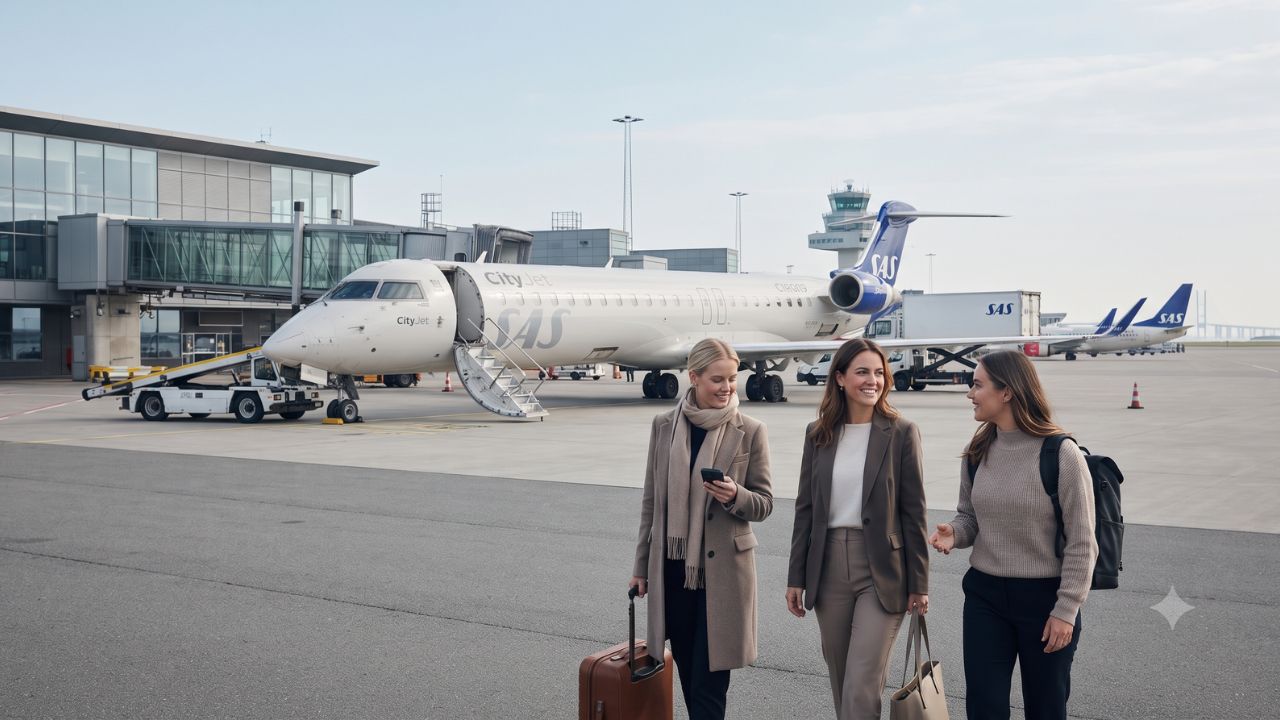
With European Union residents spending €379.4 billion on cross-border travel in 2025—directing 32% of that capital into transport—and logging 1.321 billion accommodation nights in the first half of 2026, the structural backbone of regional aviation increasingly relies on outsourced capacity agreements rather than legacy carrier-owned aircraft. Operating from heavy maintenance and crew bases in Copenhagen and Stockholm, Irish wet-lease specialist CityJet provides regional flight capacity for Scandinavian Airlines (SAS), operating 88- and 90-seat regional jets without marketing a single direct passenger ticket under its own brand. For business travelers and international tourists navigating routes between Denmark, Sweden, and northern Europe, this division between ticketing brand and operating carrier governs boarding procedures, onboard cabin standards, and statutory disruption compensation.
While passengers purchase tickets bearing SAS flight numbers, the aircraft, flight crews, technical maintenance, and operational hull insurance are supplied via an ACMI (Aircraft, Crew, Maintenance, and Insurance) wet-lease contract. This operating model allows major network airlines to match capacity on secondary routes without carrying the capital exposure of dedicated regional fleets or high-cost internal labor agreements.
The Evolution From Independent Airline to Pure Capacity Provider
CityJet’s current operational posture reflects a deliberate 33-year corporate transformation. Established in 1993, the carrier commenced scheduled commercial passenger flights between Dublin and London City Airport in January 1994. In 1996, it forged a commercial franchise with Air France, culminating in full incorporation into the Franco-Dutch airline group in 2000. Subsequent phases included the acquisition of Belgian carrier VLM Airlines, private equity ownership transitions in 2014 and 2015, and the strategic purchase of Finnish regional carrier Blue1 in 2015.
The pivotal pivot toward Nordic operations occurred in 2016 when CityJet secured dedicated wet-lease production contracts with SAS, reinforced in 2017 through the acquisition of Danish regional operator Cimber. In October 2018, CityJet permanently ceased all own-brand scheduled passenger flights, terminating public ticket sales to operate strictly as a business-to-business ACMI capacity provider.
Regulatory authorities subsequently sanctioned deeper industrial consolidation. On 1 March 2023, the European Commission issued a formal merger clearance approving a regional airline joint venture between CityJet and Spain's Air Nostrum under the Strategic Alliance of Regional Airlines (SARA) holding framework. Corporate records document international alliance participation during 2023 and restructured corporate ownership executed on 31 October 2025. Today, CityJet maintains its corporate headquarters in Dublin, flight operations planning in Luton, and an active operational base at Copenhagen Airport supported by 320 locally based personnel and an airframe maintenance hangar.
Corporate Milestones and Operational Profile: 1993–2026
The table below traces the strategic transition of CityJet from an independent Irish scheduled carrier into a specialized wet-lease provider supporting Nordic regional connectivity:
| Operational Era | Primary Milestone | Aircraft Role & Configuration | Commercial & Legal Structure |
|---|---|---|---|
| 1993–1994 | Corporate founding; Dublin–London City launch | BAe 146 regional quad-jets | Independent scheduled airline |
| 1996–2000 | Air France partnership and equity acquisition | Regional feeding fleet | Franchise and subsidiary operations |
| 2014–2015 | Private equity sale; acquisition of Blue1 (Finland) | Fleet rationalization | Transition toward contract flying |
| 2016–2017 | SAS wet-lease initiation; acquisition of Cimber (Denmark) | Introduction of 88–90 seat regional jets | Primary Scandinavian capacity provider |
| October 2018 | Complete termination of own-brand commercial flights | 88- and 90-seat regional jets | 100% dedicated ACMI provider |
| March 2023 | European Commission merger clearance with Air Nostrum | Strategic regional consolidation | SARA holding alliance structure |
| 2025–2026 | Restructured ownership; focus on CPH/ARN hubs | Bombardier CRJ900 aircraft | Dedicated wet lease for SAS |
Sources: Compiled from European Commission competition filings, Irish Aviation Authority records, and corporate disclosures.
Dissecting the ACMI Contract: Division of Operational Responsibilities
In an ACMI wet-lease relationship, commercial and operational responsibilities are strictly bifurcated between the technical contractor and the marketing airline:
- CityJet Responsibilities: Supplies the airframe, certified flight deck captains and first officers, trained cabin attendants, comprehensive line and base maintenance at Copenhagen, and hull insurance under oversight from the Irish Aviation Authority and the European Union Aviation Safety Agency (EASA).
- SAS Responsibilities: Sets the commercial route network, publishes flight frequencies, prices and sells passenger tickets, provides airport gate check-in, manages baggage handling, covers jet fuel expenses, pays airport landing fees, and manages passenger reservations.
This structural separation is invisible to most passengers at the boarding gate. Passengers board through standard SAS gates, use SAS boarding passes, and encounter cabin attendants wearing SAS uniforms operating aircraft bearing Scandinavian Airlines livery, save for a small statutory placard near the boarding door stating: "Operated by CityJet on behalf of SAS."
European Tourism Realities: Intra-EU Travel Density
Official statistical releases from Eurostat contextualize why flexible regional capacity is vital for European legacy carriers. In data published on 9 October 2026, Eurostat confirmed that EU residents took 1.20 billion tourism trips in 2025, with 92% of those journeys occurring entirely within the borders of the European Union. Furthermore, transport expenditures accounted for €121.4 billion—or 32%—of the total €379.4 billion expended on cross-border travel.
Simultaneously, accommodation statistics released on 1 September 2026 recorded 1.321 billion guest nights across the EU during the first half of 2026 (+1.7% year-on-year), with foreign visitors generating 48.9% of all stays. Notably, international guest stays expanded at 2.5%, nearly triple the 0.9% growth rate recorded for domestic travelers. In secondary Scandinavian cities like Billund, Aarhus, Gothenburg, and Malmö, feeding international travelers into long-haul intercontinental flights at Copenhagen and Stockholm requires high-frequency regional aircraft rather than oversized mainline narrowbodies.
Expert Analysis: ACMI Margins, SAS Network Restructuring, and Passenger Rights
The reliance of SAS on wet-lease operators like CityJet illustrates the financial disciplines imposed by post-restructuring airline management. Having navigated Chapter 11 bankruptcy reorganization and welcomed investment from Air France-KLM and institutional funds, SAS must maintain low fixed fleet costs. Operating 88- and 90-seat regional jets through an external ACMI contractor insulates SAS from collective bargaining pressures while allowing seasonal flight adjustments on regional feeder routes across Scandinavia.
According to consumer protection frameworks established under European regulatory mandates, wet-lease operations often create confusion during flight disruptions. For travelers booking this route, the direct consequence is that all statutory claims under EU Regulation 261/2004—including duty of care, hotel accommodation, meal vouchers, and cash compensation for delays exceeding three hours—must be filed directly with SAS as the contracting carrier, rather than CityJet as the wet-lease operator.
However, operating regional jets under tight contract margins presents unique operational vulnerabilities. When technical maintenance delays ground a regional aircraft in Copenhagen, CityJet cannot easily substitute mainline narrowbody equipment. The pricing pressure this creates means that during peak winter weather events in Scandinavia, SAS must prioritize recovery on high-density mainline corridors, occasionally resulting in protracted delays or outright flight cancellations on secondary regional routes.
Travelers with specialized physical requirements must also observe advance notification rules. Under EU disability accessibility mandates, passengers requiring mobility or wheelchair assistance must register requests with the ticketed airline at least 48 hours before scheduled departure. While European airports are legally required to make reasonable efforts to accommodate unannounced requests, adhering to the 48-hour deadline ensures ground crews properly position equipment for smaller regional jet cabins.
Key Takeaways
- Pure ACMI Operating Model: CityJet operates dedicated wet-lease services for SAS across Copenhagen and Stockholm, supplying aircraft, crew, maintenance, and insurance.
- Complete Own-Brand Exit: CityJet ceased all self-ticketed commercial scheduled passenger services in October 2018 to focus exclusively on business-to-business contract flying.
- Regional Aircraft Focus: Operations center on regional aircraft configured with 88 to 90 passenger seats, connecting secondary Nordic destinations to SAS hub terminals.
- Statutory Passenger Governance: Under EU261 mandates, the marketing airline (SAS) retains exclusive legal liability for flight delays, baggage losses, and rebooking.
- Intra-European Travel Momentum: Eurostat data reveals 92% of EU tourist trips remain within Europe, driving heavy demand for efficient regional feed into hub airports.
FAQ: CityJet and SAS Regional Operations 2026
What does ACMI wet leasing mean for a flight?
An ACMI wet lease means one airline (CityJet) provides the aircraft, flight crew, maintenance, and insurance, while the customer airline (SAS) handles scheduling, ticketing, pricing, and airport ground services.
Which airline is legally responsible if my regional flight is delayed?
Under EU Regulation 261/2004, the airline that sold the ticket and issued the boarding pass (SAS) is legally responsible for compensation, re-routing, meal vouchers, and passenger care during flight disruptions.
Can travelers buy flight tickets directly from CityJet?
No. CityJet ended all self-branded commercial ticket sales in October 2018. All travel on its aircraft must be booked through its airline partner, Scandinavian Airlines (SAS).
Where are CityJet's primary operational bases located?
CityJet maintains its primary Scandinavian operational base, maintenance hangar, and 320 employees at Copenhagen Airport (CPH), with corporate headquarters in Dublin and flight operations planning in Luton.
[Modern regional aviation functions as a complex corporate orchestra where the name printed on the fuselage rarely matches the badge of the pilots flying the plane.]
Related Travel Guides
- Global Aviation Services Market to Double to US$422B by 2045: Airbus Forecast Details Severe Fleet Maintenance and Crew Deficits
- Emirates Up-Gauges A380 Operations in Malaysia, Switzerland, and China: Strategic Fleet Allocations Reshape Long-Haul Capacity
- EZY Airlines Links U-Tapao With Hua Hin and Surat Thani: Point-to-Point Regional Aviation Bypasses Bangkok
Disclaimer
This article is for informational and educational purposes only. It does not constitute legal, financial, or professional advice. While we strive to provide accurate and up-to-date information, travel policies, regulations, and conditions change rapidly. Always verify information with official sources before making travel decisions. Nomad Lawyer makes no representations about the accuracy, reliability, completeness, or suitability of the information provided. Readers should consult qualified professionals for advice specific to their circumstances. The views expressed in this article are those of the author and do not necessarily reflect the views of Nomad Lawyer.
Preeti Gunjan
Contributor & Community Manager
A passionate traveller and community builder. Preeti helps grow the Nomad Lawyer community, fostering engagement and bringing the reader experience to life.
Learn more about our team →