
China Targets North American Corporate Travel: Six Premier MICE Destinations Unveiled at IMEX America 2026

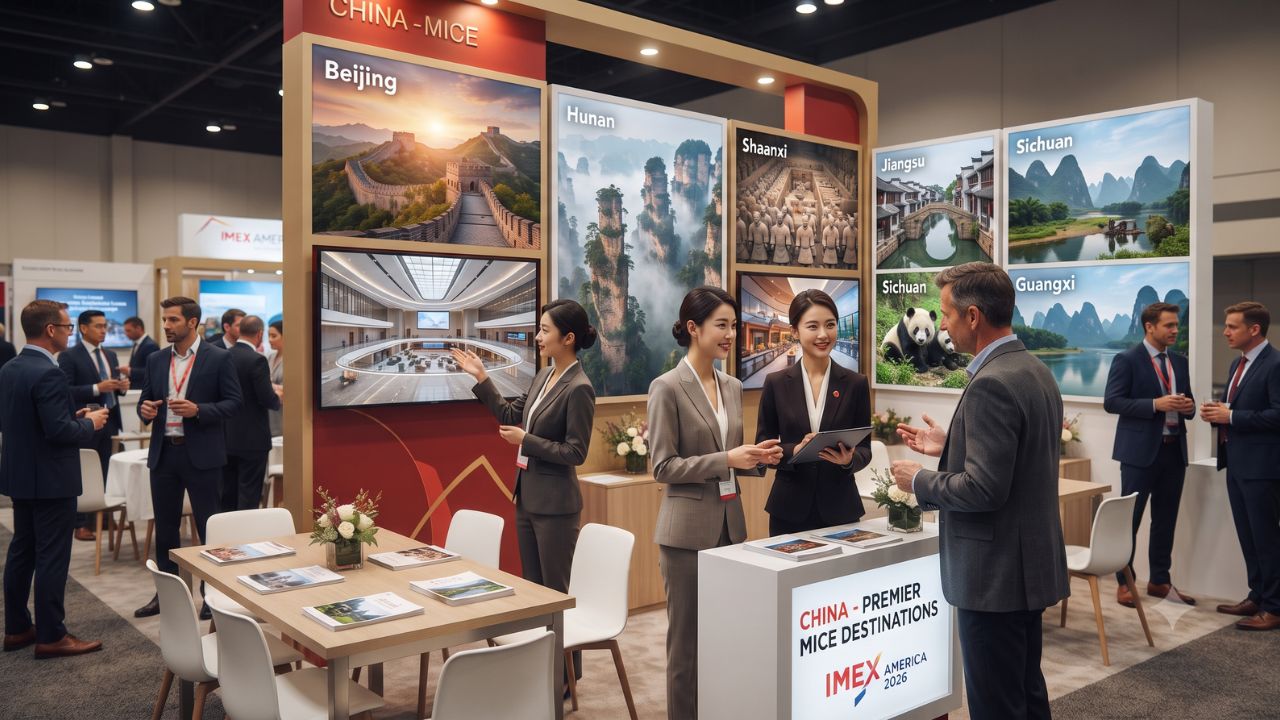
Anchored by a 1,000-square-foot exhibition pavilion and the strategic leverage of a 240-hour visa-free transit facility, China mounted an aggressive corporate travel campaign at IMEX America 2026 in Las Vegas from 13 to 15 October. Represented by the China National Tourist Office (CNTO) in Los Angeles at Mandalay Bay, the national delegation unveiled a curated portfolio of six regional MICE powerhouses—Beijing, Hunan, Shaanxi, Jiangsu, Sichuan, and Guangxi—aimed directly at capturing North American meeting planners, corporate incentive buyers, and association executives.
Convening under the official promotional banner "China: Where Business Meets Extraordinary Experiences," the initiative reflects a coordinated effort to reposition China's business travel sector. Rather than restricting corporate itineraries to established tier-one commercial gateways like Shanghai and Guangzhou, Chinese tourism authorities are pitching high-speed rail connectivity, frictionless foreign digital payment integration, and secondary provincial convention facilities to North American event strategists seeking high-value alternatives to inflated domestic event markets.
Strategic Realignment: Positioning Beyond Tier-One Commercial Gateways
The annual IMEX America trade exposition provided the backdrop for Chinese tourism authorities to engage with multinational meeting planners and enterprise travel buyers. In the post-pandemic corporate procurement era, Fortune 500 travel managers have placed heightened scrutiny on return on investment, attendee experiential engagement, and the integration of cultural programming into traditional convention agendas.
To address these requirements, the CNTO Los Angeles pavilion moved deliberately beyond generic destination marketing. The presentation highlighted purpose-built convention complexes capable of hosting tens of thousands of delegates, integrated with international luxury hotel chains and high-speed rail corridors. By pairing heavy industrial and technological convention capacity with provincial heritage assets, the strategy targets planners seeking to combine rigorous plenary conferences with memorable executive retreat itineraries.
The Regional Hexagon: Cultural Dynasties to Subtropical Karst Retreats
The six featured destinations represent distinct geographic and functional segments of China's business events infrastructure:
- Beijing: The political and diplomatic capital anchors massive international congresses with Tier-1 convention centers, extensive five-star hotel clusters, and direct access to landmark imperial heritage. Event planners can schedule plenary sessions downtown while hosting private evening receptions at the Great Wall or exclusive cultural dinners near the Forbidden City.
- Shaanxi (Xi'an): Representing China’s ancient imperial heritage and the historic eastern terminus of the Silk Road, Shaanxi provides cultural gravitas through Xi'an. The world-famous Terracotta Warriors and preserved ancient city walls offer immersive cultural excursions for international academic symposiums and corporate incentive groups.
- Hunan: Pivoting from urban boardrooms to nature-centric incentives, Hunan highlights the breathtaking topography of Zhangjiajie. Celebrated for thousands of soaring quartz-sandstone pillars that served as the visual inspiration for James Cameron's cinematic masterpiece Avatar, the region caters to executive leadership summits, team-building expeditions, and outdoor adventure incentives.
- Jiangsu: Situated along the Yangtze River economic belt, Jiangsu balances modern industrial powerhouses with centuries-old heritage. The province markets its historic canal water towns, classical scholar gardens, and canal-side luxury resorts, providing serene settings for executive board meetings and creative workshops.
- Sichuan: Anchored by Chengdu, Sichuan blends premier metropolitan exhibition facilities with world-famous conservation projects. The province offers corporate groups direct access to giant panda breeding sanctuaries, UNESCO-recognized natural parks, and a globally celebrated gastronomic heritage.
- Guangxi: Known for its dramatic limestone karst topography and winding waterways along the Li River, Guangxi provides tranquil rural environments tailored for small-to-mid-sized corporate retreats, wellness incentive programs, and executive reflection gatherings away from urban centers.
Strategic Assessment: China's Six Featured MICE Destinations and Corporate Infrastructure
To assist corporate event planners in evaluating regional capacities, the following matrix details the infrastructure, incentive assets, and target profiles across China's six featured provinces:
| Destination & Province | Primary Convention & Meeting Assets | Distinctive Cultural & Incentive Feature | Target Corporate Event Format | Logistical Connectivity |
|---|---|---|---|---|
| Beijing Municipality | Mega-scale convention centers; Tier-1 global hotel brands | Forbidden City private viewings; Great Wall gala venues | Major world congresses, association summits, trade expos | Dual international airports; extensive metro network |
| Shaanxi (Xi'an) | Xi'an International Convention Center; historic venues | Terracotta Warriors archaeological park; Tang Dynasty banquets | Academic symposiums, heritage corporate retreats | Direct high-speed rail from Beijing (4.5 hours); airport |
| Hunan (Zhangjiajie) | Mountain resort conference facilities; boutique retreats | Avatar-inspiring sandstone pillars; glass skywalks | Executive team-building, wellness, nature incentives | High-speed rail connections; domestic airport links |
| Jiangsu (Suzhou/Nanjing) | Waterfront exhibition centers; tech-park facilities | Historic canal water towns; UNESCO classical gardens | Innovation forums, executive workshops, luxury retreats | 30-minute high-speed train from Shanghai |
| Sichuan (Chengdu) | Western China International Expo City; modern hotels | Giant Panda research bases; famous culinary culture | Tech conventions, incentive dining programs, corporate summits | Dual international hubs (Tianfu & Shuangliu) |
| Guangxi (Guilin/Yangshuo) | Riverside meeting lodges; eco-resort conference halls | Limestone karst river navigation; outdoor cultural shows | Leadership retreats, sustainability summits, wellness incentives | High-speed rail from Guangzhou; regional airport |
The Logistical Engine: 240-Hour Visa-Free Transit and High-Speed Rail Corridors
The commercial viability of this regional strategy relies on sweeping logistical reforms implemented by Chinese authorities over the past two years. At the forefront is the 240-hour (10-day) visa-free transit facility, available to citizens of designated Western nations traveling through approved international gateways to a third country or territory.
For corporate planners, this policy substantially reduces the bureaucratic hurdles of organizing regional events. Rather than requiring hundreds of delegates to navigate individual consular visa applications months in advance, eligible business travelers can enter China for up to ten days for meetings, site inspections, and incentive excursions.
On the ground, logistical movement is powered by the world's most extensive high-speed railway grid, which connects cities like Shanghai to Suzhou in under 30 minutes, or Beijing to Xi'an in four and a half hours. Furthermore, financial transaction barriers have been dismantled through recent updates by WeChat Pay and Alipay, allowing foreign corporate travelers to link international Visa and Mastercard accounts directly to mobile payment apps for seamless dining, ground transport, and retail transactions. Planners collaborating with the Global Business Travel Association (GBTA) increasingly recognize that these systemic improvements elevate China's competitiveness against regional peers like Singapore and Japan.
Expert Analysis: Corporate Procurement Realities, Geopolitical Hedging, and Infrastructure Arbitrage
China’s renewed overture to North American corporate meeting planners represents a calculated attempt at economic arbitrage within the global MICE industry. As hotel room rates, convention hall rentals, and catering costs across North American convention hubs like Las Vegas, Chicago, and Orlando continue to face sharp post-pandemic inflation, corporate procurement departments are actively seeking cost-effective alternatives for annual incentive trips and global sales conventions.
For travelers booking this route, the direct consequence is an extraordinary cost-to-quality advantage, where five-star international luxury accommodations, private VIP heritage access, and world-class convention catering can be secured at 35% to 50% below prevailing rates in major Western convention cities. Furthermore, municipal governments in cities like Chengdu, Xi'an, and Suzhou offer substantial financial subsidies and hosting grants to international associations bringing high-spending foreign delegations to their local convention centers.
The pricing pressure this creates means that competing Asia-Pacific MICE hubs—such as Bangkok, Seoul, and Kuala Lumpur—must work harder to justify premium pricing against China’s heavily subsidized provincial convention infrastructure. When Chinese provincial authorities combine zero-cost venue rentals with the 240-hour visa-free entry window, corporate planners operating within constrained travel budgets face a compelling commercial equation.
However, corporate travel buyers must carefully balance these financial efficiencies against organizational duty-of-care obligations and sovereign travel advisories. Successful execution demands that North American planners secure robust force-majeure contract protections, establish clear data-security protocols for corporate electronics, and partner with vetted local destination management companies to navigate regional administrative procedures.
Key Takeaways
- Targeted MICE Offensive: China presented six key provincial destinations at IMEX America 2026 in Las Vegas to capture high-value North American corporate and incentive travel.
- Diverse Regional Portfolio: The initiative moves beyond traditional tier-one gateways, highlighting Beijing, Shaanxi, Hunan, Jiangsu, Sichuan, and Guangxi.
- Visa-Free Transit Catalyst: The 240-hour (10-day) visa-free transit framework enables eligible corporate delegates to attend conferences and multi-city incentives without consular visas.
- Seamless Ground Logistics: Unrivaled high-speed rail corridors and foreign-credit-card-compatible mobile payments eliminate historic logistical friction for Western travelers.
- Significant Cost Arbitrage: Provincial convention subsidies and favorable hospitality rates deliver luxury corporate events at 35% to 50% below North American and Western European costs.
FAQ: China Business Travel and MICE Programs 2026
What is the 240-hour visa-free transit rule for business travelers in China?
Eligible international travelers transiting through approved Chinese ports to a third destination can stay up to 240 hours (10 days) without a visa, enabling short conferences, meetings, and incentive trips.
Which Chinese destinations were featured at IMEX America 2026?
The China National Tourist Office featured six premier destinations: Beijing, Shaanxi (Xi'an), Hunan (Zhangjiajie), Jiangsu (Suzhou/Nanjing), Sichuan (Chengdu), and Guangxi (Guilin).
Can foreign business delegates use international credit cards in China?
Yes. International travelers can link Visa and Mastercard credit cards directly to WeChat Pay and Alipay mobile wallets, enabling easy electronic payments for dining, taxis, and shopping nationwide.
What unique incentive experiences does Zhangjiajie offer corporate groups?
Hunan's Zhangjiajie features quartz-sandstone pillars that inspired the film Avatar, glass skywalks, and mountain cable cars, making it a premier venue for executive retreats and team-building programs.
[In the evolving marketplace of global commerce, the most successful events are those that anchor strategic business within an unforgettable world.]
Related Travel Guides
- Air India Cuts Delhi to Birmingham and Vienna Routes: Geopolitics and Fuel Costs Squeeze Europe Capacity
- Southwest Carry-On Rules Face TSA Scanner Friction: Why 24-Inch Bags Strain Next-Gen Airport Checkpoints
- Mexico Pacific Coast Travel Alert: Hurricane Simon and Tropical Storm Trudy Menace Puerto Vallarta and Manzanillo
Disclaimer
This article is for informational and educational purposes only. It does not constitute legal, financial, or professional advice. While we strive to provide accurate and up-to-date information, travel policies, regulations, and conditions change rapidly. Always verify information with official sources before making travel decisions. Nomad Lawyer makes no representations about the accuracy, reliability, completeness, or suitability of the information provided. Readers should consult qualified professionals for advice specific to their circumstances. The views expressed in this article are those of the author and do not necessarily reflect the views of Nomad Lawyer.
Naina Thakur
Contributor & Travel Specialist
Travel enthusiast and legal writer covering visa regulations, responsible tourism, and cultural journeys across global destinations.
Learn more about our team →