
China Constructs World's Largest Ocean Airport in Dalian: Marine Aviation and Asia-Pacific Coastal Hubs Guide

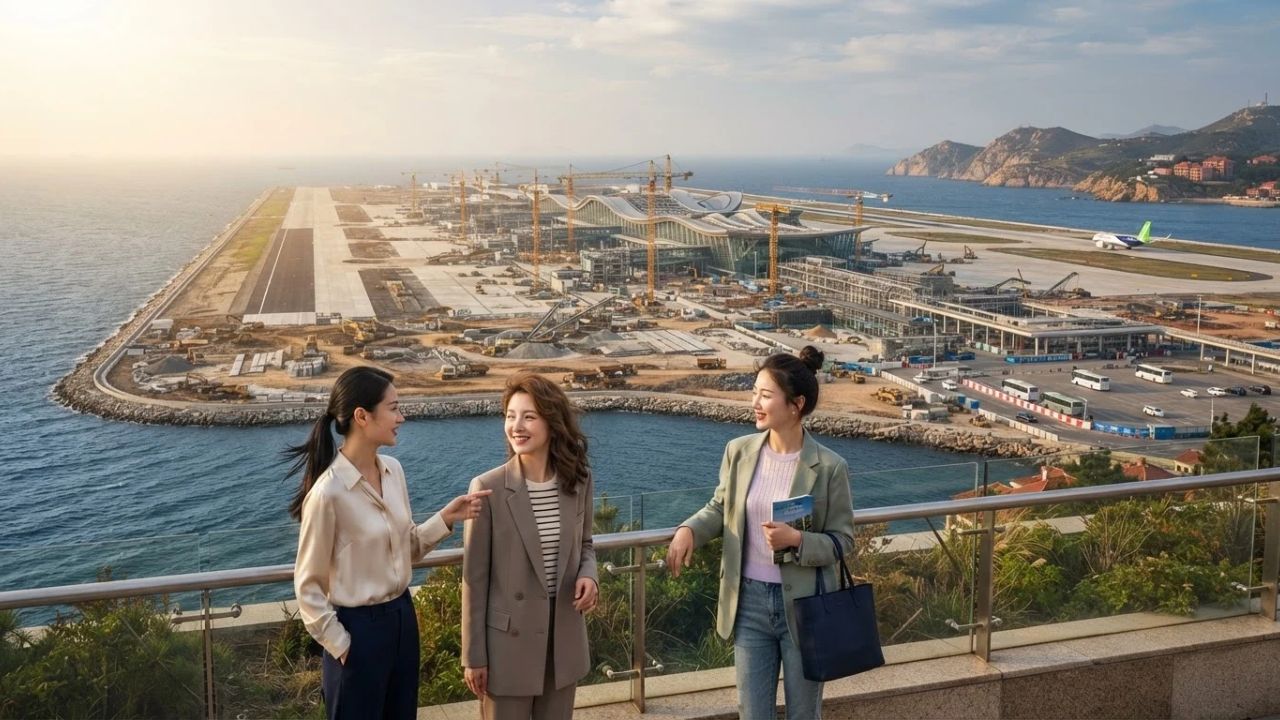
Rising across 20 square kilometres of reclaimed ocean in Jinzhou Bay, China's RMB26.3 billion Dalian Jinzhouwan International Airport is engineered to handle 43 million passengers annually, spearheading an unprecedented wave of marine airport construction across Asia-Pacific coastal hubs. With primary sea reclamation finalized and structural works accelerating, the offshore mega-hub introduces a dual-runway layout designed to break urban land constraints and anchor northeast China's maritime tourism and international trade networks.
The Local Trend Revealed: Coastal Civil Engineering Redefines Asian Aviation
Land-scarce coastal metropolises across East and Southeast Asia are increasingly looking seaward to solve long-term aviation capacity bottlenecks. Leading this transformation is Dalian Jinzhouwan International Airport in Liaoning Province, China. Frequently referred to in international aviation circles as China’s "$4 billion airport in the ocean"—a figure reflecting an approximate currency conversion of its official RMB26.3 billion state-approved budget—the facility represents the world's largest offshore artificial-island aviation development.
With principal reclamation works completed in Jinzhou Bay, construction teams are advancing the initial operational phase. The first phase features two parallel runways: one measuring 3,600 metres and the other 3,400 metres, alongside a passenger terminal spanning approximately 500,000 square metres. Engineered to process 43 million passengers and 550,000 tonnes of cargo and mail annually, the facility secured State Council approval in 2022. Commercial operations are targeted within China's 2026 to 2030 five-year planning horizon, though civil aviation authorities have not finalized an exact opening date.
The offshore installation bypasses the spatial limits of Dalian's existing Zhoushuizi International Airport, which remains Hemmed in by dense residential districts. By shifting flight paths over the Bohai Sea, Dalian eliminates urban noise curfews while opening direct widebody access between Liaoning Province, Japan, South Korea, Europe, and North America.
Asia-Pacific Marine and Reclaimed Airport Projects in 2026
| Airport Project | Location | Scope & Marine Land Formation | Projected Capacity & Target Timeline |
|---|---|---|---|
| Dalian Jinzhouwan | Jinzhou Bay, Liaoning, China | 20 sq km offshore artificial island; 2 runways (3,600m & 3,400m); 500,000 sq m terminal | 43M passengers & 550,000 tonnes cargo; Target 2026–2030 |
| Xiamen Xiang’an | Fujian Province, China | Coastal sea reclamation; terminal works passed quality acceptance in February 2026 | 45M passengers & 750,000 tonnes cargo; Expected opening 2026 |
| Macau International Expansion | Macao SAR | 129.6234 hectares reclaimed sea around existing runway and taxiways; deep cement piles | 13M passengers; Phase 1 completion targeted by 2030 |
| Gadeokdo New Airport | Busan, South Korea | 4M sq m offshore site; 1 runway (3,500m x 45m); 250,000 sq m passenger terminal | Basic design begun March 2026; Official opening target 2035 |
| Sangley Point International | Cavite City, Manila Bay, Philippines | Coastal reclamation; Joint Technical Working Group directed August 2026 | Multi-phase Manila relief gateway; Detailed 2026 metrics pending |
| Maldives Regional Airports | Multiple Atolls (Laamu, Noonu, Haa Alifu, Thaa) | Kadhdhoo/Fonadhoo (144 ha total); Vihafaru (>40 ha); Dhidhdhoo (112 ha); Vilufushi | Island tourism connectivity; 30- to 36-month delivery targets |
| Singapore Changi Terminal 5 | Changi East, Singapore | 50M passenger capacity; built on land reclaimed between 1992 and 2004 | Mid-2030s opening; historical land reclamation benchmark |
China's coastal aviation cluster extends south to Fujian Province, where Xiamen Xiang’an International Airport is slated to open in 2026 after terminal-area structures secured quality completion acceptance in February 2026. Designed for 45 million annual passengers and 750,000 tonnes of air freight, the coastal-reclaimed facility will anchor direct services to Xiamen's historic shipping ports and coastal islands.
In the Macao Special Administrative Region, the Macau International Airport Expansion and Reclamation Project is actively reclaiming 129.6234 hectares of marine seabed surrounding its offshore runway. Using deep cement-mixing piles and hydraulic sand filling, the project expands airfield capacity to 13 million passengers annually by 2030 while incorporating inert construction material recycling and ecological seawalls.
Across the region, other maritime economies are executing similar strategies. South Korea’s Gadeokdo New Airport near Busan—spanning a 4 million square metre marine footprint with a 3,500-metre runway—advanced to basic design in March 2026 under a Daewoo Engineering & Construction consortium, targeting commercial flights in late 2035. In the Philippines, President Ferdinand Marcos Jr issued directives in August 2026 instructing a Joint Technical Working Group—comprising the Department of Transportation, Philippine Reclamation Authority, and Civil Aviation Authority of the Philippines—to fast-track Sangley Point International Airport along Manila Bay. Meanwhile, the Maldives is executing multiple atoll-based sea reclamation airfields, including 114 hectares at Kadhdhoo and 30 hectares at Fonadhoo in Laamu Atoll, over 40 hectares at Vihafaru in Noonu Atoll raised 1.6 metres above sea level, and 112 hectares at Dhidhdhoo in Haa Alifu Atoll.
Cultural & Environmental Value: Ecological Seawalls and Coastal Heritage
Building massive aviation infrastructure over marine waters requires rigorous ecological balance. For the visitor, the impact extends far beyond flight convenience—it reshapes how travelers interact with marine environments and coastal heritage.
In Jinzhou Bay, the Liaoning Provincial Department of Ecology and Environment and maritime engineers have implemented hydrodynamic monitoring to mitigate sediment plumes and protect Bohai Bay fisheries. Runoff filtration systems prevent aircraft de-icing fluids and operational runoff from discharging into coastal waters.
The environmental framework takes cues from the Macao airport expansion, which established benchmark conservation protocols:
- Marine Mammal Protections: Specialized acoustic monitoring and marine exclusion zones protect habitats of the vulnerable Chinese white dolphin during piling operations.
- Living Seawalls and Artificial Reefs: Submerged rock revetments are embedded with stepped concrete cavities that promote benthic algae attachment, shellfish colonization, and fish stocking.
- Circular Material Sourcing: Utilizing non-toxic, inert construction waste for marine filling reduces offshore dredging pressures on regional river estuaries.
On the cultural front, Dalian Jinzhouwan Airport connects international travelers directly to Liaoning's maritime heritage. Dalian sits at the southern tip of the Liaodong Peninsula, where the Yellow Sea meets the Bohai Sea. The region preserves centuries of naval history, Qing dynasty fortifications, and distinct northern Chinese maritime traditions that contrast sharply with southern trading ports.
Visitor Insider Tips: Exploring Dalian and the Liaodong Coastline
For travelers planning a trip to Dalian and Liaoning Province, local knowledge ensures a smooth journey:
- Optimal Visit Windows: Late spring (May to June) and early autumn (September to mid-October) offer comfortable temperatures, clear skies, and calm coastal winds. Avoid traveling during the first week of October, when China's Golden Week holiday produces peak domestic rail and hotel congestion.
- Airport and Rail Transit Logistics: Until Jinzhou Bay opens for commercial operations, commercial flights arrive at Dalian Zhoushuizi International Airport (DLC), located 10 kilometres northwest of the city center. High-speed trains depart Dalian North Railway Station, connecting to Shenyang in two hours and Beijing in under four hours.
- Hidden Heritage Sites:
- Lushunkou (Port Arthur): Located 45 kilometres southwest of central Dalian, this historic naval district features preserved late-19th-century architecture, the Russian-era railway station, and panoramic vistas from Baiyushan Mountain overlooking the naval harbor.
- Bangchuidao Scenic Reserve: A coastal sanctuary in eastern Dalian featuring tranquil pebble beaches, pine-covered cliffs, and historic guesthouses set away from main tourist paths.
- Jinshitan (Golden Pebble Beach) National Geological Park: Located 50 kilometres northeast of downtown, this coastal park showcases 600-million-year-old marine limestone sea stacks, sedimentary wave formations, and quiet walking trails.
- Cultural Etiquette: Respect designated photography rules around Lushun's naval facilities and coastal observation points. When participating in regional banquets, it is customary to wait for senior hosts to initiate communal toasts before taking a sip.
- Local Culinary Specialties:
- Braised Sea Cucumber (Hongshao Haishen): Dalian's signature delicacy, slow-braised with scallions in a savory reduction, renowned for its delicate texture.
- Steamed Dalian Scallops: Freshly harvested local shellfish steamed on the half-shell with minced garlic, spring onions, and glass noodles.
- Grilled Squid (Tieban Youyu): Skewered whole squid seared over iron plates and brushed with fermented bean chili paste, available throughout Sanba Square and Xi'an Road evening food stalls.
- Dalian Crispy Pork (Guobaorou): Double-fried pork tenderloin coated in a light, tangy sweet-and-vinegar glaze, reflecting authentic northeastern Chinese culinary tradition.
Tourism Outlook: Northeast China's Gateway to the Pacific Rim
The completion of Dalian Jinzhouwan International Airport will anchor Liaoning Province as northeast China’s primary international gateway. By integrating 500,000 square metres of passenger terminal space with direct high-speed rail connections and Bohai ferry lines, the new hub will streamline multimodal journeys for millions of travelers.
As regional airports in Xiamen, Macao, Busan, and Manila expand their maritime footprints, the Dalian ocean airport demonstrates how next-generation civil engineering can unlock regional tourism, preserve marine ecosystems through strict environmental oversight, and connect remote global travelers to China's storied northern coastline.
Related Travel Guides
Disclaimer
This article is for informational and educational purposes only. It does not constitute legal, financial, or professional advice. While we strive to provide accurate and up-to-date information, travel policies, regulations, and conditions change rapidly. Always verify information with official sources before making travel decisions. Nomad Lawyer makes no representations about the accuracy, reliability, completeness, or suitability of the information provided. Readers should consult qualified professionals for advice specific to their circumstances. The views expressed in this article are those of the author and do not necessarily reflect the views of Nomad Lawyer.
Naina Thakur
Contributor & Travel Specialist
Travel enthusiast and legal writer covering visa regulations, responsible tourism, and cultural journeys across global destinations.
Learn more about our team →