
Chicago Midway Meltdown: 88 Severe Delays and 16 Cancellations Crush Southwest Operations
A cascading wave of severe weather delays at Chicago Midway International Airport has generated massive friction for Southwest Airlines, derailing flights across the United States and Mexico.

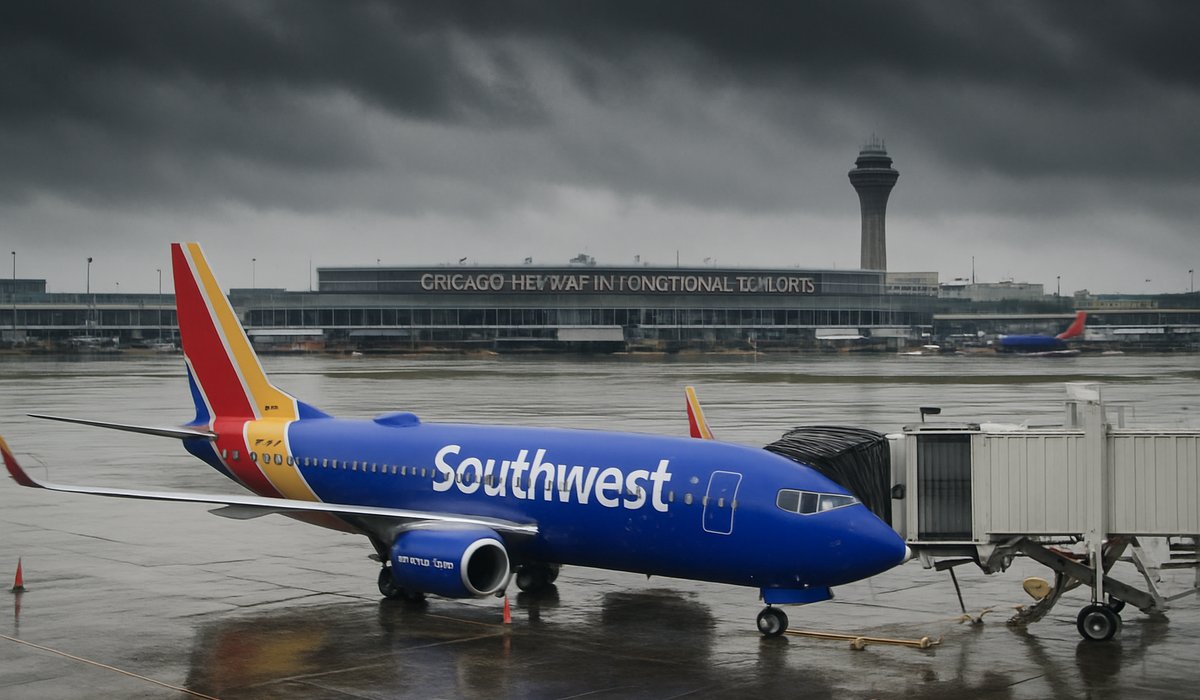
Image generated by AI
The Midwest Fortress Squeezed
Inflicting heavy operational pain on the absolute logistical beating heart of Southwest Airlines' immensely lucrative Midwest network, Chicago Midway International Airport (MDW) has sustained a deep, rapidly compounding wave of flight delays and specific groundings. On a highly complex travel day in early April 2026, the incredibly concentrated Illinois transport hub recorded a severe spasm of operational friction driven completely by raw, unyielding bad weather. The physical telemetry extracted from the massive FAA data stream is mathematically alarming: 88 severe rolling delays stacked aggressively alongside 16 absolute flight cancellations. This disruption heavily targeted Southwest Airlines, alongside Delta and ultra-low-cost carrier Volaris.
The core vulnerability exposed by this specific failure is the highly unique physical footprint of Midway Airport compared to its massive neighbor, O'Hare. Midway functions exactly like an aircraft carrier deck—an incredibly compact, square-mile footprint completely surrounded by dense urban neighborhoods. When severe weather forces air traffic control to mathematically restrict incoming landing flow to ensure safe separation, Midway saturates remarkably fast. There is literally zero physical tarmac space to permanently "park" delayed inbound widebody aircraft. They must circle in holding patterns over Lake Michigan until a physical gate is finally vacated by an outbound jet pushing back.
The Trans-Continental Ripple
The absolute devastation exposed heavily punishes the highly fragile network of Southwest's point-to-point routing architecture.
When a Midway ground halt functionally traps aircraft, those exact planes essentially vaporize from the national matrix. A Southwest Airlines jet completely designated to execute a quick noon departure from Chicago to Denver, and then subsequently execute a fast evening block to Cancun, Mexico, is entirely frozen. Travelers essentially sitting in completely functioning weather nodes in Colorado suddenly discover their highly specific sunset international jump is totally destroyed because their physical aircraft is trapped behind highly disrupted ground operations essentially 1,000 miles away in Illinois. This specific Midwest disruption rapidly heavily stranded travelers completely bound for Miami, Dallas, New York, and Toronto.
The Midway Disruption Matrix (April 2026)
| Target Airline Protocol | The Specific Terminal Failure | The Geographic Reality |
|---|---|---|
| Southwest Airlines Focus | Total structural delay of massive localized Central routing. | Obliteration of massive mid-continent hop connectivity. |
| Volaris Vulnerability | Mexican transborder feeding lines suppressed. | Forceful isolation from essential leisure hubs (Cancun). |
| The Ripple Effect | Deceptive rolling delays compounding throughout the afternoon. | Eradication of thousands of precisely timed passenger connections. |
What Guests Get
- Redefining 'The Point-to-Point Risk' — realizing that utilizing incredibly fast Southwest plane rotations mathematically isolates you aggressively when the massive central hub (Chicago) experiences a massive internal weather delay.
- The destruction of 'The Efficient Jump' — grasping that highly lucrative, short-haul business commuter flights (like Chicago to Dallas) completely evaporate during system gridlock, deeply trapping corporate travelers.
- Micro-economic terminal gridlock — understanding that an airport delay of this magnitude instantly completely overwhelms Midway's incredibly compact Triangle food court, creating a suffocating environment for massive rebooking.
What This Means for Travelers
If you are trapped executing a flight out of Midway during a massive delay: You must execute immediate, highly disciplined self-reliance. Do absolutely not wait passively in the massive concourse lines for Southwest customer service agents. If your flight is severely delayed or physically canceled, completely abandon the central human rebooking queue. Open your smartphone, cleanly navigate to the airline's official app, and violently battle the digital rebooking engine. If Midway is completely ruined, pull open a competitor's app (like United or American) and evaluate purchasing an absolutely brand-new walk-up ticket physically departing from O'Hare (ORD) to completely bypass the localized Southwest network failure.
Surviving The US DOT Hotel Reality: If your canceled or massively delayed Midway flight completely ruins your connection, you must immediately understand the mathematical limits of federal protection. Because this massive Midway gridlock is explicitly officially classified as an uncontrollable "weather event," Southwest Airlines is completely shielded by US DOT passenger laws from physically paying for your Chicago airport hotel. You are uniquely financially liable for your own emergency survival.
FAQ: Decrypting the Chicago Airport Trap
Why does MDW predominantly severely impact Southwest operations? Chicago Midway Airport is the mathematical beating heart of the Southwest Airlines domestic empire. They physically control overwhelming majority of the physical terminal gates. When airspace or ground constraints hit MDW, Southwest mathematically absorbs the overwhelming, catastrophic majority of the physical pain because they execute the highest immense volume of flights there.
Is it better to route through Chicago O'Hare (ORD) or Midway (MDW) during bad weather? O'Hare (ORD) possesses massive, staggering physical runway redundancy (eight massive intersecting runways) compared to Midway's tiny, constrained 'X' layout. During high-wind and severe weather anomalies, O'Hare mathematically can frequently continue landing jets slowly, whereas Midway frequently executes complete ground stops far faster due to raw physical limitations.
Does airline elite status help during a massive weather delay? It provides exactly one distinct mathematical advantage: elite members are placed massively higher on the automated digital rebooking priority list for the incredibly few physical seats remaining on the next outbound jet. It does not magically create a new airplane or clear a freezing rain storm.
External Resources
- Chicago Midway International Airport (MDW) Official Status
- FlightAware Live tracking data
- US Department of Transportation Aviation Consumer Protection
Related Travel Guides
- USA Aviation Crisis Explodes: 114 Flight Cancellations and 3,440 Delays Create Nationwide Chaos Across 27 Major Airports Including New York, Los Angeles, Miami, Atlanta, Orlando, Seattle with Delta, American, Southwest Affected
- Dubai Unveils Powerful 80km Fourth Corridor To Transform Travel With 60% Faster Journeys Across UAE
- American Airlines Backs Commercial Service Return to Marathon International Airport MTH Florida Keys for 2027
Disclaimer
This article is for informational and educational purposes only. It does not constitute legal, financial, or professional advice. While we strive to provide accurate and up-to-date information, travel policies, regulations, and conditions change rapidly. Always verify information with official sources before making travel decisions. Nomad Lawyer makes no representations about the accuracy, reliability, completeness, or suitability of the information provided. Readers should consult qualified professionals for advice specific to their circumstances. The views expressed in this article are those of the author and do not necessarily reflect the views of Nomad Lawyer.
Raushan Kumar
Founder & Lead Developer
Full-stack developer with 11+ years of experience and a passionate traveller. Raushan built Nomad Lawyer from the ground up with a vision to create the best travel and law experience on the web.
Learn more about our team →