
Aviation Updates: Travel Chaos Engulfs Charlotte Airport as American Airlines Suffers 243 Delays
Charlotte Douglas International Airport buckles under extreme operational congestion, delaying 243 flights across the American Airlines, Delta, and United networks.

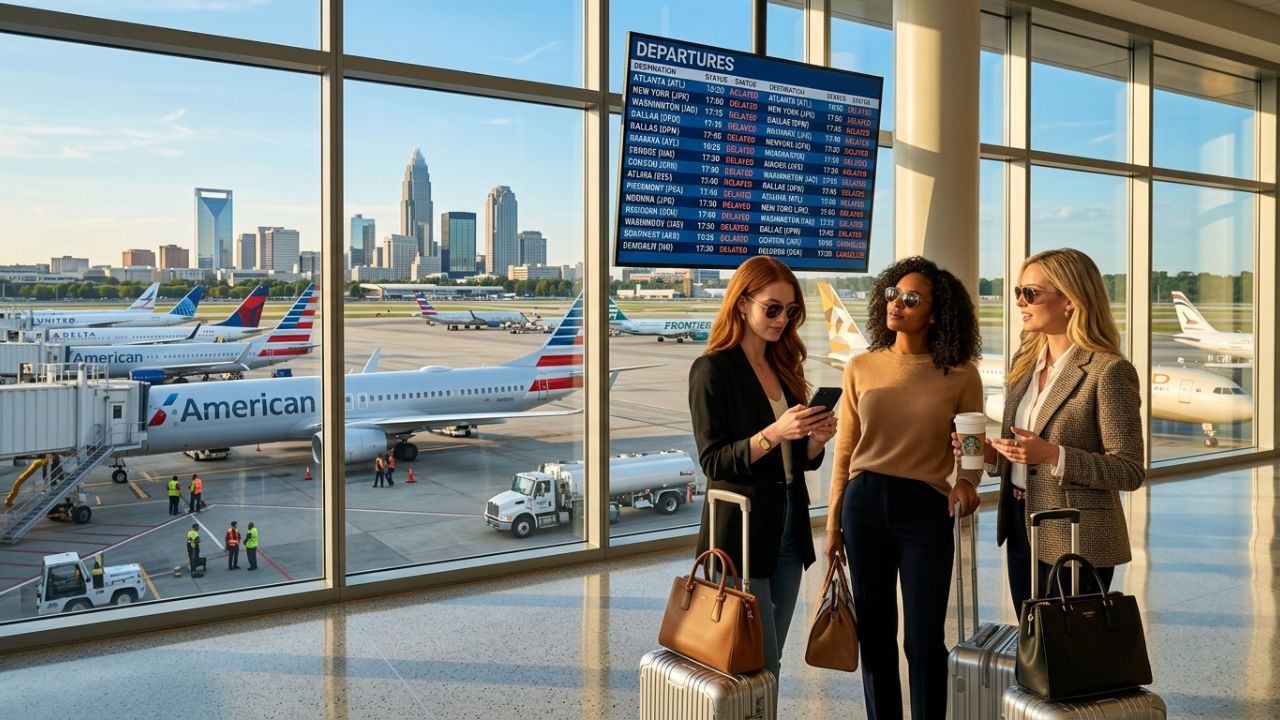
Image generated by AI
Aviation Updates: Travel Chaos Engulfs Charlotte Airport as American Airlines Suffers 243 Delays
A severe operational bottleneck at a critical US Southeastern hub has proven that maintaining zero cancellations frequently results in massive, rolling schedule degradation.
Image generated by AI
Severe airport disruptions have violently fractured domestic connectivity across the Southeastern United States as a massive wave of congestion paralyzed operations at Charlotte Douglas International Airport (CLT). According to the absolute latest airline news and integrated US aviation system data, the critical transit hub registered a staggering 243 flight delays during a single operational cycle, making it one of the most disrupted airports in the country. Remarkably, despite the extreme travel chaos, the airport recorded exactly zero flight cancellations. Instead of grounding aircraft, airlines—heavily led by American Airlines, Delta Air Lines, United Airlines, and Southwest Airlines—opted to aggressively force traffic through the congested terminal, resulting in agonizing, rolling delays. This rapid decline in flight turnaround efficiency severely impacted major domestic corridors, stranding tens of thousands of passengers bound for absolutely critical hubs including Atlanta, New York, Chicago, Dallas, and Washington DC.
Expanded Overview: The Zero Cancellation Anomaly
When analyzing major aviation updates, an operational scenario featuring 243 delays and zero cancellations is incredibly telling regarding an airline's hub strategy.
Charlotte Douglas is structured on a massive, highly sensitive hub-and-spoke system where the vast majority of operations are laser-focused on connecting passengers to the major cities of the Continental United States. By utilizing advanced air traffic control telemetry and the airport’s internal flow management system, it is clear that the facility reached its absolute maximum movement density. Rather than executing outright cancellations—which instantly displace passengers and require massive financial compensation—airlines operating at CLT chose to sacrifice punctuality entirely. They prioritized keeping the schedule intact, meaning aircraft were forced into extended holding patterns or held at the gate, actively pushing the entire daily schedule hours into the red.
Section-Wise Breakdown: The American Airlines Hub Squeeze
The delay distribution at Charlotte was not evenly spread; it heavily targeted the airport's dominant operator.
American Airlines absolutely absorbed the brunt of this operational friction. The mainline carrier alone accounted for a staggering 126 delayed flights, making it the most heavily impacted operator of the day. Because American Airlines manages a massive share of domestic departures and arrivals at CLT, any degradation in turnaround efficiency instantly corrupts its national network. The damage also heavily infected American's regional affiliates. PSA Airlines recorded an agonizing 64 delays, while Piedmont Airlines reported 29 delayed flights. Because these regional carriers actively operate the critical feeder routes pushing passengers into Charlotte, the disruption quickly cascaded backward, choking smaller US airports attempting to push aircraft into the hub.
Section-Wise Breakdown: Widespread Network Contagion
While American Airlines suffered the highest volume of delays, the sheer scale of the congestion aggressively spilled over to infect virtually every other carrier on the tarmac.
Smaller regional operators providing essential feeder traffic were caught in the gridlock, with Contour Airlines logging 4 delays, SkyWest Airlines suffering 3, and Republic Airways recording 2. Furthermore, the massive national competitors utilizing CLT as a spoke rather than a hub also suffered schedule degradation. Frontier Airlines (6 delays), Mesa operating for United Express (3 delays), Southwest Airlines (2 delays), Delta Air Lines (1 delay), and United Airlines (1 delay) all experienced severe turnaround friction. Even the international sector felt the ripple effect, with Etihad Airways recording a minor delay, proving that Charlotte's terminal congestion actively reaches long-haul operations.
Flight Details: Charlotte Airport (CLT) Delay Matrix
The exact operational telemetry outlining this sprawling breakdown, detailing the specific delay counts for every affected carrier, has been consolidated into the mandatory matrix below.
Charlotte Airport (CLT) Delay Matrix
| Airline / Operator | Delayed Flights |
|---|---|
| American Airlines | 126 |
| PSA Airlines (AAL affiliate) | 64 |
| Piedmont (AAL affiliate) | 29 |
| Frontier Airlines | 6 |
| Contour Airlines | 4 |
| SkyWest Airlines | 3 |
| Mesa (United Express) | 3 |
| Republic Airways | 2 |
| Southwest Airlines | 2 |
| United Airlines | 1 |
| Delta Air Lines | 1 |
| Sun Country Airlines | 1 |
| Etihad Airways | 1 |
Passenger Impact: Tens of Thousands Stranded
While the exact passenger headcount was not officially disclosed in the dataset, standard aviation operational averages dictate that each delayed flight at a major hub impacts between 80 and 180 passengers, depending on aircraft configuration.
Based on the 243 delayed movements, it is estimated that tens of thousands of travelers experienced intense schedule disruption. Because Charlotte operates as a primary gateway for both leisure and business travel across the Southeastern US, the impact was severe. Passengers traveling to destinations across North Carolina, South Carolina, Florida, and Tennessee experienced heavily extended ground delays and aggressively missed connections. Business travelers relying on American Airlines to reach major financial centers like New York, Dallas, and Chicago were severely delayed, while leisure passengers suffered knock-on delays affecting hotel check-ins and vital cruise connections.
Industry Analysis: FAA Sequencing and Congestion Limits
Aviation strategists monitoring the US airspace note that the situation at Charlotte perfectly illustrates standard FAA airport traffic flow management principles.
While no official cause (such as extreme weather) was confirmed, the scale of the delays strongly points to systemic congestion driven by high aircraft movement density and departure sequencing constraints. When an airport operating at peak capacity suffers a minor disruption—such as a crew rotation mismatch or localized gate unavailability—the hub-and-spoke system instantly bottlenecks. Flights arriving late into Charlotte cannot secure a gate, forcing departing flights to hold on the tarmac. This creates a massive ripple effect that propagates across the entire US aviation network, degrading schedule integrity nationwide.
Conclusion: Efficiency Sacrificed for Continuity
Ultimately, the severe travel chaos recorded at Charlotte Douglas International Airport perfectly highlights the extreme vulnerability of highly concentrated aviation hubs. By absorbing 243 flight delays and executing exactly zero flight cancellations, the airport proved that maintaining operational continuity often comes at the absolute expense of punctuality. American Airlines and its regional affiliates (PSA and Piedmont) absorbed the vast majority of the damage, heavily delaying passengers bound for major cities like Atlanta, Washington DC, and Chicago. As air traffic volumes continue to surge, airports like CLT will require massive, much-needed upgrades to gate management and air traffic control sequencing to prevent these sprawling, systemic delays from becoming a daily occurrence in the US domestic market.
Key Takeaways
- Massive Congestion: Charlotte Douglas International Airport (CLT) registered an incredible 243 flight delays in a single day.
- Zero Cancellations: Despite the extreme travel chaos and terminal congestion, exactly zero flights were officially cancelled.
- American Airlines Battered: American Airlines (126 delays) and its regional affiliates, PSA (64 delays) and Piedmont (29 delays), accounted for the vast majority of the disruptions.
- Widespread Impact: The delays impacted major US metropolitan corridors, disrupting travel to Atlanta, New York, Chicago, Dallas, and Washington DC.
- Systemic Bottleneck: The disruption was driven by extreme terminal congestion, gate availability constraints, and departure sequencing friction.
FAQ: Charlotte Airport Flight Delays 2026
How many flights were delayed at Charlotte Douglas International Airport? During this specific operational breakdown, the airport officially recorded 243 flight delays and exactly zero flight cancellations.
Which airline suffered the most delays at Charlotte Airport? American Airlines was the most heavily disrupted operator, recording 126 mainline delays, while its regional affiliates PSA Airlines and Piedmont Airlines recorded 64 and 29 delays respectively.
Why were there so many delays but no cancellations at Charlotte? Airlines prioritized maintaining operational continuity over punctuality, choosing to force traffic through the congested hub and absorb rolling delays rather than cancelling flights and displacing passengers entirely.
Related Travel Guides
United Airlines Denver Turks and Caicos Route Expansion 2026
Vancouver International Airport Delays Air Canada Lufthansa Travel Chaos 2026
US Domestic Hub Flight Delay Passenger Compensation Guide 2026
Disclaimer: This article is strictly for informational purposes. The delay statistics (243 total delays), cancellation figures (0 cancellations), specific destination impacts, and the comprehensive airline breakdown matrix (American Airlines, Delta, United, etc.) are based on real-time data sourced directly from FlightAware for operations at Charlotte Douglas International Airport (CLT) at the time of publication. Airline schedules, airspace flow restrictions, and terminal gate availability are highly dynamic and subject to continuous modification by the FAA and individual carriers. Passengers must proactively verify their exact flight status and review their carrier’s rebooking policies before arriving at the terminal.
Disclaimer
This article is for informational and educational purposes only. It does not constitute legal, financial, or professional advice. While we strive to provide accurate and up-to-date information, travel policies, regulations, and conditions change rapidly. Always verify information with official sources before making travel decisions. Nomad Lawyer makes no representations about the accuracy, reliability, completeness, or suitability of the information provided. Readers should consult qualified professionals for advice specific to their circumstances. The views expressed in this article are those of the author and do not necessarily reflect the views of Nomad Lawyer.
Kunal K Choudhary
Co-Founder & Contributor
A passionate traveller and tech enthusiast. Kunal contributes to the vision and growth of Nomad Lawyer, bringing fresh perspectives and driving the community forward.
Learn more about our team →