
Charles de Gaulle Airport Chaos: Air France, easyJet Ground 11 Flights, 300+ Delays Hit Paris-Nice Routes June 2026
Air France, HOP!, Lufthansa, KLM, and easyJet face massive operational meltdown at Paris CDG and Nice airports, canceling 11 flights and creating 300+ delays across France's busiest aviation hub.

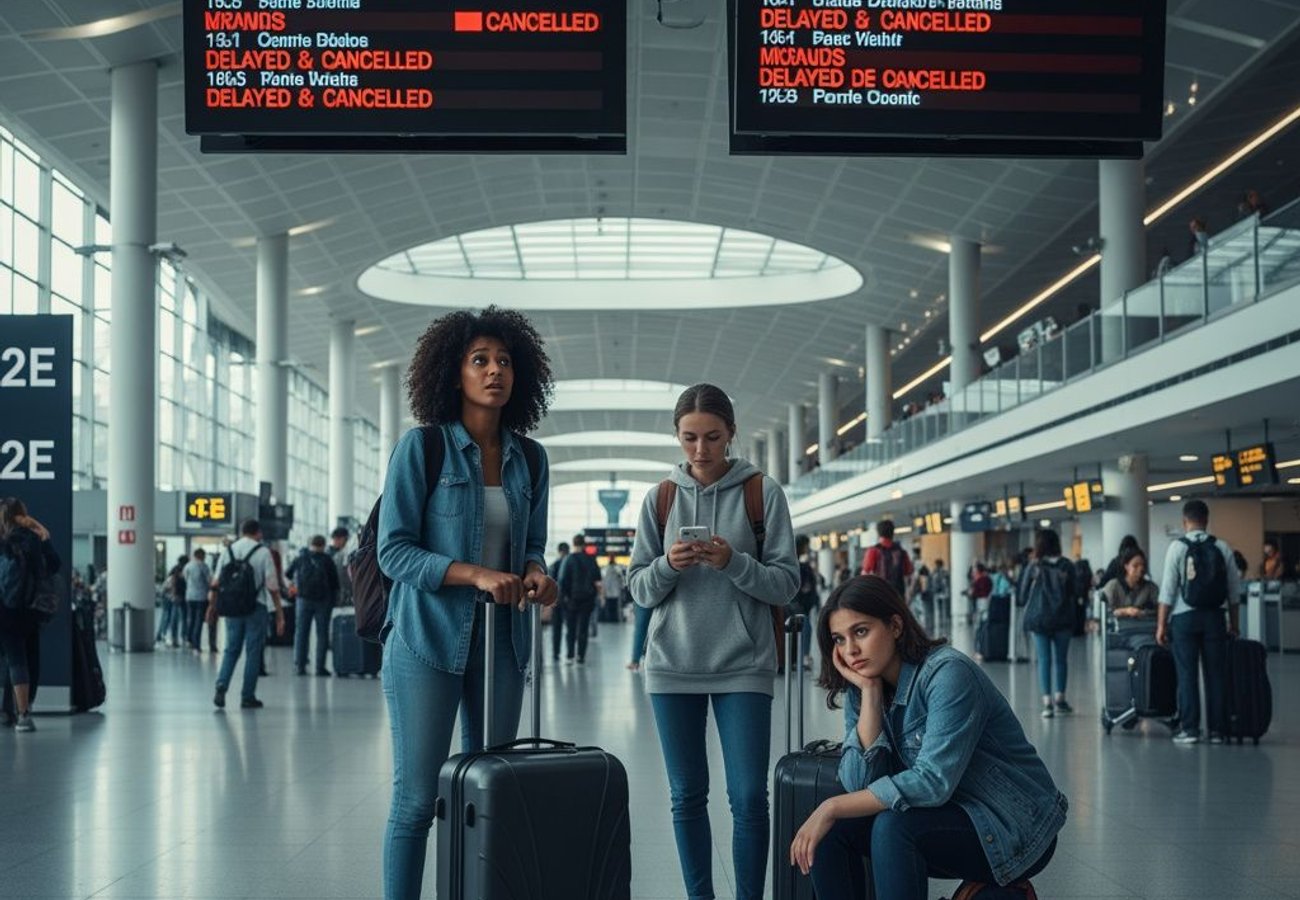
Image generated by AI
Massive Operational Meltdown Paralyzes Two of France's Busiest Airports
On June 19, 2026, the aviation network across France ground to a near-halt as Charles de Gaulle/Roissy Airport (CDG) in Paris and Nice Côte d'Azur Airport (NCE) descended into operational chaos. Multiple carriers—including Air France, HOP!, Lufthansa, KLM, Delta Air Lines, and easyJet—simultaneously faced cascading failures that left thousands of passengers stranded, rebooking frantically, or abandoning their travel plans entirely.
The numbers tell a grim story: 11 flights were grounded outright, while more than 300 additional flights faced delays across the two hubs. For context, CDG alone processes over 70 million passengers annually, making this disruption one of the most consequential operational failures of the travel season.
Reddit: "Stuck at CDG for 8 hours. Air France says it's a 'system issue,' but won't explain what that means. No rebooking, no real answers. Just chaos." — r/travel
The Numbers Behind the Chaos
Air France bore the brunt of the crisis, canceling 4 flights while managing 191 delayed departures—an astronomical figure that suggests systemic rather than isolated failures. HOP!, the regional carrier and Air France subsidiary, added 2 cancellations and 35 delays to the tally.
The domino effect rippled outward. Delta Air Lines grounded 2 flights with 11 delays. Lufthansa canceled 1 flight while tracking 10 delays. At Nice Côte d'Azur, KLM canceled 1 flight with 5 delays, while easyJet—operating on a razor-thin margin already—canceled 1 flight but faced the staggering burden of 53 delays.
The concentrated nature of these cancellations at Europe's second-busiest airport hub (after London Heathrow) meant that recovery wasn't simply a matter of waiting a few hours. Passengers on domestic routes to Paris and the French Riviera faced cascading missed connections, while international travelers heading to London, Amsterdam, Frankfurt, and beyond watched their itineraries unravel in real-time.
What Triggered the Perfect Storm?
While airlines remained characteristically vague about root causes—citing "operational challenges" without specificity—the sheer scale of simultaneous disruptions suggests a failure of airport infrastructure, air traffic control capacity, or ground handling services rather than individual airline issues.
CDG operates three parallel runways and handles roughly 1,500 aircraft movements daily. When those systems contract, even minor inefficiencies cascade exponentially. A FlightAware analysis of the June 19 disruptions indicated that delays began clustering mid-morning and intensified through the afternoon, consistent with a bottleneck rather than isolated mechanical failures.
The timing proved brutal for summer travel season ramping up. June 19 fell squarely in the first major European vacation push of the year, meaning airports were already operating at or near capacity. When slack vanishes, disruption hits like a shock.
Passengers Left to Fend For Themselves
What angered travelers most wasn't the disruption itself—airline operations are unpredictable—but the communication vacuum. Thousands of passengers arrived at CDG and Nice to discover their flights canceled or delayed by 3+ hours with minimal advance notice.
Reddit: "easyJet's app crashed right when flights got grounded. Customer service line hit a 2-hour wait. This is unacceptable in 2026." — r/travel
The customer experience collapsed across all carriers. Long queues formed at service desks. Online rebooking systems became overwhelmed. Phone lines registered perpetual busy signals. Airlines prioritized their own crew positioning and aircraft availability over passenger convenience—a standard practice during crises, but one that left families, business travelers, and tourists scrambling for alternative transport.
Your Rights When Your Flight Gets Cancelled
If you were affected on June 19 or face similar disruptions, EU regulations provide concrete protections. Under EU Regulation 261/2004, passengers are entitled to:
- Reaccommodation on the next available flight at no additional cost
- Compensation of €250–€600 depending on flight distance (if the airline caused the cancellation and didn't provide 14 days' notice)
- Care and assistance including meals, refreshments, and hotel accommodation for overnight delays
Beyond regulatory minimums, know these actionable steps:
Immediate Response
Contact your airline's customer service in person at the airport or via phone/chat. Avoid email in the moment—responses take days. In-airport service desks have live rebooking authority; remote channels operate with delays.
Documentation
Retain your original booking confirmation, boarding pass, and any receipts for alternative transportation, meals, or accommodation. Photograph departure boards showing "CANCELLED" status. These become evidence for compensation claims.
Alternative Transport
If rebooking delays stretch beyond 2-3 hours, request the airline book you on competitor flights. Under EU law, airlines must pay for equivalent transport on other carriers. easyJet, Air France, and KLM have reciprocal agreements for this purpose.
Compensation Claims
Don't rely on airlines to proactively compensate. File claims directly with the carrier or use specialized compensation services that operate on no-win/no-fee models. EU-based passengers should reference their booking reference and claim number 261/2004.
The Broader Pattern: Summer 2026 Chaos
June 19's collapse at CDG and Nice wasn't isolated. European airports have endured sequential crises throughout spring and early summer 2026—staffing shortages, ground handling delays, air traffic control bottlenecks, and weather disruptions. London Gatwick, Amsterdam Schiphol, Frankfurt, and Rome Fiumicino all reported significant disruptions in the preceding weeks.
The systemic issue: European aviation infrastructure hasn't scaled to match post-pandemic travel demand. Airports invested heavily in terminal renovations but underinvested in operational capacity—staffing, ground handling, and air traffic control automation. The result is a summer of recurring chaos.
For travelers, the lesson is uncomfortable but clear: build buffer time between connecting flights (minimum 2.5 hours for international connections through major hubs), purchase travel insurance that covers carrier-caused disruptions, and maintain flexibility with hotel bookings and onward reservations.
Recovery and Moving Forward
By evening on June 19, airlines began restoring normalcy. The 191 Air France delays gradually cleared as aircraft cycled through the airport. By the following morning, operations had largely normalized, though passengers continued facing knock-on effects—crew positioning issues, aircraft out of position, and cascading downstream delays.
Airlines and CDG committed to root-cause analysis, though such commitments rarely translate to visible improvements within months. European aviation operates with structural capacity constraints that require years of infrastructure investment to resolve.
For now, expect similar disruptions throughout peak summer travel season. Monitor your flights obsessively via FlightAware or airline apps rather than relying on notifications. Arrive at major European hubs 3+ hours before departure. And know your rights—EU regulation 261/2004 exists precisely because disruptions like June 19 happen regularly.
Stay flexible, document everything, and never assume an airline will voluntarily compensate you.
Related Travel Guides
Disclaimer
This article is for informational and educational purposes only. It does not constitute legal, financial, or professional advice. While we strive to provide accurate and up-to-date information, travel policies, regulations, and conditions change rapidly. Always verify information with official sources before making travel decisions. Nomad Lawyer makes no representations about the accuracy, reliability, completeness, or suitability of the information provided. Readers should consult qualified professionals for advice specific to their circumstances. The views expressed in this article are those of the author and do not necessarily reflect the views of Nomad Lawyer.
Kunal K Choudhary
Co-Founder & Contributor
A passionate traveller and tech enthusiast. Kunal contributes to the vision and growth of Nomad Lawyer, bringing fresh perspectives and driving the community forward.
Learn more about our team →