
Cruise Updates: Carnival Corporation Expands 'Less Left Over' Programme in the Dominican Republic Amid Global Travel Chaos
As airport disruptions plague traditional travel, Carnival Corporation bolsters Caribbean sustainability by expanding its surplus food donation programme to Puerto Plata.

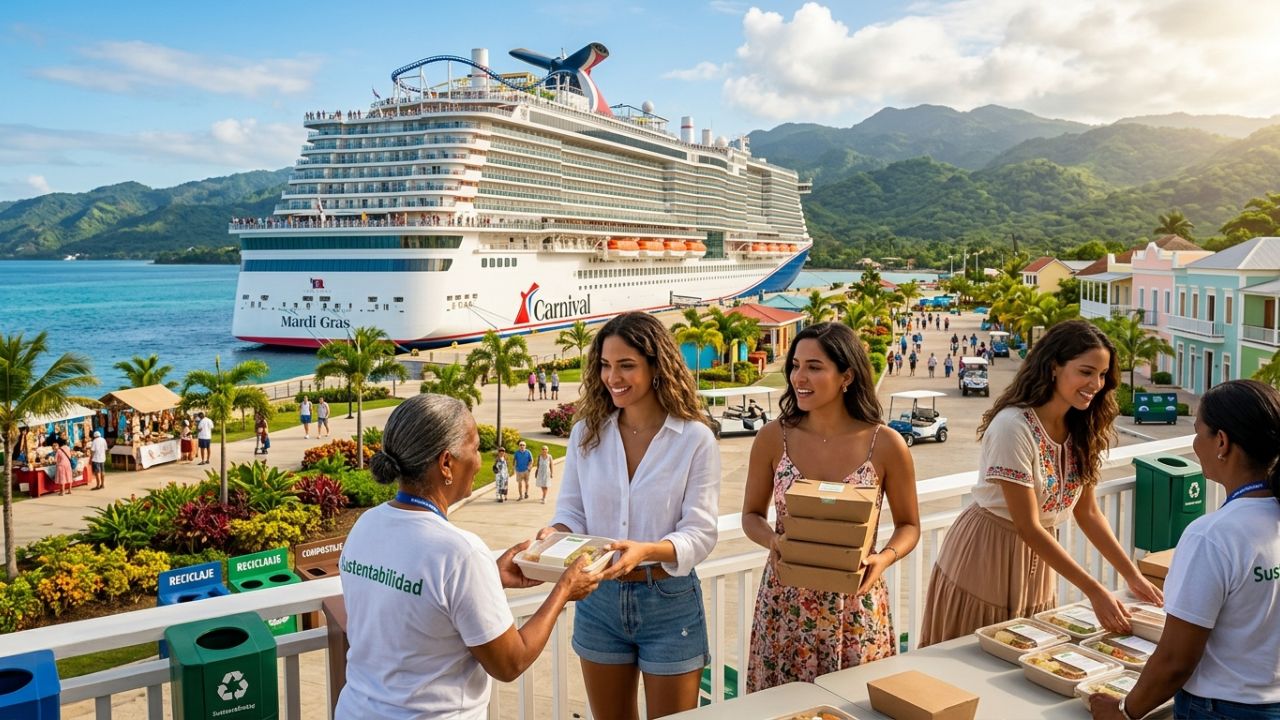
Image generated by AI
Cruise Updates: Carnival Corporation Expands 'Less Left Over' Programme in the Dominican Republic Amid Global Travel Chaos
While the terrestrial travel industry struggles with brutal operational friction, the global cruise sector continues to leverage its massive, highly stable logistics networks to actively support vulnerable Caribbean communities.
Image generated by AI
As peak-season airline news and strategic aviation updates continue to focus almost exclusively on massive airport disruptions and crippling flight cancellations, the global cruise sector is demonstrating incredibly robust operational stability and community focus. Global maritime heavyweight Carnival Corporation has officially expanded its highly successful surplus meal donation programme into the Dominican Republic. This initiative, a core pillar of the company’s massive “Less Left Over” food sustainability strategy, marks a profound evolution in how modern cruise operators manage onboard logistics. By completely redirecting massive volumes of prepared, untouched meals from its massive floating resorts to local organizations supporting vulnerable families, Carnival is actively bridging the gap between luxury travel and critical community support. As travelers increasingly pivot to cruise vacations to escape terrestrial travel chaos, this initiative proves that the maritime industry’s highly regulated, ultra-efficient logistics network can successfully deliver direct, measurable humanitarian aid across Latin America.
Expanded Overview: The "Less Left Over" Logistics Strategy
When analyzing sustainable tourism practices, managing onboard food logistics is one of the absolute greatest operational challenges facing the global cruise industry.
Massive cruise ships are required to prepare immense volumes of food to satisfy thousands of passengers operating on highly dynamic schedules. Historically, untouched surplus food generated massive environmental waste. Carnival Corporation’s “Less Left Over” strategy completely rewrites this operational standard. Launched globally in 2017, the programme establishes highly structured donation systems that ensure safe, unserved meals are rapidly redistributed ashore rather than being discarded at sea. By expanding this highly complex logistical operation to the Dominican Republic—making it the second Latin American country to join the network—Carnival is permanently embedding food sustainability directly into the core of its Caribbean operations.
Section-Wise Breakdown: The Amber Cove and Puerto Plata Hub
The absolute epicenter for this massive Caribbean rollout is the port of Amber Cove, located in the northern region of Puerto Plata.
Amber Cove was developed in 2015 following a massive $85 million investment strategy designed to revitalize cruise traffic to the northern Dominican coastline. Under this new initiative, the port now functions as a highly controlled logistics hub for food redistribution. During the initial implementation phase, the flagship cruise vessel Mardi Gras successfully offloaded approximately 200 portions of prepared, unserved meals. These high-quality meals were transferred directly to the Archdiocese of Puerto Plata, which serves as the primary local distribution partner. The Archdiocese actively coordinates with localized community groups to ensure the food reaches vulnerable families and elderly residents immediately upon the ship's arrival, maintaining strict temperature and food safety protocols throughout the transfer.
Section-Wise Breakdown: Government Coordination and FAO Standards
Executing a logistics operation of this magnitude requires absolute cooperation between corporate maritime entities and sovereign governments.
Vicky Rey, the Vice President of Government Relations for Latin America at Carnival Corporation, explicitly confirmed that this expansion absolutely requires "clear processes, strong coordination with government and local partners, and a shared commitment." By operating under the strict regulatory oversight of Dominican Republic tourism authorities and municipal health boards, the programme ensures total compliance with international food safety frameworks. Furthermore, this highly regulated redistribution model perfectly aligns with global sustainability guidelines supported by the United Nations Food and Agriculture Organization (FAO), which actively encourages the safe redistribution of surplus food to permanently stabilize food security in tourism-heavy regions.
Cruise Details: Carnival Corporation "Less Left Over" Dominican Republic Matrix
The exact operational telemetry outlining this highly structured sustainability initiative, including the regional market metrics and specific donation statistics, has been consolidated into the mandatory matrix below.
Carnival Corporation "Less Left Over" Dominican Republic Matrix
| Operational Metric | Program Data & Impact Statistics |
|---|---|
| Cruise Operator | Carnival Corporation |
| Sustainability Initiative | "Less Left Over" |
| Primary Hub | Amber Cove, Puerto Plata (Dominican Republic) |
| Local Distribution Partner | Archdiocese of Puerto Plata |
| Initial Donation Volume | ~200 meal portions (via Mardi Gras vessel) |
| Global Program Launch | 2017 (Now active in 19 ports globally) |
| Total Global Donations | >320,000 meal portions (by end of 2025) |
| DR Market Share | ~50% (>1.3 million passengers in 2026) |
Community Impact: Bridging Nutritional Gaps
For the local populations residing in Puerto Plata, the immediate impact of this highly coordinated initiative is the direct stabilization of food-insecure households.
Tourism development frequently creates massive wealth disparities within port cities. By physically redistributing luxury surplus meals from the cruise ships into the local community, the "Less Left Over" programme actively bridges this gap. Elderly populations and vulnerable families receive high-quality nutritional support directly subsidized by the cruise operation. Local authorities strongly support these public-private partnerships, recognizing that integrating high-yield tourism with direct social development objectives is the absolute most effective national strategy to ensure the local population tangibly benefits from international cruise traffic.
Industry Analysis: Carnival's 50% Market Dominance
Maritime strategists note that the success of this programme is deeply tied to Carnival Corporation’s absolute dominance within the Dominican Republic cruise sector.
Operating eight global cruise brands across six distinct Dominican ports, Carnival is projected to bring more than 1.3 million passengers into the country in 2026 alone. This volume grants the corporation a massive 50 percent market share, making it the most powerful force in shaping Caribbean tourism flows. Because the "Less Left Over" programme is expected to rapidly expand to all Carnival Cruise Line ships calling at Amber Cove, the volume of redistributed food will scale exponentially. Furthermore, this highly successful framework is now positioned as a definitive benchmark for the entire industry, with similar redistribution models expected to launch across other major Caribbean destinations, including Jamaica, the Bahamas, and Puerto Rico.
Conclusion: A Benchmark for Sustainable Cruising
Ultimately, Carnival Corporation’s expansion of the "Less Left Over" programme into Puerto Plata permanently alters the relationship between massive cruise operators and destination communities. By successfully redirecting unserved meals from vessels like the Mardi Gras to the Archdiocese of Puerto Plata, the company proves that sustainable, highly regulated logistics can directly combat food insecurity. While the terrestrial travel industry remains bogged down by flight cancellations and crippling travel chaos, Carnival is utilizing its massive 50% Dominican market share to execute complex humanitarian logistics. Having already donated over 320,000 meals globally across 19 ports since 2017, this initiative officially establishes the Dominican Republic as the absolute benchmark for sustainable, socially responsible cruise operations across Latin America and the Caribbean.
Key Takeaways
- Programme Expansion: Carnival Corporation successfully expanded its "Less Left Over" surplus food donation programme to the Dominican Republic.
- Logistics Hub: The initiative is heavily centered at Amber Cove in Puerto Plata, a port developed in 2015 via an $85 million investment.
- Initial Rollout: The cruise ship Mardi Gras executed the initial phase by donating approximately 200 meal portions to the Archdiocese of Puerto Plata.
- Global Impact: Since 2017, the programme has launched in 19 global ports, donating over 320,000 meals by the end of 2025.
- Market Dominance: Carnival Corporation holds a massive 50% market share in the Dominican Republic, bringing over 1.3 million passengers to the country in 2026.
FAQ: Carnival Cruise Line Food Donation Programme 2026
What is the "Less Left Over" programme by Carnival Corporation? It is a highly structured sustainability initiative designed to redirect massive volumes of prepared but unserved meals from cruise ships to local community organizations supporting vulnerable families.
Which ship donated food in Puerto Plata, Dominican Republic? During the initial rollout at Amber Cove in Puerto Plata, the Carnival cruise ship Mardi Gras successfully donated approximately 200 meal portions to the Archdiocese of Puerto Plata.
How many meals has the programme donated globally? Since its inception in 2017, the programme has successfully expanded to 19 ports worldwide, contributing more than 320,000 meal portions globally by the end of 2025.
Related Travel Guides
MSC Meraviglia Southampton Deployment UK No Fly Cruises 2028
MSC Cruises Meyer Werft New Frontier Class Mega Ships 2026
Caribbean Cruise Port Environmental Compliance Guide 2026
Disclaimer: This article is strictly for informational purposes. The logistical data (200 meal portions from Mardi Gras), historical statistics (320,000 meals by 2025, 2017 launch), and market share figures (1.3 million passengers, 50% market share) are based on official corporate sustainability reports and Dominican Republic tourism data at the time of publication. Cruise line donation programmes, port logistics operations at Amber Cove, and NGO partnerships are highly dynamic and subject to continuous modification based on local municipal health regulations and operational capacity.
Disclaimer
This article is for informational and educational purposes only. It does not constitute legal, financial, or professional advice. While we strive to provide accurate and up-to-date information, travel policies, regulations, and conditions change rapidly. Always verify information with official sources before making travel decisions. Nomad Lawyer makes no representations about the accuracy, reliability, completeness, or suitability of the information provided. Readers should consult qualified professionals for advice specific to their circumstances. The views expressed in this article are those of the author and do not necessarily reflect the views of Nomad Lawyer.
Raushan Kumar
Founder & Lead Developer
Full-stack developer with 11+ years of experience and a passionate traveller. Raushan built Nomad Lawyer from the ground up with a vision to create the best travel and law experience on the web.
Learn more about our team →