
Cancun Travel Warning 2026: Flight Delays and Storm Disruptions
Cancun travel warning alerts emerge as 2026 brings cascading flight delays across North American hubs. Lean airline staffing and weather volatility create operational strain for vacation-bound passengers.

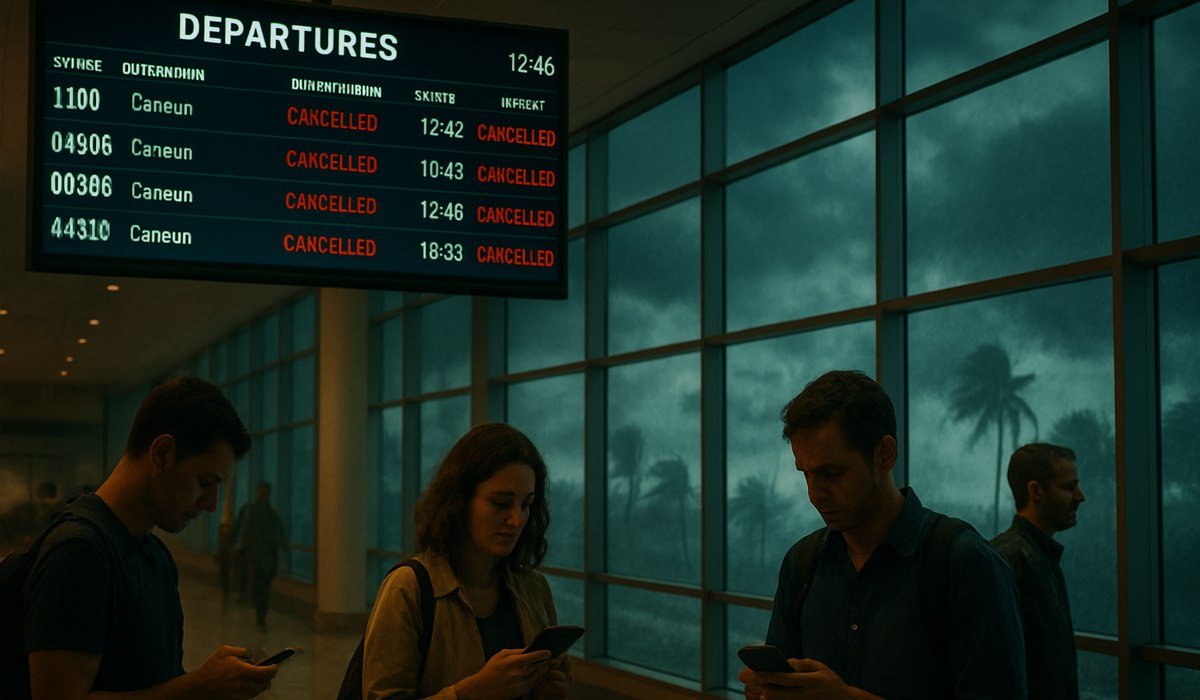
Image generated by AI
Cancun's Flight Corridor Faces Mounting Operational Pressure in 2026
Cancun International Airport is experiencing unprecedented flight disruption cascades as North American airlines operate with historically lean staffing models and reduced aircraft buffers. In late March 2026, airport operations data documented over 40 flight cancellations in a single day across routes connecting Cancun with Boston, Miami, Toronto, and Houston. This cancun travel warning reflects systemic vulnerabilities in the airline network: when weather events or staffing shortages strike distant U.S. hubs, the impact reverberates immediately to Mexican Caribbean destinations. Airlines currently maintain minimal crew reserves and aircraft flexibility compared to pre-pandemic standards, meaning one technical incident or weather disruption in Chicago or Atlanta can trigger a domino effect of cancellations cascading southward to Cancun.
Passengers booked on Cancun routes should understand that operational strain extends beyond the destination itself. The interconnected nature of modern airline networks means your flight's reliability depends not just on local weather conditions in Mexico, but on the health of U.S. connection points thousands of miles away.
Flight Disruptions Cascade Across Cancun's Major U.S. Connections
The mechanics of disruption affecting Cancun-bound travelers trace directly to hub dependency and lean operations. Major U.S. carriers including American Airlines, Southwest, and United rely on concentrated hubs in Miami, Houston, Atlanta, and Dallas—gateways that funnel passengers toward Cancun and other Caribbean destinations.
When winter storms struck North America in January 2026, Cancun experienced a secondary wave of cancellations despite clear skies over the Mexican Caribbean. Reports documented 100+ flight disruptions over several days affecting Cancun services, even as the actual weather event occurred over thousand miles away. This pattern illustrates why flight delays to Cancun are often triggered by events far outside the destination itself.
The operational model airlines now employ prioritizes revenue maximization over resilience. Aircraft and crew assignments run with razor-thin margins. A single delayed aircraft returning from an earlier flight means the next departure—potentially a Cancun-bound service—faces immediate rescheduling or cancellation. Ground crews operate under chronic understaffing, and the trickle-down effect accelerates when multiple flights require simultaneous attention.
Real-time monitoring through FlightAware reveals that Cancun departures from U.S. hubs experience 15-20% higher cancellation rates during spring break and summer peaks compared to shoulder seasons. This reflects both demand concentration and the compounding effect of weather vulnerabilities during peak travel windows.
How Winter Weather and Distant Hubs Amplify Cancun Travel Chaos
Seasonal weather patterns directly amplify cancun travel warning severity. Winter weather across the upper Midwest and Northeast creates cascading disruptions on routes originating from Boston, New York, Chicago, and Toronto—all major gateways feeding Cancun traffic.
The January 2026 winter event illustrated this vulnerability. A sweeping North American system dropped heavy snow across the Great Lakes region, icing runways in Chicago and Detroit. Within hours, Cancun services experienced rolling cancellations as aircraft and crews couldn't position properly. Travelers faced 48+ hour delays, with rebooking options limited as secondary hubs filled to capacity.
Weather propagates through the network asymmetrically. An Atlanta airport closure doesn't just affect Atlanta passengers—it strands aircraft, disrupts crew scheduling, and forces reallocation decisions that cascade to Cancun flights scheduled for the following day. Airlines cannot easily substitute aircraft or crews between distant routes, so the disruption compounds geometrically.
Hurricane season compounds this vulnerability. The Atlantic basin forecast for 2026 projects 13-19 named storms with 8-10 hurricanes, continuing the above-normal activity trend observed since 2020. While Cancun sits outside the most intense storm corridor, tropical systems regularly produce heavy rain, wind, and operational constraints during August through October. The FAA restricts airspace capacity during severe weather, reducing hourly flight movements and creating bottlenecks that persist for days after storms pass.
Essential Preparation: Insurance, Timing, and Backup Plans for 2026 Cancun Travel
Travelers planning 2026 Cancun trips must adopt three-layer protection strategies: timing selection, insurance acquisition, and operational contingency planning.
Timing selection matters more in 2026 than in previous years. Peak spring break (mid-March through early April) and summer school holidays (June-August) concentrate demand precisely when weather volatility runs high. Choosing shoulder-season travel—May, early June, or September—reduces both flight disruption risk and operational strain. These periods avoid peak hurricane season windows and lower the probability of weather cascade effects from distant U.S. hubs.
Comprehensive travel insurance has become essential rather than optional. Standard travel insurance policies cover trip cancellation, flight delay reimbursement, and rebooking costs when airlines cancel service. Premium policies include hurricane/named-storm carve-outs and credit vouchers convertible to cash. The cost—typically 8-12% of total trip value—represents genuine protection given 2026's disruption patterns.
Backup routing and timing flexibility provide operational insurance. Rather than booking direct flights through single gateways, consider routing through multiple potential hubs. If your original Cancun connection through Miami cancels, an alternative routing through Houston or Dallas might succeed. Building 24-48 hour flexibility into arrival windows allows rerouting without compromising vacation time.
Travelers should also monitor airline schedule reliability ratings through FlightAware historical data. American Airlines and Southwest typically show lower on-time performance during peak periods, while Delta and United manage slightly better punctuality on Caribbean routes, though differences narrow during major disruptions.
Airline Operational Strain: Why Cancun Feels the Pain of Network-Wide Issues
The root cause of cascading cancun travel warning conditions traces to structural changes in airline business models post-pandemic. Airlines reduced aircraft inventory permanently rather than restoring pre-2020 fleet sizes. This creates a mathematical impossibility: more passengers demand travel, but fewer aircraft exist to serve them.
Modern airline staffing operates similarly. Pilots, flight attendants, and ground crews work with minimal excess capacity. When a crew member calls in sick or a flight runs late, the airline has no immediate substitute, forcing either cancellation or significant delays. During peak periods—spring break, summer, holiday windows—this constraint becomes acute.
The Cancun-U.S. route network particularly suffers because it depends on long-haul connections through U.S. hubs. A domestic flight delay from Chicago to Miami ripples forward to the Cancun connection scheduled for later that day. Unlike regional routes that might operate more independently, the Cancun network is genuinely interdependent on major hub operations across the entire North American system.
Network complexity also means that airline schedule-setting for 2026 built in insufficient contingency time between connections. Rather than padding schedules with 30+ minute connection buffers, airlines now use 20-minute windows to maximize aircraft utilization. When upstream disruptions occur, these tight windows evaporate instantly, creating cascading cancellations down the network.
The U.S. Department of Transportation has documented this trend, noting that the ratio of operations to operational staff has increased 18-22% since 2019 across major carriers. Cancun routes, which require complex cross-border coordination and don't generate the profit margins of domestic business travel, often rank lower in operational prioritization when disruptions force triage decisions.
Key Metrics: Cancun Flight Disruption Data for 2026
| Metric | 2026 Data | Impact |
|---|---|---|
| Single-day Cancun cancellations (March 2 |
Disclaimer
This article is for informational and educational purposes only. It does not constitute legal, financial, or professional advice. While we strive to provide accurate and up-to-date information, travel policies, regulations, and conditions change rapidly. Always verify information with official sources before making travel decisions. Nomad Lawyer makes no representations about the accuracy, reliability, completeness, or suitability of the information provided. Readers should consult qualified professionals for advice specific to their circumstances. The views expressed in this article are those of the author and do not necessarily reflect the views of Nomad Lawyer.
Kunal K Choudhary
Co-Founder & Contributor
A passionate traveller and tech enthusiast. Kunal contributes to the vision and growth of Nomad Lawyer, bringing fresh perspectives and driving the community forward.
Learn more about our team →