
Severe Thunderstorms and Wildfire Smoke Trigger One Hundred Sixty-Four Cancellations and Six Hundred Twenty-Six Flight Delays Across Canadian Airport Hubs
Severe convective weather and wildfire smoke triggered 164 flight cancellations and 626 delays across major Canadian airports on July 18, 2026.

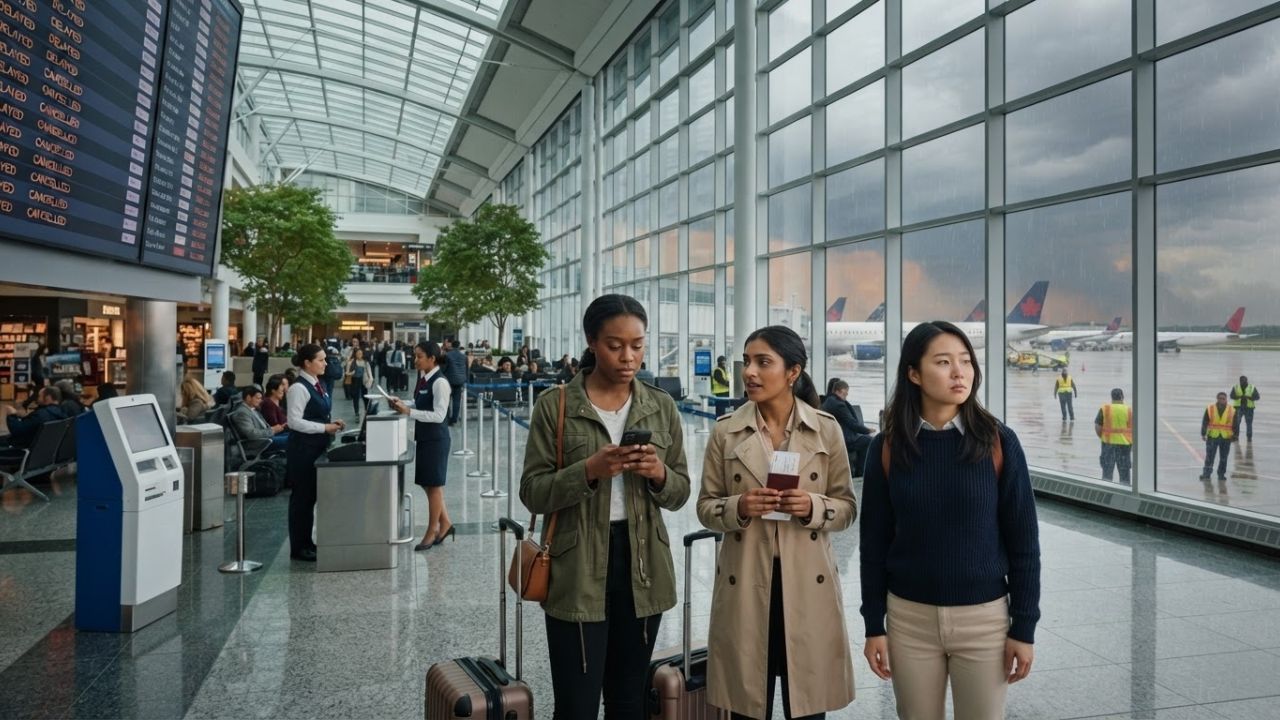
Image generated by AI
Severe Thunderstorms and Wildfire Smoke Trigger One Hundred Sixty-Four Cancellations and Six Hundred Twenty-Six Flight Delays Across Canadian Airport Hubs
Widespread flight cancellations and delays disrupted Canadian aviation networks on July 18, 2026, as severe convective weather and wildfire smoke reduced visibility across key transport corridors. Airports including Toronto Pearson, Montréal-Trudeau, and Vancouver recorded 164 cancellations and 626 delays, heavily affecting passengers flying on Air Canada, Jazz, and Porter Airlines.
The Disruption Details
Flight tracking systems show that environmental and atmospheric conditions created significant capacity constraints at major Canadian airport hubs. Environment Canada issued severe thunderstorm warnings across Ontario, bringing heavy rain, high winds, and lightning that temporarily halted ground operations.
Simultaneously, smoke from hundreds of active wildfires drifted across eastern and western provinces, triggering air quality warnings and severely reducing landing visibility. The combination of convective storms and smoke haze forced air traffic controllers to increase separation intervals between flights, causing cascading scheduling backlogs that disrupted regional and transcontinental schedules.
Flight & Airport Impact Breakdown
Our analysis of flight tracking data indicates that the following airports and airlines experienced the greatest operational impact:
| Airport / Carrier | Code | Verified Cancellations | Verified Delays | Primary Impact Factors |
|---|---|---|---|---|
| Toronto Pearson Airport | YYZ | 73 | 244 | Thunderstorms, wind gusts, and wildfire smoke |
| Montréal-Trudeau Airport | YUL | 41 | 117 | Poor visibility and regional storm systems |
| Vancouver Airport | YVR | 7 | 117 | Airspace congestion and network delays |
| Jazz Aviation | ACA | 60 | 91 | Regional connector scheduling backlogs |
| Air Canada | AC / ACA | 27 | 136 | Hub capacity constraints and fleet rotations |
| Porter Airlines | PD / POE | 7 | 86 | Eastern Canada convective weather systems |
- Toronto Pearson International Airport (YYZ): The country's busiest hub recorded the highest level of disruption, with 73 cancelled flights and 244 delays.
- Montréal-Trudeau International Airport (YUL): Experienced severe schedule disruptions, resulting in 41 cancellations and 117 delays.
- Vancouver International Airport (YVR): Faced significant incoming delays, recording 7 cancellations and 117 delayed arrivals.
- Jazz Aviation (ACA): The regional partner for Air Canada bore the brunt of the cancellations, grounding 60 flights and delaying 91 others.
- Air Canada: The national carrier experienced 27 cancellations and 136 delayed flights across its mainline network.
- Porter Airlines: Faced widespread short-haul disruptions, with 7 cancellations and 86 delays, primarily affecting operations in eastern Canada.
Passenger Rights & Advisory (Information Gain)
Under the Canadian Air Passenger Protection Regulations (APPR), traveler compensation and rebooking rights depend on the primary cause of the flight disruption:
- Situations Within Airline Control: If a cancellation or delay is determined to be within the carrier's control (e.g. crew scheduling issues or mechanical failures), passengers are entitled to rebooking on the next available flight (including competitor airlines if necessary), food and drink vouchers, and cash compensation of up to CAD 1,000 based on the length of the delay.
- Situations Outside Airline Control (Weather and Wildfires): Because the disruptions on July 18, 2026, were primarily caused by severe weather and wildfire smoke, they are classified under APPR as safety events outside the airline's control. In this scenario, carriers are not required to pay cash compensation.
- Standard Rebooking Obligations: Even during uncontrollable weather events, Canadian airlines must rebook passengers on the next available flight operated by themselves or a partner carrier within 90 minutes of the original departure. If the airline cannot accommodate the passenger within 48 hours, they must offer a choice between a full refund or rebooking on any carrier, including competitors.
- Overnight Accommodations: While airlines are not legally mandated to provide free hotel lodging for weather-related delays, travelers should check if their credit card or independent travel insurance policy covers trip delay and interruption expenses.
Industry Analyst View
Our analysis indicates that the operational vulnerability of regional carriers like Jazz Aviation highlights a key challenge for North American aviation networks. Regional operators run tight fleet rotations with minimal crew reserves, making them highly susceptible to airport flow control restrictions. When a major hub like Toronto Pearson reduces its arrival rate, dispatchers prioritize mainline widebody flights, forcing regional routes to absorb the majority of the cancellations.
Additionally, the rising frequency of wildfire smoke and extreme convective weather events in North America represents a systemic risk to airline scheduling. To maintain safety margins, air traffic control agencies must establish more resilient airspace flow management protocols. Carriers will likely need to adjust their schedule densities during summer months to prevent localized convective storms from causing system-wide network failures.
FAQ: Canadian Flight Cancellations 2026
Why were so many flights cancelled across Canada?
Flights were cancelled and delayed due to a combination of severe thunderstorms, strong winds, and reduced landing visibility caused by drifting Canadian wildfire smoke.
Am I entitled to compensation under APPR for weather-related delays?
No, cash compensation is not required under APPR because weather and wildfire smoke are classified as safety events outside the airline's control. However, airlines must still rebook passengers.
What are the rebooking rules if my flight is delayed by weather?
Airlines must rebook you on the next available flight within 90 minutes. If they cannot accommodate you within 48 hours, you are entitled to a full refund or rebooking on a competitor.
Related Travel Guides
The Best Airport Lounges at Toronto Pearson Airport YYZ, According To Reddit
Disclaimer
This article is for informational and educational purposes only. It does not constitute legal, financial, or professional advice. While we strive to provide accurate and up-to-date information, travel policies, regulations, and conditions change rapidly. Always verify information with official sources before making travel decisions. Nomad Lawyer makes no representations about the accuracy, reliability, completeness, or suitability of the information provided. Readers should consult qualified professionals for advice specific to their circumstances. The views expressed in this article are those of the author and do not necessarily reflect the views of Nomad Lawyer.
Kunal K Choudhary
Co-Founder & Contributor
A passionate traveller and tech enthusiast. Kunal contributes to the vision and growth of Nomad Lawyer, bringing fresh perspectives and driving the community forward.
Learn more about our team →