
Aviation Updates: Severe Travel Chaos Sweeps Canada as Weather System Triggers 604 Delays and 84 Flight Cancellations Nationwide
Intense rainfall and severe thunderstorms across Canada paralyze Air Canada, WestJet, and regional carriers, causing massive delays at Toronto, Vancouver, and Montreal.

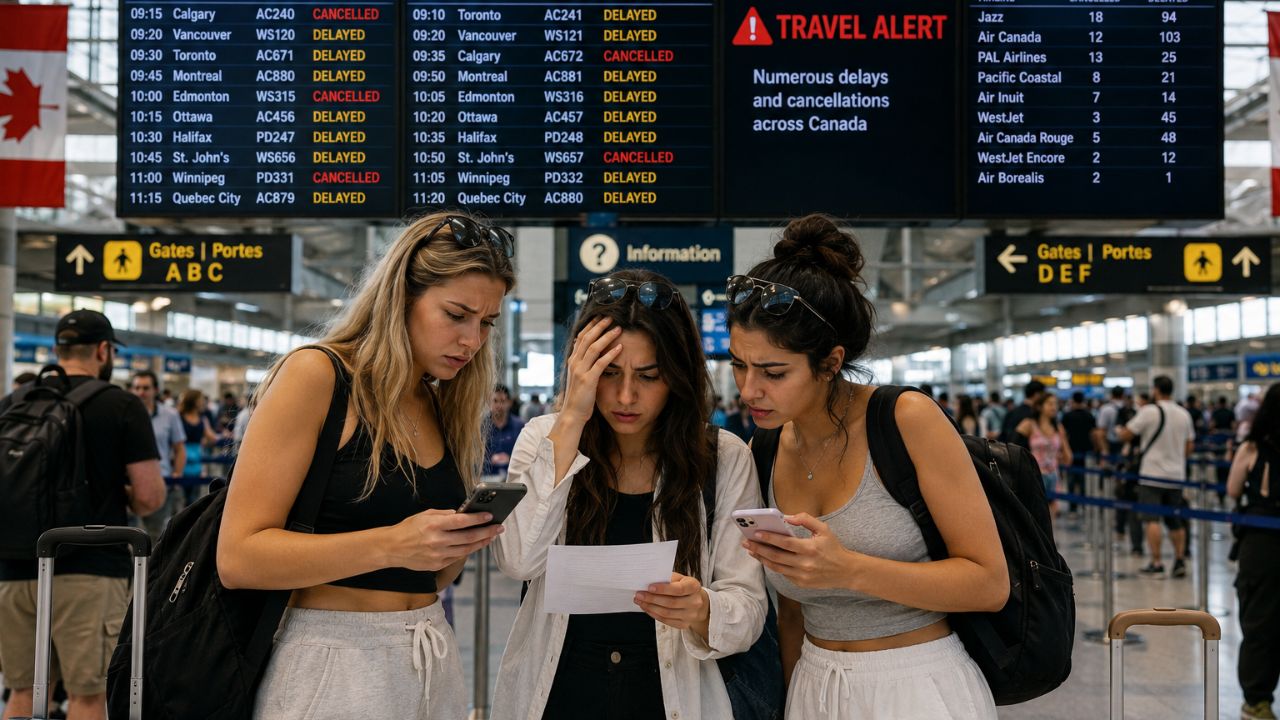
Image generated by AI
Aviation Updates: Severe Travel Chaos Sweeps Canada as Weather System Triggers 604 Delays and 84 Flight Cancellations Nationwide
A violent string of severe weather alerts has completely disrupted the Canadian aviation network, severely grounding domestic and international fleets at Toronto, Vancouver, and Montreal.
Image generated by AI
As international airline news and relentless aviation updates continue to report heavily on weather-related airport disruptions worldwide, a brutal storm system has plunged Canada's commercial aviation sector into absolute travel chaos. Over the weekend, the entire national aviation network experienced a catastrophic breakdown, resulting in a staggering 604 flight delays and 84 massive flight cancellations nationwide. This deep, systemic disruption has severely halted operations across multiple major hubs, including Edmonton, Toronto, Vancouver, Calgary, and Sept-Îles. Heavy operational pressure has completely overwhelmed Canada’s major carriers, with Air Canada and WestJet absorbing massive schedule hits, alongside a vast array of critical regional airlines including Jazz, Air Inuit, Air Borealis, PAL Airlines, Pacific Coastal Airlines, Air Canada Rouge, and WestJet Encore. This massive disruption highlights a dangerous vulnerability within Canada's air transport ecosystem when faced with severe, overlapping weather instability and regional congestion.
Expanded Overview: The Alberta Weather Crisis
When analyzing massive nationwide transit failures, localized severe weather systems frequently act as the primary trigger for cascading global delays.
The widespread travel disruptions crippling central Alberta and cascading outward are being driven entirely by a series of severe orange weather alerts issued by Environment Canada. An incredibly violent incoming rainfall system is aggressively targeting the region, specifically severely impacting Edmonton, Sherwood Park, St. Albert, and highly populated central and western communities. Forecasters explicitly predict between 40 and 70 mm of heavy rain to devastate the region over the weekend. Because the ground is already deeply saturated from severe storms earlier in June, officials are urgently warning of imminent overland flooding, destructive road washouts, and massive infrastructure stress. Scattered thunderstorms are aggressively intensifying into a broad area of heavy rainfall, heavily compounded by severe thunderstorm watches predicting highly destructive large hail, intense lightning activity, and strong winds across northwestern Alberta.
Section-Wise Breakdown: The Major International Gateways
The sheer scale of this severe weather system is heavily reflected in the devastating operational statistics emerging from Canada's largest, most vital international aviation hubs.
Toronto Pearson International Airport (YYZ), operating as the undisputed busiest aviation hub in the country, registered the absolute highest delay count nationwide with a staggering 177 delays, heavily coupled with 15 cancellations. This reflects immense terminal congestion and massive ripple effects devastating connecting flights. On the West Coast, Vancouver International Airport (YVR) recorded the absolute highest number of grounded aircraft with 19 total cancellations alongside 112 delays, violently destabilizing both domestic and trans-Pacific international routing. In Eastern Canada, Montreal-Trudeau International Airport (YUL) followed closely with 16 cancellations and exactly 137 delays, confirming the massive, coast-to-coast nature of this disruption.
Section-Wise Breakdown: Regional Airports Under Severe Strain
While the primary international gateways dominate the overall disruption totals, Canada's vital regional airports are also showcasing extreme operational irregularities.
In western Canada, Calgary International Airport (YYC) suffered 6 cancellations and 48 delays, while Edmonton International Airport (YEG) bore the direct brunt of the Alberta storms with 4 cancellations and 29 delays. Moving east, Ottawa Macdonald–Cartier International Airport (YOW) and Quebec/Jean Lesage International Airport (YQB) both recorded 4 cancellations and a combined 70 delays. Further illustrating the deep impact on remote connectivity, Sept-Îles Airport (YZV) registered 4 cancellations and 19 delays. Notably, Toronto City Centre Airport (YTZ) reported only 3 cancellations but a massive 67 delays, heavily suggesting severe short-haul congestion caused by the massive knock-on effects bleeding out from Pearson's operations.
Flight Details: Canada Airport and Airline Disruption Matrices
The exact operational telemetry outlining this highly complex nationwide transit failure, explicitly detailing the affected airports and exact carrier disruption metrics, has been consolidated into the mandatory matrices below.
Canada Airport Disruption Matrix
| Airport | Cancellations | Delays |
|---|---|---|
| Vancouver International (YVR) | 19 | 112 |
| Toronto Pearson (YYZ) | 15 | 177 |
| Montreal-Trudeau (YUL) | 16 | 137 |
| Calgary International (YYC) | 6 | 48 |
| Ottawa Macdonald–Cartier (YOW) | 4 | 42 |
| Edmonton International (YEG) | 4 | 29 |
| Quebec/Jean Lesage (YQB) | 4 | 28 |
| Sept-Îles Airport (YZV) | 4 | 19 |
| Toronto City Centre (YTZ) | 3 | 67 |
Canada Airline Disruption Matrix
| Airline | Cancellations | Delays |
|---|---|---|
| Jazz | 18 | 94 |
| PAL Airlines | 13 | 25 |
| Air Canada | 12 | 103 |
| Pacific Coastal Airlines | 8 | 21 |
| Air Inuit | 7 | 14 |
| Air Canada Rouge | 5 | 48 |
| WestJet | 3 | 45 |
| WestJet Encore | 2 | 12 |
| Air Borealis | 2 | 1 |
Passenger Impact: Systemic Missed Connections
For the tens of thousands of passengers currently trapped inside the Canadian aviation network, the immediate reality is extreme schedule uncertainty.
The highest concentration of massive delays at Toronto, Vancouver, and Montreal is triggering a catastrophic ripple effect extending deep into regional networks. Passengers are suffering from severely overlapping delays across multiple carriers, heavily increasing the massive likelihood of missed short-haul connections and totally compromised onward international transfers. With high demand violently straining alternative flights, travelers are facing agonizing, highly extended waiting times on terminal floors as customer service queues buckle under the volume of stranded passengers.
Industry Analysis: A Network-Wide Breakdown
Aviation analysts note that this specific disruption perfectly highlights a deeply interconnected aviation system buckling under intense operational pressure.
Because regional operators like Jazz, PAL Airlines, and Air Inuit are absolutely essential for remote connectivity, their massive disruption figures (Jazz alone recorded 18 cancellations and 94 delays) prove that the crisis is not limited to long-haul routes. The national carrier, Air Canada, absorbed a massive 12 cancellations and 103 delays, while WestJet recorded 45 delays. This scale heavily suggests a total network-wide imbalance. Recovery is now absolutely dependent on improved scheduling efficiency and rapid stabilization across both the national and regional airline operations, requiring immense logistical coordination from ground traffic control.
Conclusion: Waiting on the Weather
Ultimately, the severe 604 delays and 84 cancellations recorded across Canada represent a brutal systemic failure triggered by extreme weather volatility. As the 40-70 mm of heavy rainfall continues to pound Alberta, the resulting operational bottlenecks at major hubs like Toronto Pearson and Vancouver International have completely paralyzed domestic mobility. Passengers navigating the Canadian network must aggressively monitor real-time flight statuses, prepare for severe knock-on effects if connecting through major gateways, and remain highly flexible as airlines like Air Canada, WestJet, and Jazz struggle desperately to restore their massive, heavily compromised schedules.
Key Takeaways
- Total Disruption: The Canadian aviation network suffered a massive 84 flight cancellations and 604 flight delays due to severe weather instability.
- Weather Catalyst: Environment Canada issued severe orange alerts for central Alberta (Edmonton), predicting 40-70 mm of rain, flooding, large hail, and lightning.
- Major Hubs Devastated: Toronto Pearson (YYZ) recorded 177 delays, Vancouver (YVR) suffered 19 cancellations, and Montreal (YUL) managed 137 delays.
- Airlines Impacted: Regional feeder Jazz led the cancellations with 18, while national carrier Air Canada suffered 103 delays and 12 cancellations.
- Regional Fallout: Critical remote operators, including PAL Airlines, Pacific Coastal Airlines, Air Inuit, and Air Borealis, experienced heavy scheduling deviations.
FAQ: Canada Flight Delays and Cancellations 2026
Why are there so many flight delays in Canada right now? The massive travel disruptions are being triggered primarily by severe weather alerts, including 40-70 mm of heavy rain, severe thunderstorms, and large hail targeting central and northwestern Alberta, causing a massive nationwide ripple effect.
Which Canadian airports have the highest number of flight delays? Toronto Pearson International Airport recorded the highest number of delays (177), followed closely by Montreal-Trudeau (137) and Vancouver International Airport (112).
What should I do if my Air Canada or WestJet flight is delayed? Passengers must frequently check their flight status through airline apps, contact the airline directly via digital chat for faster rebooking, and anticipate severe knock-on effects if connecting through major hubs like Toronto or Montreal.
Related Travel Guides
UAE Aviation Network Delays Dubai Sharjah Travel Chaos 2026
Vancouver International Airport Delays Air Canada Lufthansa Travel Chaos 2026
Canada Passenger Rights Flight Delay Compensation Guide 2026
Disclaimer: This article is strictly for informational purposes. The flight disruption data (604 delays, 84 cancellations), specific airport statistics (Toronto Pearson, Vancouver, Montreal, Edmonton), affected airlines (Air Canada, WestJet, Jazz, PAL Airlines), and severe weather telemetry (40-70 mm rainfall in Alberta) are based on data sourced directly from FlightAware and Environment Canada at the time of publication. Severe weather conditions and airline recovery operations are highly dynamic and subject to continuous modification. Passengers must explicitly verify exact flight times, monitor local weather alerts, and coordinate directly with their airline prior to travel.
Disclaimer
This article is for informational and educational purposes only. It does not constitute legal, financial, or professional advice. While we strive to provide accurate and up-to-date information, travel policies, regulations, and conditions change rapidly. Always verify information with official sources before making travel decisions. Nomad Lawyer makes no representations about the accuracy, reliability, completeness, or suitability of the information provided. Readers should consult qualified professionals for advice specific to their circumstances. The views expressed in this article are those of the author and do not necessarily reflect the views of Nomad Lawyer.
Kunal K Choudhary
Co-Founder & Contributor
A passionate traveller and tech enthusiast. Kunal contributes to the vision and growth of Nomad Lawyer, bringing fresh perspectives and driving the community forward.
Learn more about our team →