
Aviation Updates: British Airways Shocks Travelers by Giving First Class Suites to 20,000 Crew Members
As catastrophic logistical bottlenecks severely paralyze major transit grids, British Airways overhauls its crew rest policies, placing off-duty flight attendants into empty First Class suites.

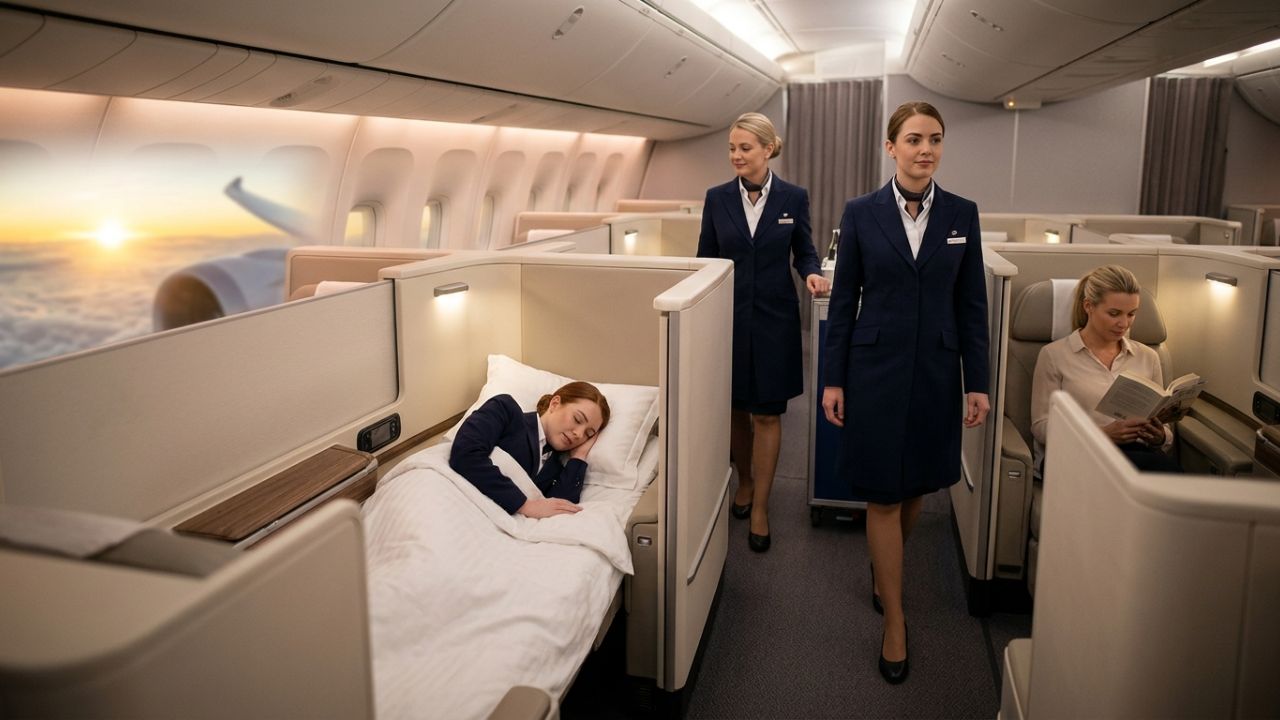
Image generated by AI
Aviation Updates: British Airways Shocks Travelers by Giving First Class Suites to 20,000 Crew Members
As extreme operational friction and suddenly compounding infrastructure bottlenecks continue to terrorize standard travel itineraries, British Airways has violently shattered global aviation norms, officially permitting its massive 20,000-member workforce to physically sleep in vacant First Class luxury suites.
Image generated by AI
[London, July 1] — As high-impact airline news platforms rapidly issue continuous, grim aviation updates regarding the intense fragility of massively congested primary transit grids, an unprecedented corporate policy shift has officially sent shockwaves through the luxury travel sector. Amidst widespread rolling travel chaos, severe airport disruptions, and the terrifying threat of devastating flight cancellations severely plaguing heavily overcrowded mega-hubs, British Airways has aggressively rewritten its internal rest protocols. Taking immediate operational effect across select long-haul routes, the flagship carrier will now explicitly permit off-duty cabin crew members to sleep directly in vacant, multi-thousand-pound First and Business Class suites. This massive, unprecedented development completely redefines the delicate relationship between premium ticket exclusivity, militant airline labor dynamics, and incredibly strict regulatory compliance. The controversial decision heavily impacts high-paying premium flyers and an aviation industry currently grappling with a severe structural conflict between cabin real estate monetization and modern fatigue risk management rules.
Background Context: The Reality of the Non-Bunk Fleet
To fully comprehend the sheer scale of this severe operational evolution, commercial aviation analysts must closely examine exactly how massive corporate aircraft design choices violently reshape terminal stability and international transit economics.
For decades, the absolute standard assumption among commercial airline passengers has been that every massive widebody aircraft actively operating overseas possesses a highly secretive, hidden staircase leading directly to a dedicated crew bunk compartment. In stark reality, aircraft manufacturers like Boeing and Airbus heavily treat these intricate crew rest modules strictly as optional, incredibly high-cost extras. When initially configuring its current, massive fleet of Boeing 787-10 Dreamliners and a highly specific sub-fleet of Boeing 777-200ER aircraft, British Airways management famously elected to completely forgo these factory-installed crew bunks. The brutal engineering trade-off was incredibly simple: by actively eliminating the dedicated physical crew rest quarters, the carrier successfully, aggressively squeezed exactly three additional revenue-generating Economy Class (World Traveller) seats directly onto each Dreamliner.
Section-Wise Breakdown: Navigating the New Rest Protocols
Terminal operations and aircraft fleets are violently transforming across competing hubs, forcing major international operators to furiously deploy highly advanced operational frameworks to strictly ensure they maximize payload revenue while satisfying labor unions.
The Jumpseat Reality: Until this massive policy revision, highly stressed cabin crew operating on these specific, tightly configured aircraft were legally required to take their mandatory mid-flight rest periods directly in "high-comfort attendant seats." These brutal setups are essentially just heavily reinforced, fold-down jumpseats securely positioned immediately adjacent to the main galley doors. While technically isolated by incredibly thin privacy curtains, they offer virtually zero recline, absolutely zero noise dampening, and incredibly minimal physical comfort for flight attendants aggressively working highly demanding, multi-time-zone overnight schedules.
The Luxury Suite Pivot: Following highly intensive, heavily multi-layered negotiations with the powerful British Airlines Stewards and Stewardesses Association (BASSA), British Airways leadership aggressively agreed to a massive, sweeping operational pivot. Under the newly enacted rules, if a long-haul flight actively departs with completely empty berths in the First Class or Business Class (Club World) cabins, off-duty cabin crew are officially, explicitly authorized to utilize these fully flat beds. Furthermore, crew members are explicitly permitted to actively use the luxury bedding, massive pillows, and exclusive duvet sets standard to those premium cabins to strictly ensure genuine physiological recovery.
The Soft Block Exception: On incredibly crowded flights where the premium cabins are entirely full but the rear of the massive aircraft is not, British Airways will actively implement a highly strategic “soft block” directly on selected Economy Class rows. These physical blocks act as makeshift, heavily protected rest zones shielded by temporary curtains, though they completely remain available for urgent public sale if passenger demand suddenly surges immediately before departure. Finally, if the aircraft is completely, totally booked across absolutely all tiers, the massive policy instantly reverts. Flight crews must aggressively return to the traditional galley jumpseats, heavily maintaining the baseline safety parameters without ever physically displacing paying customers. To fiercely prevent passenger confusion, off-duty crew members actively transitioning into premium passenger spaces are legally required to completely remove or deeply obscure all visible uniform items, corporate badges, and branded accessories before settling into a luxury passenger suite.
Strategic Details: Verified British Airways Crew Rest Matrix
To ensure stranded passengers and commercial aviation analysts can accurately track the incredibly precise operational telemetry of this massive labor evolution, the verified structural data has been consolidated into the exact, mandatory matrix below.
| Cabin Scenario / Metric | Operational Rest Protocol |
|---|---|
| Vacant Premium Cabins | Crew access to First Class / Club World suites |
| Full Premium, Vacant Economy | "Soft Block" of selected Economy Class rows |
| 100% Booked Flight | Reversion to traditional galley jumpseats |
| Required Uniform Action | Obscure all corporate branding and badges |
| Affected Aircraft Fleet | Boeing 787-10, Boeing 777-200ER (sub-fleet) |
| Regulatory Authority | UK Civil Aviation Authority (CAA) |
(Source: Airline Labor Agreements and Fleet Operations)
Impact Analysis: The Massive Cost of Three Economy Seats
Air travel explicitly across massive global transit corridors continues to massively struggle, driven violently by incredibly fragile air traffic flow constraints and severely overloaded security infrastructures.
While public discussion has aggressively focused on the visual friction of an off-duty flight attendant peacefully sleeping directly next to a highly affluent passenger who paid £5,000 for a luxury suite, the real, highly verified story lies heavily in a massive structural miscalculation. British Airways is essentially paying a massive premium in incredibly valuable luxury real estate completely to offset a highly short-sighted initial design choice. By aggressively prioritizing three extra economy seats strictly over permanent, dedicated crew infrastructure, the massive airline inadvertently heavily capped the absolute operational flexibility of its entire Boeing 787-10 fleet.
Under incredibly strict UK Civil Aviation Authority (CAA) Flight Time Limitations (FTL), aircraft severely lacking dedicated, totally private lie-flat crew quarters are legally, violently barred from actively operating ultra-long-haul routes where highly extended duty periods aggressively pose critical fatigue risks. Consequently, these massive, highly capable premium aircraft have been structurally bottlenecked, violently restricted exclusively to shorter long-haul routes actively departing out of London Heathrow Airport (LHR). While British Airways is officially slated to rapidly receive brand-new Boeing 787-10 deliveries explicitly featuring factory-installed crew bunks, the existing legacy fleet mathematically cannot be physically retrofitted. This grim reality forcefully leaves the empty-seat policy as the absolute, only legally viable mechanism to safely manage crew fatigue under incredibly strict modern aviation oversight frameworks.
Why This Matters: Labor Rights Versus Luxury Optics
Ultimately, the aggressive, massive deployment of flight attendants into First Class actively marks a massively significant victory for aviation safety over premium passenger exclusivity. This controversial policy has completely exposed a stark, highly volatile philosophical divide among the airline’s elite frequent flyer community, heavily triggering intense debates across luxury travel forums. Many affluent passengers forcefully argue that aggressively allowing off-duty crew to rest openly in the premium cabins severely devalues the entire brand ecosystem.
Conversely, aggressive aviation safety advocates strongly, violently defend the massive adjustment. Proponents actively point out that a heavily well-rested cabin crew is the absolute, ultimate line of defense during an incredibly terrifying in-flight catastrophic emergency. Under highly modernized Safety Management Systems (SMS) aggressively audited by powerful regulators, actively mitigating severe cognitive decline and brutal physical exhaustion among flight attendants is officially considered a non-negotiable operational imperative that takes absolute legal precedence over passenger optics. As global airlines furiously look to aggressively maximize cabin density, the violent intersection of massive labor union leverage and incredibly rigid fatigue regulations will continue to forcefully trigger highly creative, deeply controversial operational compromises.
Key Takeaways
- Unprecedented Suite Access: British Airways has officially authorized its 20,000 cabin crew members to sleep in vacant First Class and Club World suites on select long-haul flights.
- The Three-Seat Mistake: The carrier previously eliminated factory-installed crew bunks on its Boeing 787-10 and Boeing 777-200ER sub-fleets to squeeze in three extra Economy (World Traveller) seats.
- Union Negotiations: Following heavy pressure from the BASSA union, the policy replaces grueling galley jumpseats with fully flat beds and premium bedding.
- Regulatory Bottleneck: Due to strict UK CAA Flight Time Limitations (FTL), the lack of crew bunks legally restricts these aircraft exclusively to shorter routes out of London Heathrow (LHR).
- Passenger Optics vs Safety: Off-duty crew must hide all corporate uniforms and badges while resting, as the airline balances premium brand exclusivity against mandatory fatigue management.
FAQ: British Airways First Class Crew Rest 2026
Why is British Airways letting crew sleep in First Class? Because the airline previously eliminated dedicated crew bunks on its Boeing 787-10 Dreamliners to add three Economy seats, it must now utilize vacant First Class or Club World suites to comply with strict UK Civil Aviation Authority fatigue regulations on long-haul flights.
Do flight attendants wear their uniforms while sleeping in First Class? No. Under the heavily negotiated policy, off-duty crew members are strictly required to completely remove or obscure all visible uniform items, corporate badges, and branded accessories before utilizing the passenger suites.
What happens if the British Airways flight is completely full? If an aircraft is 100% booked across all cabins, the luxury rest policy instantly reverts, and flight crews must take their mandatory breaks in the traditional, highly uncomfortable galley jumpseats.
Are other British Airways planes affected by this? This specific policy targets the Boeing 787-10 fleet and a specific sub-fleet of Boeing 777-200ER aircraft that lack factory-installed crew bunks. Future deliveries of the 787-10 will feature dedicated crew quarters.
Related Travel Guides
Qatar Airways Cancels A380 Guangzhou Travel Chaos 2026
China Beijing Shanghai Guangzhou Airport Delays Travel Chaos 2026
Emirates Global Lounge Upgrades Frankfurt Munich Travel Chaos 2026
Disclaimer: This article is strictly for informational and aviation tracking purposes. The specific operational telemetry (Boeing 787-10 seat configurations, 20,000 crew members) and labor agreements (BASSA negotiations) are based on verified analytics data available at the time of publication. Security wait times, airport weather delays, localized air traffic congestion, and internal airline rest protocols are highly dynamic and subject to immediate modification by the operating authorities. Passengers navigating the global aviation grid should explicitly verify exact terms, conditions, and real-time transit alerts via official travel portals prior to departure.
Disclaimer
This article is for informational and educational purposes only. It does not constitute legal, financial, or professional advice. While we strive to provide accurate and up-to-date information, travel policies, regulations, and conditions change rapidly. Always verify information with official sources before making travel decisions. Nomad Lawyer makes no representations about the accuracy, reliability, completeness, or suitability of the information provided. Readers should consult qualified professionals for advice specific to their circumstances. The views expressed in this article are those of the author and do not necessarily reflect the views of Nomad Lawyer.
Raushan Kumar
Founder & Lead Developer
Full-stack developer with 11+ years of experience and a passionate traveller. Raushan built Nomad Lawyer from the ground up with a vision to create the best travel and law experience on the web.
Learn more about our team →