
British Airways Airbus A320 Nose Wheel Failure at London Gatwick Airport Triggers Runway Closure and UK Flight Diversions
A technical nose wheel failure on a British Airways Airbus A320 blocked a primary runway at London Gatwick Airport, forcing widespread flight diversions and delays across the UK aviation network.

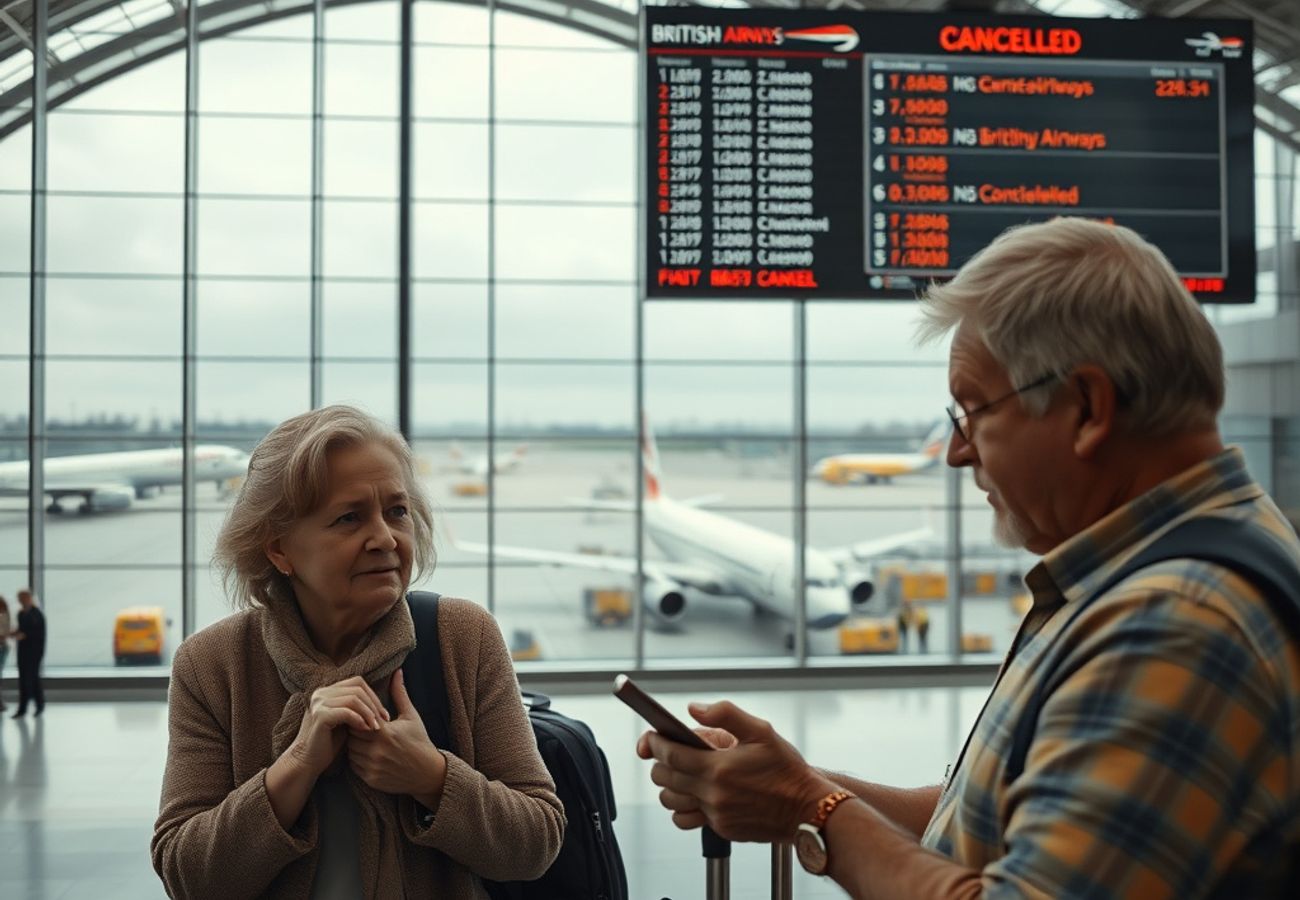
Image generated by AI
[London, July 18, 2026] — A technical malfunction involving a British Airways Airbus A320 has caused extensive operational chaos at London Gatwick Airport after a nose wheel failure left the aircraft stranded on the runway. The incident forced airport authorities to implement immediate runway restrictions, leading to a cascade of flight diversions and delays affecting thousands of passengers across the United Kingdom's aviation infrastructure.
The aircraft successfully touched down, but the failure of the nose wheel assembly rendered the plane unable to taxi off the active strip. This blockage created an immediate bottleneck at one of the UK's most congested aviation hubs, requiring a coordinated response from emergency teams, engineers, and air traffic controllers to clear the airfield and resume standard operations.
Technical Failure of British Airways Airbus A320 Immobilizes Gatwick Runway
The disruption began when a British Airways Airbus A320 experienced a critical nose wheel failure upon arrival at London Gatwick Airport. Because the nose wheel is essential for steering and movement on the ground, the aircraft became an immobile obstacle on the runway. Safety crews were dispatched immediately to the site to evaluate the structural integrity of the landing gear and determine the safest method for towing the aircraft to a holding area.
Due to the high volume of traffic handled by Gatwick, the presence of a disabled aircraft on the runway had an immediate impact on the airport's capacity. The temporary closure of the runway forced air traffic control to halt both arrivals and departures, illustrating the vulnerability of single-runway operations to localized technical failures.
Operational Disruptions and Widespread Flight Diversions
As the runway remained blocked, the ripple effects were felt throughout the UK aviation network. Several arriving flights were unable to land at Gatwick and were redirected to alternative UK airports to avoid dangerous holding patterns and fuel depletion. These diversions caused significant logistical challenges, as passengers were suddenly transported to different cities, often missing connecting flights and complicating ground transportation arrangements.
Industry reports indicate that passengers traveling for business, leisure, and international connections were the most heavily impacted. Airlines were forced to dynamically adjust their schedules, with many flights facing hours of delay while waiting for the runway to be cleared. Flight tracking data showed a surge in redirected traffic as Gatwick's airspace became restricted.
Safety Protocols and Nose Wheel Recovery Procedures
Despite the operational turmoil, the incident was handled according to strict aviation safety standards. The aircraft landed without injury to passengers or crew, and the subsequent recovery process focused on mitigating further risks. The nose wheel system is a critical component of the landing gear; when it fails, the aircraft cannot be moved by its own power without risking further damage to the fuselage or the runway surface.
Specialized ground support equipment and engineering teams were utilized to lift and tow the Airbus A320. This process requires precision to ensure that the aircraft is moved without creating additional hazards for airport personnel or other aircraft in the vicinity. The adherence to these protocols ensured that while the delay was significant, no further accidents occurred during the recovery phase.
Restoration of Services at London Gatwick Airport
The restoration of normal flight operations required a synchronized effort between British Airways, Gatwick airport management, and air traffic control. Once the disabled A320 was successfully removed from the runway, the airport began a phased reopening of its services. However, the "recovery period" for a major hub like Gatwick extends far beyond the physical clearing of the runway.
Airlines faced the secondary challenge of reorganizing aircraft rotations and managing crew duty time limits, which were often exceeded due to the delays. This meant that even after the runway reopened, some flights remained cancelled or delayed as airlines worked to reposition aircraft and crews across their networks.
Passenger Guidance During Major Aviation Disruptions
For travelers caught in the Gatwick disruption, the situation highlighted the necessity of real-time communication. Aviation experts suggest that during such systemic failures, passengers should not rely solely on the original flight schedules provided at the time of booking.
The following steps are recommended for passengers facing similar airport disruptions:
| Action Step | Recommended Method | Purpose |
|---|---|---|
| Status Verification | Airline mobile apps and official websites | Get real-time updates on delays or diversions |
| Rebooking | Direct contact with airline customer service | Secure alternative flights or hotel vouchers |
| Timing | Arriving at the airport earlier than scheduled | Account for increased security queues during recovery |
| Documentation | Keeping digital and physical copies of itineraries | Facilitate faster re-routing and claims |
Why This Matters: The Fragility of Hub-and-Spoke Aviation
The British Airways incident at Gatwick serves as a critical case study in the "single point of failure" risk inherent in modern aviation. When a primary runway at a major hub is blocked, the impact is not limited to a single airline or airport but extends to the entire national airspace.
From a professional perspective, this event underscores the tension between maximizing airport efficiency and maintaining operational redundancy. As airports push for higher aircraft movements per hour, the margin for error shrinks. A simple mechanical failure on one aircraft can effectively paralyze a hub, leading to millions of dollars in lost productivity and operational costs.
Furthermore, this incident highlights the importance of "recovery resilience." The speed at which Gatwick and British Airways cleared the runway and resumed flights is a testament to established safety protocols, yet the lingering delays prove that the aviation network's "elasticity" is limited. For the travel industry, the lesson is clear: investing in rapid-response recovery technology and diversified routing is essential to prevent a single technical glitch from triggering a national travel crisis.
Aviation reliability remains the cornerstone of global travel, where safety must always supersede schedule.
Related Travel Guides
Disclaimer
This article is for informational and educational purposes only. It does not constitute legal, financial, or professional advice. While we strive to provide accurate and up-to-date information, travel policies, regulations, and conditions change rapidly. Always verify information with official sources before making travel decisions. Nomad Lawyer makes no representations about the accuracy, reliability, completeness, or suitability of the information provided. Readers should consult qualified professionals for advice specific to their circumstances. The views expressed in this article are those of the author and do not necessarily reflect the views of Nomad Lawyer.
Raushan Kumar
Founder & Lead Developer
Full-stack developer with 11+ years of experience and a passionate traveller. Raushan built Nomad Lawyer from the ground up with a vision to create the best travel and law experience on the web.
Learn more about our team →