
Brisbane’s South Bank Festival Village Sets New Benchmark for Waterfront Tourism and 2032 Olympic Readiness
Brisbane's South Bank transforms into a massive Festival Village, drawing 14M annual visitors and testing urban infrastructure for the 2032 Olympic Games.

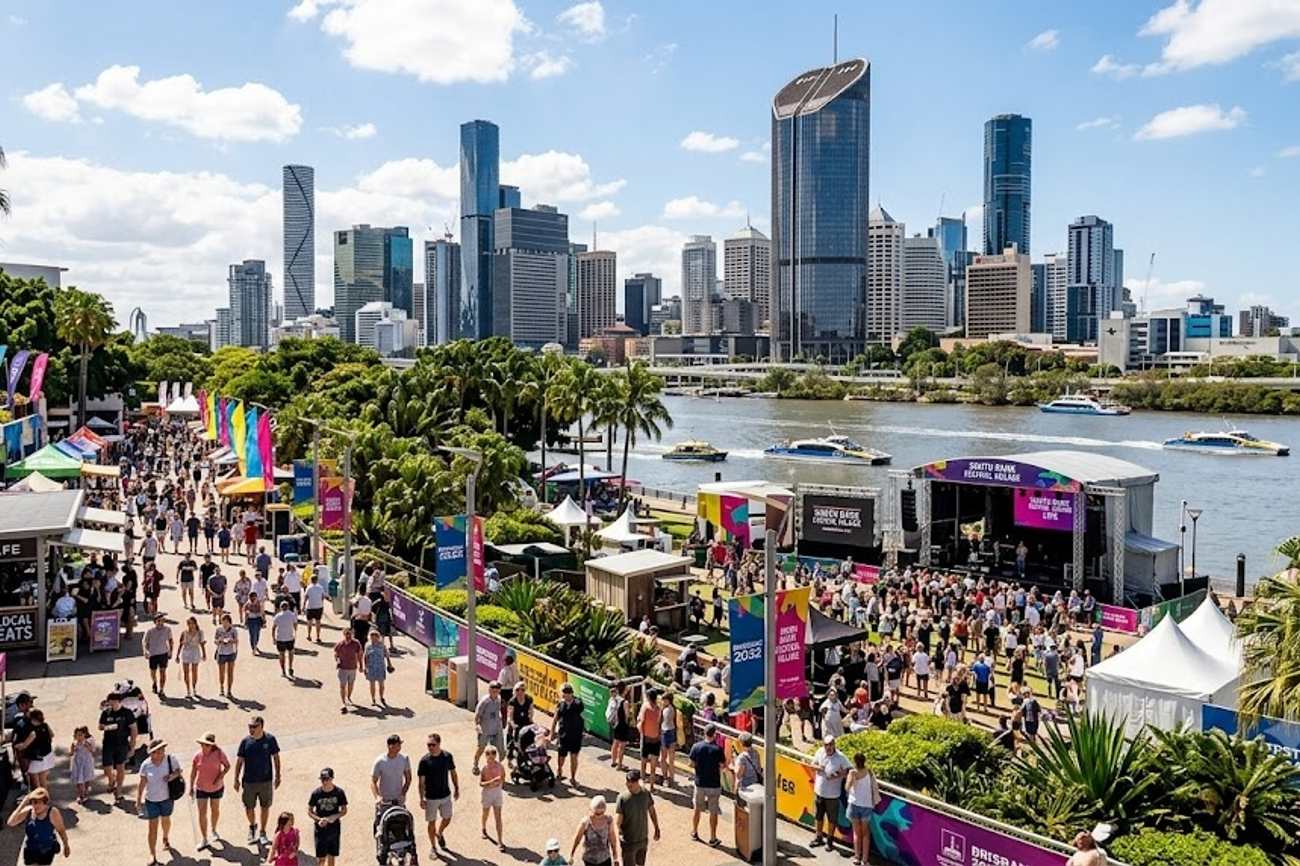
Image generated by AI
[Brisbane, September 4, 2026] — The 2026 Brisbane Festival is transforming the South Bank precinct into a living laboratory for global waterfront tourism, demonstrating how targeted urban activation can exponentially increase hospitality revenue and civic capacity. By converting 42 hectares of riverfront land into a coordinated "Festival Village," city officials are utilizing the event as a critical operational rehearsal for the 2032 Olympic and Paralympic Games.
The current strategy marks a departure from traditional event planning, moving away from isolated venues toward a systemic, precinct-wide approach. This model focuses on maximizing the economic yield of public assets by integrating retail, dining, and cultural experiences into a single, walkable visitor journey.
Strategic Evolution of the South Bank Waterfront
The modern approach to waterfront tourism now prioritizes "spatial aggregation," where municipal authorities structure land to ensure spending is distributed across all adjacent business sectors. Brisbane’s South Bank serves as a primary international example of this shift. Originally established as the legacy site for World Expo ’88, the 42-hectare corridor is managed under the statutory authority of the South Bank Corporation Act 1989.
A significant portion of this area—17 hectares—is dedicated to activated parklands and public plazas. This infrastructure supports a baseline of more than 14 million visitors every year. A central pillar of this economic engine is the Brisbane Convention & Exhibition Centre (BCEC), managed by ASM Global. The BCEC acts as a primary driver for high-spending business travel; in the 2023–24 period, the venue hosted 702,000 delegates across 875 events. This volume grew to 765,000 delegates across 876 events in the 2024–25 cycle, proving the precinct's ability to blend corporate demand with mass leisure tourism.
South Bank Precinct Governance & Metrics
| Metric | Detail |
|---|---|
| Total Precinct Footprint | 42 hectares |
| Dedicated Activated Parklands | 17 hectares |
| Statutory Management Authority | South Bank Corporation — South Bank Corporation Act 1989 |
| Primary Venue Commercial Manager | ASM Global — BCEC Management |
| Baseline Annual Visitation | More than 14.0 million visitors annually |
| BCEC Annual Delegate Volume | 765,000 delegates across 876 events |
The 2026 Festival Village Framework
Under the artistic direction of Ebony Bott, the September 2026 festival operates under the theme "Switch On, Light Up, Come Alive." This iteration has consolidated the riverfront into a unified "Festival Village," with the Cultural Forecourt and Verso Projects serving as the primary hubs.
From September 4 to September 26, 2026, the precinct will host approximately 2,000 artists delivering over 750 performances. The operational model relies heavily on public accessibility to drive foot traffic; more than 70% of the programming is free of charge. This "open-access" strategy is designed to draw massive crowds into the promenade, where they then engage with paid hospitality and retail services.
This activation is supported by the Queensland Government's "Time to Shine" 10-year creative economy strategy. Key officials, including Minister for Education and the Arts John-Paul Langbroek and Minister for the Environment and Tourism Andrew Powell MP, view the festival as a method to stimulate regional travel demand. Lord Mayor Adrian Schrinner has emphasized that utilizing parks and riversides as open-air stages solidifies Brisbane's reputation as a lifestyle capital while maximizing the return on public arts investment.
23-Day Festival Programme at a Glance
| Component | Detail |
|---|---|
| Festival Operating Window | 4 September – 26 September 2026 |
| Total Artists Participating | Approximately 2,000 artists |
| Total Scheduled Performances | More than 750 performances |
| Public Accessibility Proportion | More than 70% free-to-access programming |
| Core Precinct Hub | Verso Projects, Cultural Forecourt |
Quantifying the Economic Impact on Hospitality
The shift toward precinct clustering has a measurable effect on urban economic KPIs. Data from Tourism Research Australia (TRA) and CBRE indicates that these high-density events compress hotel supply and increase the pricing power of accommodation providers.
During the festival peak, hotel occupancy in the South Bank and West End areas surges from a baseline of 71.5%–73.0% to between 86.5% and 92.0%. This demand spike allows for a significant increase in the Average Daily Rate (ADR), which climbs from a standard $215.00 AUD to a peak of $285.00–$320.00 AUD.
Brisbane Accommodation & Economic KPI Comparison (September)
| Metric | Non-Event Baseline | Festival Activation Peak |
|---|---|---|
| Hotel Occupancy Rate (%) | 71.5% – 73.0% | 86.5% – 92.0% |
| Average Daily Rate (ADR) (AUD) | $215.00 | $285.00 – $320.00 |
| RevPAR Performance (AUD) | $153.70 | $246.50 – $294.40 |
| Average Dwell Time (Hours) | 1.5 – 2.5 hours | 6.0 – 9.5 hours |
| Average Daily Spend / Visitor | $117.00 | $245.00 – $310.00 |
| Nighttime Spend Share (9pm–2am) | 18.0% | 42.5% |
The most striking change is observed in visitor behavior. The average dwell time—the amount of time a visitor spends in the precinct—increases from roughly two hours to as many as 9.5 hours. This extended stay directly correlates with a rise in daily spend per visitor, jumping from $117.00 to as high as $310.00. Furthermore, the "nighttime economy" sees a massive boost, with spend between 9:00 PM and 2:00 AM rising from 18% to 42.5% of total daily expenditure.
Why This Matters: The Path to 2032
For the traveler and the local business owner, the South Bank Festival Village is more than a cultural event; it is a blueprint for the future of the city. From a logistical standpoint, the ability to move hundreds of thousands of people through a 42-hectare space while maintaining high spend-per-head is the exact challenge Brisbane will face during the 2032 Olympics.
The "free-to-entry" model for 70% of the events is a strategic psychological tool. By removing the barrier to entry, the city creates a "low-friction" environment that encourages visitors to enter the precinct. Once inside, the extended dwell time (up to 9.5 hours) transforms a casual visitor into a high-value consumer of the surrounding hospitality ecosystem.
For the hospitality sector, this demonstrates that "precinct clustering"—grouping events, arts, and dining in one walkable zone—is far more lucrative than hosting events in isolated stadiums. It creates a "halo effect" where the success of a free concert directly fuels the revenue of a nearby restaurant or hotel.
Related Travel Guides
Disclaimer
This article is for informational and educational purposes only. It does not constitute legal, financial, or professional advice. While we strive to provide accurate and up-to-date information, travel policies, regulations, and conditions change rapidly. Always verify information with official sources before making travel decisions. Nomad Lawyer makes no representations about the accuracy, reliability, completeness, or suitability of the information provided. Readers should consult qualified professionals for advice specific to their circumstances. The views expressed in this article are those of the author and do not necessarily reflect the views of Nomad Lawyer.
Preeti Gunjan
Contributor & Community Manager
A passionate traveller and community builder. Preeti helps grow the Nomad Lawyer community, fostering engagement and bringing the reader experience to life.
Learn more about our team →