
Brazil Aviation Network Hit by 204 Delays and 45 Cancellations Across São Paulo and Rio de Janeiro Hubs Disrupting Major Carriers
A massive wave of flight delays and cancellations hit Brazil's busiest airports in São Paulo and Rio de Janeiro. Read carrier statistics and ANAC passenger rights rules.

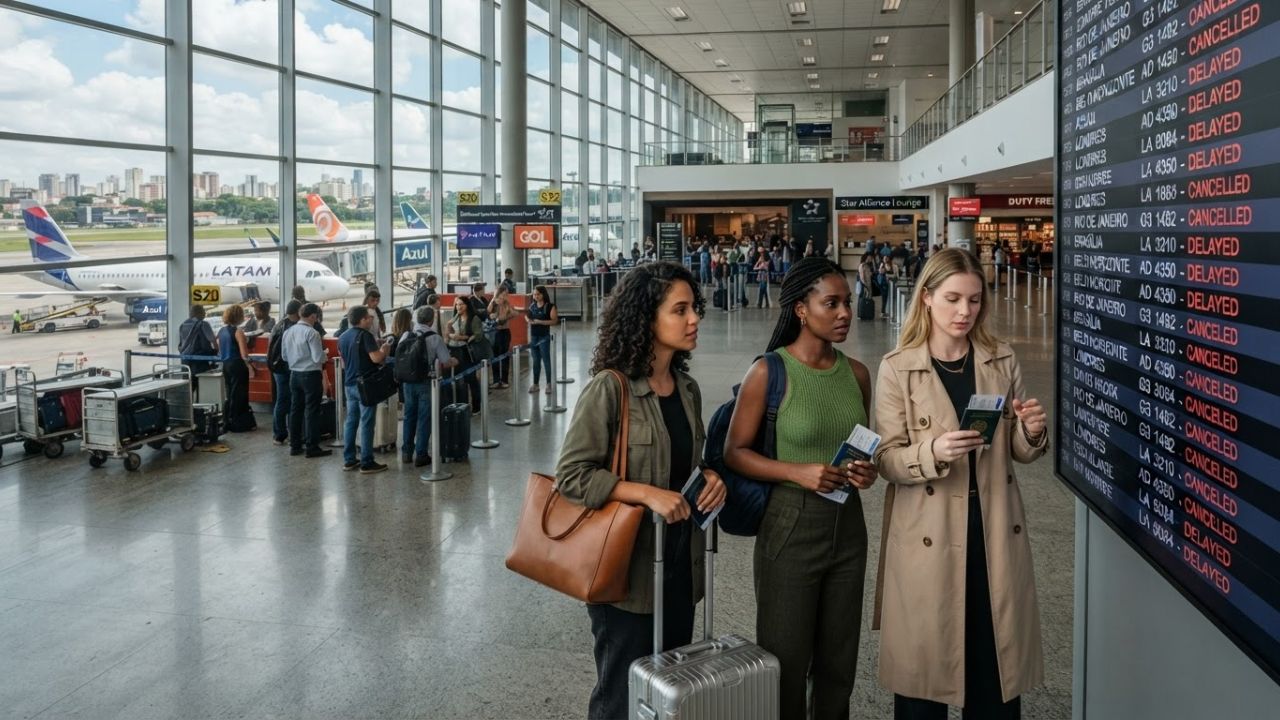
Image generated by AI
Brazil Aviation Network Hit by 204 Delays and 45 Cancellations Across São Paulo and Rio de Janeiro Hubs Disrupting Major Carriers
Brazil's major metropolitan airports, including hubs in São Paulo and Rio de Janeiro, recorded 204 flight delays and 45 cancellations on July 16, 2026. The widespread infrastructure strain impacted regional travel schedules for LATAM Brasil, GOL, and Azul, triggering strict consumer compensation mandates under national aviation regulations.
The Core Transit Update
A systemic operational disruption has affected Brazil's primary domestic and international air corridors. According to real-time flight tracking telemetry compiled on July 16, 2026, airports across the country logged 204 delays and 45 flight cancellations. The logistical bottlenecks were concentrated in the Southeast region, specifically within the states of São Paulo and Rio de Janeiro, which serve as the primary gateways for regional air traffic.
The most severe operational pressures occurred at São Paulo-Guarulhos International Airport (GRU), the nation's premier international gateway. GRU recorded 113 delays alongside 7 cancellations, representing a total of 120 irregular flight operations. Concurrently, São Paulo-Congonhas Airport (CGH), which handles high-density domestic commuter routes, experienced 39 delays and 15 cancellations.
The coastal city of Rio de Janeiro also faced notable schedule adjustments. Galeão International Airport (GIG) reported 17 delays and 3 cancellations, while Santos Dumont Airport (SDU), serving regional business shuttles, logged 8 delays and 13 cancellations. The disruption extended inland, affecting Tancredo Neves International Airport (CNF) in Belo Horizonte with 19 delays and 3 cancellations, and Afonso Pena International Airport (CWB) in Curitiba with 8 delays and 4 cancellations.
Flight metrics released by FlightAware indicate that the country's largest airlines absorbed the highest volume of disruptions. LATAM Brasil recorded 76 delays (approximately 8 percent of its daily schedule) and 11 cancellations. GOL Linhas Aéreas followed with 57 delays (7 percent) and 9 cancellations. While Azul Brazilian Airlines maintained its cancellation rate at zero percent, it still accrued 47 delays.
Transit Schedule & Route Specifications
The airport-by-airport disruption metrics and airline performance indices for the Brazilian aviation corridor are organized in the tables below:
Brazil Flight Disruption Metrics by Airport (July 16, 2026)
| Airport Hub Name | IATA Code | Scheduled Flight Delays | Scheduled Flight Cancellations | Total Daily Disruptions |
|---|---|---|---|---|
| São Paulo-Guarulhos | GRU | 113 | 7 | 120 |
| São Paulo-Congonhas | CGH | 39 | 15 | 54 |
| Belo Horizonte Tancredo Neves | CNF | 19 | 3 | 22 |
| Rio de Janeiro Galeão | GIG | 17 | 3 | 20 |
| Rio de Janeiro Santos Dumont | SDU | 8 | 13 | 21 |
| Curitiba Afonso Pena | CWB | 8 | 4 | 12 |
| Combined Network Total | N/A | 204 | 45 | 249 |
Carrier Operational Performance Indicators
| Operating Airline Brand | Flight Delays | Delay Rate | Flight Cancellations | Cancellation Rate |
|---|---|---|---|---|
| LATAM Brasil | 76 | 8% | 11 | 1% |
| GOL Linhas Aéreas | 57 | 7% | 9 | 1% |
| Azul Brazilian Airlines | 47 | 5% | 0 | 0% |
| Azul Conecta (Feeder) | 8 | 20% | 4 | 10% |
Traveler Logistics Guide (Information Gain)
- Connection Planning at São Paulo-Guarulhos (GRU):
- Terminal Transitions: GRU is split into three main passenger terminals. Terminal 2 handles the bulk of domestic flights and Latin American routes, while Terminal 3 is dedicated to long-haul international departures. Moving between Terminal 2 and Terminal 3 requires a walk of approximately 15 to 20 minutes through an enclosed corridor.
- Layover Buffers: If you are booking a connection from an international flight to a domestic service on LATAM Brasil, allow at least 2.5 hours for domestic transfers and 3.5 hours for international connections. This buffers against immigration queues and baggage recheck delays.
- Understanding Passenger Rights Under ANAC Resolution 400:
- Delay over 1 Hour: The airline is legally required to provide travelers with communication options, such as internet access or telephone services.
- Delay over 2 Hours: The carrier must supply appropriate meals or food vouchers matching the time of day.
- Delay over 4 Hours or Cancellation: The airline must offer options for immediate rebooking on the next available flight (including competitor flights if necessary), a full ticket refund, or alternative ground transport. If an overnight delay occurs and the traveler is away from home, the carrier must provide hotel accommodations and round-trip airport transfers.
- Digital Management and Self-Service Rebooking:
- Carrier Apps: In the event of a delay, use the GOL, Azul, or LATAM mobile apps to check-in and search for rebooking options. This often bypasses the need to wait in physical lines at the airport ticket counters.
- Documenting Outages: Ensure you save boarding passes, digital cancellation notices, and request a physical proof-of-delay statement from airport ground agents. This documentation supports formal compensation claims submitted to the regulator.
Infrastructure Impact Assessment
The geographical concentration of the current disruption in Brazil's Southeast highlights the network vulnerabilities of a hub-and-spoke system. Because Guarulhos (GRU) serves as the primary mega-hub, any delay there causes a domino effect, delaying aircraft scheduled to fly to regional secondary airports in Curitiba and Belo Horizonte.
Additionally, the operational statistics reveal a notable divergence between airport categories. Main international airports prioritize delays over outright cancellations to prevent the high logistics costs of rebooking long-haul international travelers. Conversely, regional hubs like Santos Dumont (SDU) record higher cancellation numbers, as short-haul domestic flights are canceled to preserve aircraft availability and crew hours for longer, high-priority routes.
This operational vulnerability is particularly evident in regional turboprop feeder carriers like Azul Conecta. Feeder airlines operate smaller aircraft with tighter crew rotations and fewer reserve planes. Consequently, they face a disproportionate impact during systemic disruptions, as shown by Azul Conecta's 20 percent delay rate and 10 percent cancellation rate.
Passenger rights and airline compliance are monitored under the authority of the National Civil Aviation Agency (ANAC), which enforces passenger care standards across all Brazilian airports.
FAQ: Brazil Airport Flight Disruptions 2026
Which Brazilian airports suffered the most flight delays on July 16, 2026?
São Paulo-Guarulhos (GRU) was the most impacted airport, recording 113 flight delays, followed by São Paulo-Congonhas (CGH) with 39 delays.
What passenger rights apply during a flight cancellation in Brazil?
Under ANAC Resolution 400, carriers must offer rebooking, a full refund, or alternative transport, along with hotel lodging if the delay is overnight and the traveler is away from home.
Why did regional feeder airlines face higher cancellation rates than major carriers?
Regional operations, such as Azul Conecta, utilize smaller fleets and have fewer backup aircraft, making them more vulnerable to cascading crew and aircraft scheduling issues.
Related Travel Guides
- Ryanair Updates Family Seat Allocation Policy After CMA Intervention
- Singapore Airlines Profits Explode as Global Rerouting Turns Changi into the World’s Primary Sanctuary from Middle East Travel Chaos and Airport Disruptions
- Saudia Deploys Brand-New Airbus A321XLR Fleet to Combat Travel Chaos and Flight Cancellations: Expanded Routes from Jeddah and Riyadh Launching to Paris, Geneva, Moscow, and Malé in June 2026
Disclaimer
This article is for informational and educational purposes only. It does not constitute legal, financial, or professional advice. While we strive to provide accurate and up-to-date information, travel policies, regulations, and conditions change rapidly. Always verify information with official sources before making travel decisions. Nomad Lawyer makes no representations about the accuracy, reliability, completeness, or suitability of the information provided. Readers should consult qualified professionals for advice specific to their circumstances. The views expressed in this article are those of the author and do not necessarily reflect the views of Nomad Lawyer.
Kunal K Choudhary
Co-Founder & Contributor
A passionate traveller and tech enthusiast. Kunal contributes to the vision and growth of Nomad Lawyer, bringing fresh perspectives and driving the community forward.
Learn more about our team →