
Aviation Updates: Massive Travel Chaos Strikes Brazil as 256 Disruptions Paralyze LATAM, Azul, and GOL in São Paulo and Rio
As catastrophic logistical bottlenecks severely paralyze the Brazilian transit grid, desperate travelers are trapped in intense travel chaos following 256 sudden flight disruptions across major South American hubs.

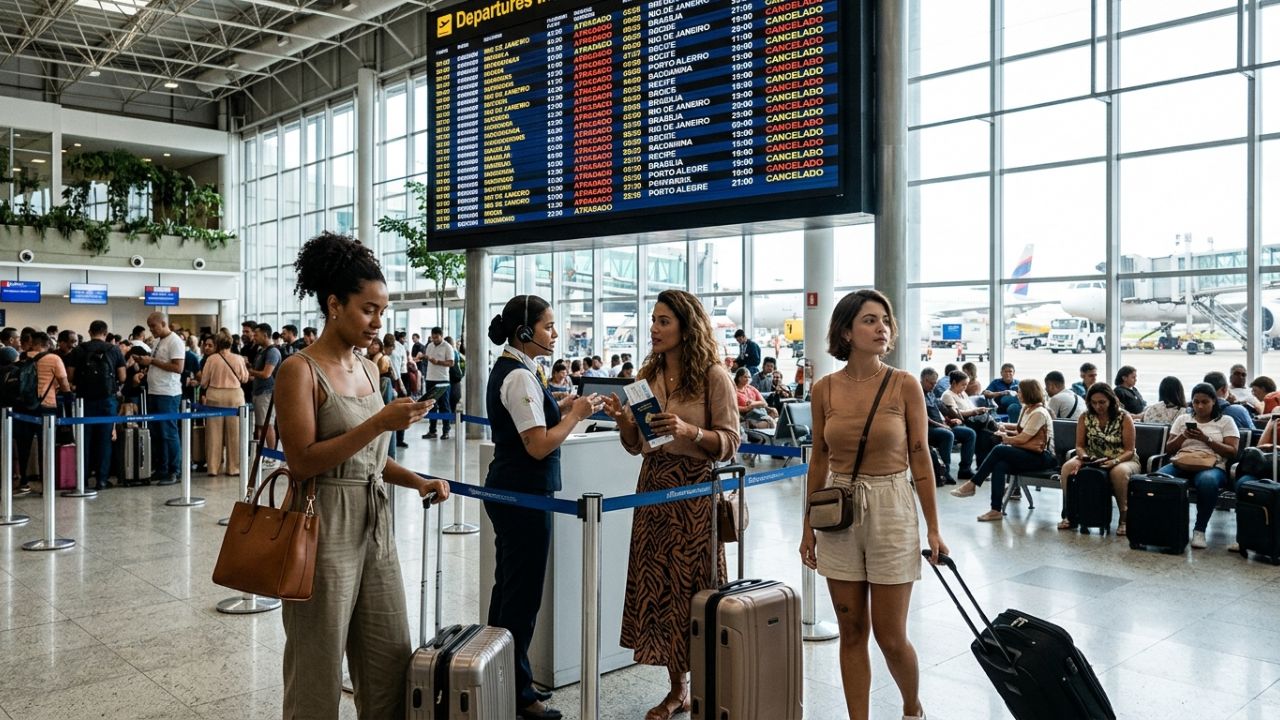
Image generated by AI
Aviation Updates: Massive Travel Chaos Strikes Brazil as 256 Disruptions Paralyze LATAM, Azul, and GOL in São Paulo and Rio
As highly localized operational friction and suddenly compounding infrastructure bottlenecks continue to terrorize the South American transit grid, a severe wave of massive logistical failures has officially struck Brazil's primary aviation gateways.
Image generated by AI
As high-impact airline news platforms rapidly issue continuous aviation updates regarding the intense fragility of the South American transit grid, Brazil has suffered a highly concentrated, nationwide operational meltdown. Today, severe ground operations completely deteriorated across the country's most vital economic sectors, instantly creating massive disruption. Based strictly on transport-aligned tracking metrics, incredibly vital air travel facilities—including São Paulo, Campinas, Brasília, Porto Alegre, Recife, Rio de Janeiro, Cuiabá, and Goiânia—recorded a massive combined 203 flight delays and 53 outright flight cancellations. This sudden, aggressive wave of severe airport disruptions instantly fractured the entire regional flow of crucial domestic and international connections. The intense travel chaos directly triggered a devastating cascading effect for thousands of desperate travelers, brutally disrupting major routes for leading carriers including LATAM Brasil, Azul Brazilian Airlines, and GOL Linhas Aéreas Inteligentes, alongside massive international partners like Air Canada, Iberia, Avianca, and Aerolineas Argentinas.
Expanded Overview: The Collapse of the Brazilian Hubs
To fully comprehend the sheer scale of this localized disaster, aviation analysts must closely examine the cascading operational failures paralyzing Brazil's busiest terminals.
The flight disruptions aggressively extended across an incredibly wide network of cities, highlighting the broad operational impact on regional commerce. LATAM Brasil, Azul Brazilian Airlines, and GOL accounted for the massive majority of destroyed services, completely failing to maintain their highly optimized daily rotations. The combination of rolling flight cancellations and severe delays placed immediate, crushing pressure on local airport services and passenger travel plans. As terminal congestion heavily spiked, desperately overworked airline representatives worked frantically to rebook thousands of passengers, while countless others faced agonizing, extended waits for alternative departures or overnight hotel vouchers. Consequently, regulatory bodies fiercely advised travelers to closely monitor flight updates before even attempting to travel to heavily congested terminals like São Paulo-Guarulhos.
Section-Wise Breakdown: São Paulo Absorbs the Heaviest Blow
The travel chaos heavily concentrated its destructive force on São Paulo State, completely devastating the region's three primary, interconnected aviation mega-hubs.
São Paulo-Guarulhos International Airport: Brazil’s absolute busiest international gateway collapsed under the pressure, recording a massive 82 delays and eight cancellations. LATAM Brasil was completely overwhelmed, suffering 45 delays and eight cancellations, followed closely by GOL Linhas Aéreas Inteligentes with 14 severe delays. International partners Air Canada, Iberia, Boliviana de Aviación, and Aerolineas Argentinas were also trapped in the escalating terminal gridlock.
São Paulo-Congonhas Airport: The crucial domestic hub experienced a brutal 38 delays and 11 outright cancellations. GOL Linhas Aéreas Inteligentes accounted for eight devastating cancellations and 14 delays, while LATAM Brasil recorded 18 delays and three cancellations. Azul Brazilian Airlines also suffered six delays, crippling short-haul commuter routes.
Viracopos International Airport (Campinas): Viracopos handled a severe 31 delayed flights and seven cancellations. Azul Brazilian Airlines, utilizing the hub as a primary base, was responsible for nearly all disruptions, suffering 29 delays and all seven cancellations. Euroatlantic Airways also recorded one delayed widebody flight.
Section-Wise Breakdown: Capital and Coastal Corridors Severed
The regional failures aggressively bled beyond São Paulo, devastating domestic passengers heavily relying on vital north-south connections.
Brasília & Rio de Janeiro: At Presidente Juscelino Kubitschek International Airport (Brasília), the capital suffered 10 delays and four cancellations, heavily split between LATAM Brasil and GOL. Simultaneously, Rio de Janeiro’s highly congested Santos Dumont Regional Airport registered five delays and six cancellations, with GOL suffering four cancellations and LATAM suffering two.
Porto Alegre & Recife: In the south, Salgado Filho International Airport (Porto Alegre) registered 13 delays and three cancellations, heavily paralyzing LATAM operations. In the northeast, Guararapes International Airport (Recife) recorded 10 delayed flights and three cancellations, heavily damaging Azul's coastal network. Furthermore, Goiânia (Santa Genoveva) reported nine delays and three cancellations, while Cuiabá (Marechal Rondon) suffered a brutal eight cancellations, heavily impacting Azul Conecta.
Flight Details: Brazil National Aviation Disruption Matrix
To ensure international travelers and aviation analysts can accurately track the exact operational telemetry of this highly concentrated transit failure, the verified disruption data has been consolidated into the mandatory matrix below.
| Airport Hub | Total Delays | Total Cancellations | Primary Affected Carrier |
|---|---|---|---|
| São Paulo-Guarulhos (GRU) | 82 Flights | 8 Flights | LATAM Brasil |
| São Paulo-Congonhas (CGH) | 38 Flights | 11 Flights | GOL Linhas Aéreas |
| Viracopos International (VCP) | 31 Flights | 7 Flights | Azul Brazilian Airlines |
| Brasília (BSB) | 10 Flights | 4 Flights | LATAM Brasil |
| Salgado Filho (POA) | 13 Flights | 3 Flights | LATAM Brasil |
| Guararapes (REC) | 10 Flights | 3 Flights | Azul Brazilian Airlines |
| Santa Genoveva (GYN) | 9 Flights | 3 Flights | LATAM Brasil |
| Marechal Rondon (CGB) | 5 Flights | 8 Flights | Azul Conecta |
| Santos Dumont (SDU) | 5 Flights | 6 Flights | GOL Linhas Aéreas |
Passenger Impact: Navigating the Terminal Gridlock
For the thousands of stranded commuters violently caught in the crossfire of this massive Brazilian aviation failure, executing rapid rebooking strategies is absolutely critical.
Flight cancellations are incredibly frustrating, but executing the proper recovery steps minimizes intense travel anxiety. When 256 total disruptions strike a highly interconnected national grid, passengers are heavily advised to fiercely check flight statuses before leaving for the airport and allow massive additional travel time for agonizingly slow airport security procedures. Stranded passengers must actively review available rebooking options via digital airline applications rather than waiting in massive physical lines. Furthermore, travelers must keep all digital boarding passes and travel documents readily available, as airlines frantically attempt to shuffle passengers onto highly limited alternative flights.
Industry Analysis: The Perfect Storm of External Friction
From a macro-aviation perspective, these massive flight disruptions across Brazil are explicitly being driven by a highly volatile mix of severe operational and external factors.
Airlines are frantically continuing to adjust highly complex national schedules following recent, massive regional network changes heavily associated with the sudden Venezuela airport closure. Simultaneously, incredibly strong, unyielding domestic passenger demand is placing massive, breaking-point pressure on localized airport operations. Furthermore, intense seasonal weather conditions in specific parts of the massive South American country have drastically reduced aircraft movement efficiency. This weather friction instantly causes minor rolling delays that eventually lead to outright, devastating cancellations, particularly at major hub airports like Guarulhos, where flight schedules are incredibly closely interconnected and highly sensitive to sudden delays.
Conclusion: Systemic Stabilization Required
Ultimately, this massive operational meltdown completely paralyzing Brazil brilliantly demonstrates exactly how sensitive highly connected regional airline networks truly are. With a staggering 203 flight delays and 53 cancellations completely destroying operations for LATAM Brasil, Azul, and GOL, the national travel grid remains severely fractured. Until domestic airlines successfully decide to implement massive operational buffers and weather-resilient scheduling, desperate travelers should absolutely expect more delays. Passengers are fiercely encouraged to continuously monitor real-time flight information, maintain strict digital contact with their airline, and explicitly allow extra time for potential schedule adjustments before ever attempting to navigate Brazil's intensely congested mega-hubs.
Key Takeaways
- Massive National Disruption: Brazil suffered a highly concentrated disruption event consisting of 203 rolling flight delays and 53 outright cancellations across all major hubs.
- São Paulo Decimated: The state of São Paulo absorbed the heaviest blow, with Guarulhos, Congonhas, and Viracopos suffering massive, compounding terminal gridlock.
- LATAM Suffers Heavily: LATAM Brasil recorded the absolute highest level of disruption nationwide with 84 delayed flights and 22 total cancellations.
- External Pressures: The travel chaos is being fueled by regional network changes tied to Venezuelan airspace, massive passenger demand, and severe seasonal weather friction.
- Digital Rebooking Required: To survive the chaos, passengers are strongly urged to utilize digital chat systems and airline apps to instantly rebook flights.
FAQ: Brazil Flight Disruptions
How many total flights were delayed or canceled in Brazil today? According to verified transport tracking metrics, operations across the massive South American country were severely disrupted, with airports officially logging 53 cancellations and 203 rolling delays.
Which airlines experienced the worst flight disruptions? The localized travel chaos heavily paralyzed Brazil's "big three" carriers. LATAM Brasil suffered 84 delays and 22 cancellations, Azul suffered 55 delays and 12 cancellations, and GOL suffered 39 delays and 14 cancellations.
Which Brazilian airport was the most affected by the delays? São Paulo-Guarulhos International Airport (GRU) reported the absolute highest volume of chaos, suffering a massive 82 rolling delays and eight outright flight cancellations.
What is causing these massive flight cancellations across Brazil? Aviation analysts confirm the disruptions are driven by a volatile mix of severe seasonal weather conditions, massive domestic passenger demand, and complicated regional network adjustments related to Venezuelan airspace closures.
Related Travel Guides
- Qatar Airways Launches Europe Flight Sale with Up to 12% Savings for August 2026 Bookings
- Fresh Travel Disruption Hits the UK: Major Flights Cancelled at Heathrow and Birmingham
- Breaking Airline News: Delta Airlines Deploys Massive Strategic Expansion from LAX to Hong Kong, Shielding Passengers from Terrifying Transit Chaos
Disclaimer: This article is strictly for informational and aviation planning purposes. The specific flight disruption telemetry (53 cancellations, 203 delays), affected airlines (LATAM, Azul, GOL), and impacted routes (São Paulo, Rio, Brasília) are based on verified, manually obtained FlightAware data available at the time of publication. South American airspace conditions, specific airline recovery schedules, and localized weather restrictions are highly dynamic and subject to immediate modification by the operating carriers and regulatory authorities. Passengers planning domestic or international travel through Brazil should explicitly verify their exact flight itineraries, strictly monitor their airlines for sudden flight cancellations, and secure comprehensive travel insurance prior to departure.
Disclaimer
This article is for informational and educational purposes only. It does not constitute legal, financial, or professional advice. While we strive to provide accurate and up-to-date information, travel policies, regulations, and conditions change rapidly. Always verify information with official sources before making travel decisions. Nomad Lawyer makes no representations about the accuracy, reliability, completeness, or suitability of the information provided. Readers should consult qualified professionals for advice specific to their circumstances. The views expressed in this article are those of the author and do not necessarily reflect the views of Nomad Lawyer.
Kunal K Choudhary
Co-Founder & Contributor
A passionate traveller and tech enthusiast. Kunal contributes to the vision and growth of Nomad Lawyer, bringing fresh perspectives and driving the community forward.
Learn more about our team →