
Bauchi State Unveils Electric Tricycle Charging Network: Transforming Urban Transit Economics in Northern Nigeria

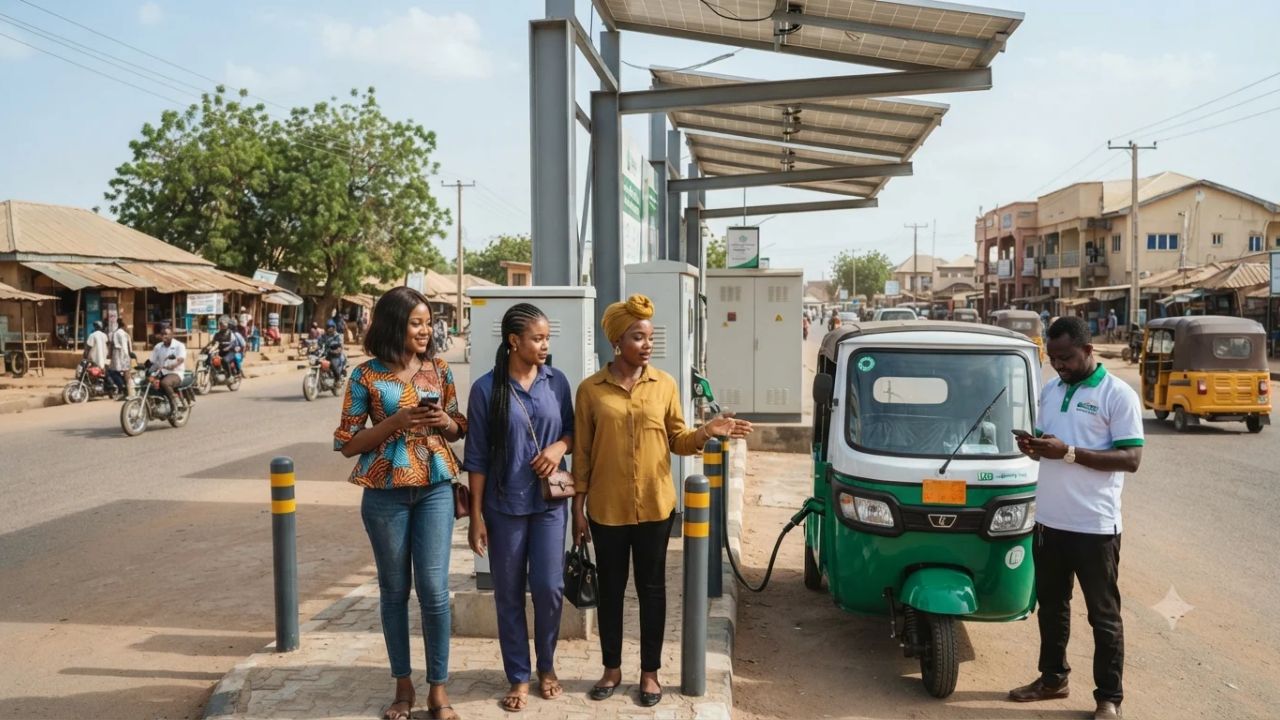
Image generated by AI
A strategic deployment of dedicated public charging hubs and battery-swapping stations across Bauchi State marks a decisive structural pivot away from volatile petroleum dependencies in northern Nigeria’s urban transit sector. By establishing purpose-built alternative energy infrastructure for commercial three-wheelers, the state administration aims to insulate daily commuters from recurrent fuel price shocks while accelerating the transition of regional public fleets toward zero-emission technologies.
Post-Subsidy Transport Economics: The Push for Clean Urban Mobility in Bauchi
Commercial three-wheelers, widely known as tricycles, represent the operational backbone of urban mobility across Bauchi, Azare, and neighboring commercial centers. Daily commuters, market traders, students, and civil servants depend heavily on these vehicles for short-haul intra-city connectivity. However, the operational viability of combustion-engine three-wheelers has faced intense structural pressure following national petroleum subsidy adjustments. Recurring swings in pump prices across retail filling stations routinely trigger unpredictable spikes in passenger fares, reducing disposable household incomes and creating logistical bottlenecks across municipal trade routes.
Recognizing the vulnerability of conventional fuel-powered transport networks, the Bauchi State Government has introduced an institutional blueprint to transition commercial transport fleets to battery-electric propulsion. Rather than relying on short-term palliative interventions or distributing additional internal combustion units, the administration is prioritizing hard infrastructure. Under the broader national decarbonization directives established by the Federal Ministry of Transportation Nigeria and renewable energy targets championed by the Energy Commission of Nigeria, Bauchi’s initiative targets the primary barrier to electric vehicle adoption: reliable charging access.
Urban transit corridors in Bauchi have historically suffered from heavy localized exhaust emissions and elevated acoustic pollution along dense market routes. The introduction of commercial electric tricycles, supported by standardized public charging hubs, directly addresses these environmental hazards. By coordinating municipal planning with regional utility distributors, the state government intends to create a predictable operating environment where clean-energy commercial vehicles can operate with commercial efficiency and technological stability.
Charging Architecture and Grid Allocation: Internal Combustion versus Electric Fleets
Building a durable ecosystem for electric commercial transport requires balancing electrical grid capacity, rapid turnaround times, and equitable retail energy tariffs.
The Bauchi State infrastructure master plan focuses on developing strategically dispersed charging hubs along high-density passenger collection corridors. To minimize vehicle downtime for commercial drivers who depend on rapid daily turnovers, planners are integrating battery-swapping protocols alongside high-voltage stationary charging units. Under a standardized battery-swapping framework, a commercial operator can exchange a depleted battery pack for a fully charged unit in under five minutes, eliminating the extended idle periods that traditionally hinder battery-powered commercial operations.
To ensure long-term operational resilience, the initiative requires structured guidelines governing safety standards, battery maintenance cycles, and driver training. Regulatory authorities are scheduling stakeholder engagement sessions with regional transport unions, vehicle fleet owners, and private clean-energy investors to establish transparent electricity retail tariffs. By clarifying grid connection protocols and establishing certified technical service hubs, the program provides clear investment visibility for commercial operators considering the transition to electric models.
| Operating Parameter | Conventional Combustion Tricycle Fleet | Municipal Electric Tricycle Network | Operational Impact on Commuters and Operators |
|---|---|---|---|
| Primary Energy Source | Premium Motor Spirit (petrol) subject to price shocks | Standardized battery packs charged via regional electrical grid | Insulates operating expenses from international petroleum swings |
| Refueling / Turnaround | Dependent on retail filling station queues and supply | Dedicated charging stations and rapid battery-swapping hubs | Reduces daily fueling delays and stabilizes vehicle availability |
| Fleet Maintenance Profile | Frequent engine oil changes, spark plugs, and belt repairs | Simplified electric drivetrain with reduced moving mechanical parts | Lowers long-term preventative maintenance overhead by up to 40% |
| Fare Volatility | Dynamic fare increases matching local petrol price spikes | Regulated, predictable passenger fares tied to power tariffs | Delivers budget certainty to everyday commuters and market traders |
| Environmental Footprint | Concentrated carbon monoxide, particulate matter, and noise | Zero tailpipe emissions and silent electric motor operation | Improves urban air quality and eliminates acoustic pollution in dense markets |
| Infrastructure Backing | Fragmented commercial fuel retail infrastructure | State-coordinated public charging bays and certified repair depots | Creates a formalized, institutional framework for commercial transit |
| Initial Capital Barrier | Established secondary vehicle market with low entry cost | Higher initial vehicle acquisition offset by lower operating costs | Demands structured micro-financing and supportive fleet lease models |
Expert Analysis: Operating Margin Compression, Fare Stability, and Fleet Electrification
The economic logic underpinning Bauchi’s public transport electrification reflects a fundamental realization among regional policymakers: urban transit stability is impossible without energy stability. When municipal mobility depends entirely on imported or highly volatile liquid fuels, transport operators inevitably pass fuel price risk directly onto vulnerable passengers.
For travelers booking this route, the direct consequence is an immediate stabilization of daily commuting budgets across major metropolitan districts. In conventional combustion tricycles, drivers routinely adjust their per-drop charges throughout the day based on the availability and price of petrol at neighborhood filling stations. In contrast, electric tricycles operating under regulated charging tariffs experience predictable operating costs per kilometer. The pricing pressure this creates means competitive fare dynamics will stabilize across key intra-city arteries, preventing sudden doubling of passenger tariffs during periods of fuel distribution friction.
Additionally, transition economics indicate substantial benefits for vehicle operators. While the upfront acquisition expense of an electric tricycle remains higher than that of an aging two-stroke or four-stroke combustion unit, daily operating costs are significantly lower. Electricity expenditures per operating shift represent a fraction of daily fuel outlays. Because electric drivetrains lack complex gearboxes, exhaust manifolds, and combustion chambers, routine mechanical breakdowns are less frequent. Drivers can direct operational savings toward loan amortizations or vehicle equity accumulation, strengthening informal transport entrepreneurship.
Nevertheless, the success of the electrification blueprint hinges on power grid reliability. Regional utility networks in northern Nigeria frequently manage constrained generation capacity and scheduled load rotation. To prevent charging stations from becoming stranded assets during grid interruptions, the Bauchi State Government must prioritize hybrid infrastructure, pairing grid feeds with distributed solar generation and battery storage banks. Aligning these municipal installations with international sustainability benchmarks outlined by the United Nations Environment Programme (UNEP) will be vital in attracting multilateral development financing to scale the network across secondary towns like Misau and Katagum.
Key Takeaways
- Strategic Charging Infrastructure: The Bauchi State Government has introduced an infrastructure plan to build electric tricycle charging stations and battery-swapping hubs across urban centers.
- Hedging Fuel Shocks: The transition directly counters erratic pump price surges, insulating intra-city commuters from sudden fare hikes caused by petrol market volatility.
- Battery-Swapping Efficiency: Integrating battery-swapping technology reduces commercial driver turnaround times to under five minutes, preserving daily earning hours.
- Lower Operating Overhead: Commercial drivers benefit from simplified electric drivetrains, eliminating standard oil changes and reducing scheduled maintenance expenses by up to 40%.
- Hybrid Energy Requirements: Long-term operational reliability demands pairing regional electrical grid connections with distributed solar power banks to ensure uninterrupted station uptime.
FAQ: Bauchi Electric Tricycle Transition 2026
Why is the Bauchi State Government investing in electric tricycle charging stations?
The Bauchi State Government is establishing electric charging hubs to insulate commercial transport from petroleum price shocks, stabilize daily commuter fares, and reduce urban air and noise pollution by replacing aging combustion-engine commercial tricycles with zero-emission alternatives.
How will electric tricycles impact commuter fares in Bauchi?
Electric tricycles operate under regulated electricity tariffs, drastically reducing per-kilometer running costs compared to petrol engines. This operational predictability stabilizes fare structures, protecting daily commuters and market traders from sudden fare hikes caused by volatile local fuel prices.
How does battery swapping solve charging downtime for commercial drivers?
Battery-swapping stations allow commercial operators to exchange depleted battery packs for fully charged units in under five minutes. This rapid process eliminates extended vehicle downtime, enabling drivers to maximize their active operating hours without waiting for standard plug-in charging cycles.
How will charging stations maintain power during regional grid outages?
To guarantee uninterrupted operational uptime, municipal charging hubs must integrate hybrid infrastructure. By combining regional grid feeds with distributed solar photovoltaic systems and commercial battery storage banks, stations can maintain charging operations during local utility power interruptions.
[By replacing volatile petroleum dependencies with standardized clean-energy charging hubs, Bauchi State establishes a durable municipal template for urban public transit across northern Nigeria.]
Related Travel Guides
Disclaimer
This article is for informational and educational purposes only. It does not constitute legal, financial, or professional advice. While we strive to provide accurate and up-to-date information, travel policies, regulations, and conditions change rapidly. Always verify information with official sources before making travel decisions. Nomad Lawyer makes no representations about the accuracy, reliability, completeness, or suitability of the information provided. Readers should consult qualified professionals for advice specific to their circumstances. The views expressed in this article are those of the author and do not necessarily reflect the views of Nomad Lawyer.
Raushan Kumar
Founder & Lead Developer
Full-stack developer with 11+ years of experience and a passionate traveller. Raushan built Nomad Lawyer from the ground up with a vision to create the best travel and law experience on the web.
Learn more about our team →