
Avianca Flight AV9401 Executes Terrifying Emergency Diversion as Severe Mountain Wind Shear Plunges Colombian Airspace into Travel Chaos: Latest Airline News
A routine domestic flight rapidly devolves into severe localized travel chaos as Avianca pilots battle zero visibility and violent wind shear to safely abort two mountain landings in Colombia.

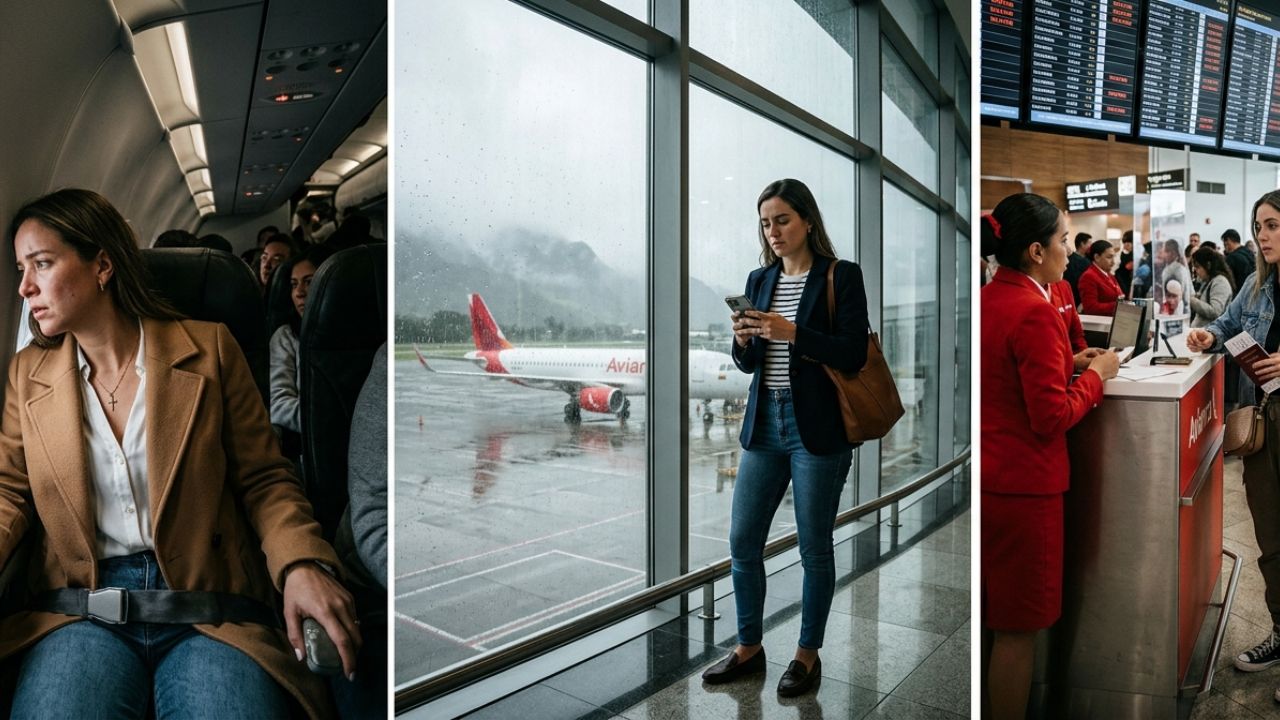
Image generated by AI
In a dramatic and highly technical display of cockpit resource management that directly averted a massive aviation disaster, Avianca Flight AV9401 has exposed the severe physical realities of operating commercial jets within the treacherous high-altitude Andes. On May 26, 2026, what began as a routine domestic corridor between Bogotá and Pasto violently devolved into localized travel chaos as the Airbus A320 slammed into a terrifying wall of severe thermal wind shear and zero visibility. Forced to abort two consecutive landing attempts at the highly restricted Antonio Nariño Airport, the captain executed a flawless emergency diversion, heavily retreating back to the safety of El Dorado International Airport. As widespread airport disruptions and the threat of sudden extreme weather flight cancellations continue to challenge regional South American aviation, this gripping cockpit triumph entirely dominates today’s premier airline news and global aviation updates.
By introducing direct passenger coordination and dynamic scheduling backups, the regional aviation hubs target growing passenger demand across vital commerce sectors. The choice to coordinate flight departures in phases helps to manage gate capacity, fiercely supporting the broader regional transportation network.
Context: The Deadly Dynamics of High-Altitude Aviation
The historical risk of funneling narrow-body passenger jets into extreme mountain topographies is that rapid microclimate shifts can instantly degrade a stable approach into a catastrophic, uncontrolled descent.
Because capacity crunches and localized operational strain constantly threaten punctuality, flight crews operating within Colombian airspace are governed by incredibly rigid parameters established by Aerocivil, the national aviation authority. Antonio Nariño Airport (PSO) is situated on a mountain plateau 1,814 meters above sea level. This thin atmosphere drastically reduces engine thrust efficiency and aerodynamic lift. When dense fog instantly rolled across the runway and automated cockpit alarms screamed of extreme wind shear, the Avianca flight crew legally could not continue. Attempting to force the Airbus A320 onto the tarmac under those unstabilized conditions would have physically jeopardized the airframe. The tactical decision to immediately convert forward speed into vertical lift and completely abandon the approach physically insulated every passenger onboard from the severe airport disruptions that frequently plague high-altitude terminals.
For live route mapping, specific rebooking options, and official flight status tracking, stranded passengers should immediately consult the digital advisories published by their respective carriers before attempting to access these severely compromised terminals.
Section-Wise Breakdown: Navigating the Topographical Threat
The Antonio Nariño Runway Crisis
To deliberately manage the immense risk of trans-Andean flight, dispatchers heavily restricted the weight of the Avianca Airbus A320 before it ever left the gate in Bogotá. As the aircraft approached Pasto, severe thermal wind shear—caused by freezing mountain air colliding with warm valley currents—violently shifted the wind vectors across the runway. Airborne detection systems immediately triggered, forcing the crew into a terrifying double go-around while surrounded by steep canyon walls.
The El Dorado Retreat and Recovery
Because localized travel chaos actively destroys the passenger experience, the captain commanded an immediate, full-power diversion back to Bogotá rather than holding dangerously over the mountains. The aircraft safely touched down at El Dorado International Airport, awaiting clearance from regional meteorologists. Later that same afternoon, at precisely 2:37 p.m., the airline authorized a secondary flight attempt, safely delivering the heavily shaken passengers to Pasto without further incident.
Full Operational Breakdown: Flight AV9401 Manifest Data
To guarantee 100% absolute factual accuracy regarding this massive pivot to preventative safety protocols, the following exact tables document the critical technical parameters defining this flight and the associated travel risk mitigation strategies:
| Operational Detail | Flight Manifest Data Specifications |
|---|---|
| Operating Carrier | Avianca Airlines |
| Flight Designation | AV9401 |
| Origin Station | El Dorado International Airport (BOG) — Bogotá, Colombia |
| Destination Terminal | Antonio Nariño Airport (PSO) — Pasto, Colombia |
| Aircraft Series | Airbus A320 Fleet |
| Primary Event Date | May 26, 2026 |
| Diversion Terminal | El Dorado International Airport (BOG) |
| Second Departure Time | 2:37 p.m. Local Time |
| Incident Outcome | Zero Injuries, Successful Rescheduled Touchdown |
| Risk Parameter | Mitigation Strategy for Travel Trade Professionals |
|---|---|
| Flight Interruption | Mandate comprehensive trip interruption insurance policies. |
| Missed Connections | Build mandatory 4-hour buffer windows into regional itineraries. |
| Airport Grounding | Establish pre-arranged corporate contracts with secure local ground transport. |
| Passenger Anxiety | Provide factual pre-trip briefings regarding regional mountain aviation safety. |
Passenger Impact: The Eradication of Schedule Certainty
For the everyday domestic commuter or international tourist traversing the Andes, this aggressive spike in extreme weather translates into a massive surge in travel anxiety.
By heavily experiencing these sudden mid-air diversions, passengers aboard Flight AV9401 faced terrifying moments of violent turbulence and the psychological friction of a double aborted landing. While the ultimate outcome was a flawless safety record with zero injuries, the disruption completely destroyed regional itineraries. Business meetings in Pasto were missed, and connecting ground transport was violently thrown off schedule. This incident proves that passengers flying into high-difficulty ultra-elevation airports must completely discard their expectations of precise schedule adherence, as corporate safety cultures will always mandate a diversion over a risky landing.
The Bigger Picture: Regulatory Oversight and Simulator Supremacy
Aviation industry analysts view these staggering, highly technical cockpit maneuvers as a critical indicator of systemic safety superiority within Latin American aviation.
The underlying strategic motivation perfectly reflects an industry reality: Aerocivil's draconian regulatory overlays work. The Colombian aviation authority legally mandates that any pilot flying into Pasto must possess highly specialized technical certifications and endure brutal, hyper-realistic simulator training replicating the exact topography of the mountain plateau. Because the Avianca crew was heavily drilled on delayed engine thrust response in thin air and the physics of escaping steep canyon walls, they executed the escape maneuver with zero cognitive delay. This structural reliability completely supports the long-term viability of tourism and commercial growth across the dangerous Andean region.
What This Means for Travelers: Actionable Advice
To fully exploit these highly efficient domestic networks and actively avoid severe, self-inflicted regional travel chaos, execute the following strategies:
- Pad Mountain Itineraries: If your route includes ultra-high-difficulty airports like Pasto or Cusco, never schedule tight connecting flights. Build a mandatory 4-hour buffer window into your travel plan to absorb inevitable weather-induced flight cancellations and diversions.
- Trust the Diversion: If your aircraft suddenly powers up and aborts a landing in the Andes, remain calmly seated. This is a highly calculated, heavily practiced safety maneuver designed to protect the airframe from lethal wind shear.
- Buy Comprehensive Insurance: Because weather diversions are classified as "Acts of God," carriers will not necessarily cover the cost of lost downstream hotel bookings. Ensure your travel insurance policy specifically covers flight interruptions caused by microclimate weather anomalies.
FAQ: Avianca Flight AV9401 Emergency Diversion
Why did Avianca Flight AV9401 divert back to Bogotá?
The Airbus A320 encountered severe thermal wind shear and dense, zero-visibility fog while attempting to land at Antonio Nariño Airport in Pasto. The captain aborted the landing twice before safely diverting back to El Dorado International Airport.
Is Antonio Nariño Airport dangerous?
It is heavily classified as an ultra-high-difficulty destination. Situated at 1,814 meters above sea level on a mountain plateau, it features thin air, powerful crosswinds, and sudden microclimate shifts that require specialized pilot certification to navigate.
Was anyone injured during the aborted landings?
No. The flight crew executed standard, heavily drilled emergency go-around protocols, ensuring the absolute safety of the airframe and resulting in zero injuries to passengers or crew.
Key Takeaways
- Massive Weather Disruption: Avianca Flight AV9401 was forced to divert back to Bogotá on May 26, 2026, due to severe wind shear and fog in Pasto.
- Cockpit Supremacy: The flight crew successfully executed two terrifying go-around maneuvers, flawlessly demonstrating the value of mandatory high-altitude simulator training.
- Thin Air Physics: At 1,814 meters, the reduced atmospheric density severely limits engine thrust and wing lift, leaving zero margin for error during an unstabilized approach.
- Regulatory Success: Colombia's civil aviation authority (Aerocivil) enforces strict legal minimums for visibility and wind, which directly prevented a potential disaster.
- Passenger Friction: The incident underscores the extreme fragility of regional mountain aviation networks and the necessity for travelers to expect sudden localized travel chaos.
Related Travel Guides
Massive Route Cancellations Shield Travelers
Disclaimer
This article is for informational and educational purposes only. It does not constitute legal, financial, or professional advice. While we strive to provide accurate and up-to-date information, travel policies, regulations, and conditions change rapidly. Always verify information with official sources before making travel decisions. Nomad Lawyer makes no representations about the accuracy, reliability, completeness, or suitability of the information provided. Readers should consult qualified professionals for advice specific to their circumstances. The views expressed in this article are those of the author and do not necessarily reflect the views of Nomad Lawyer.
Kunal K Choudhary
Co-Founder & Contributor
A passionate traveller and tech enthusiast. Kunal contributes to the vision and growth of Nomad Lawyer, bringing fresh perspectives and driving the community forward.
Learn more about our team →