
Massive Asian Monsoon Gridlock Sparks Global Travel Chaos With Over 3,800 Flight Cancellations and Delays
Breaking airline news: Severe convective weather systems and monsoons across Asia trigger unprecedented travel chaos, causing 325 flight cancellations and 3,513 delays across massive global transit hubs.

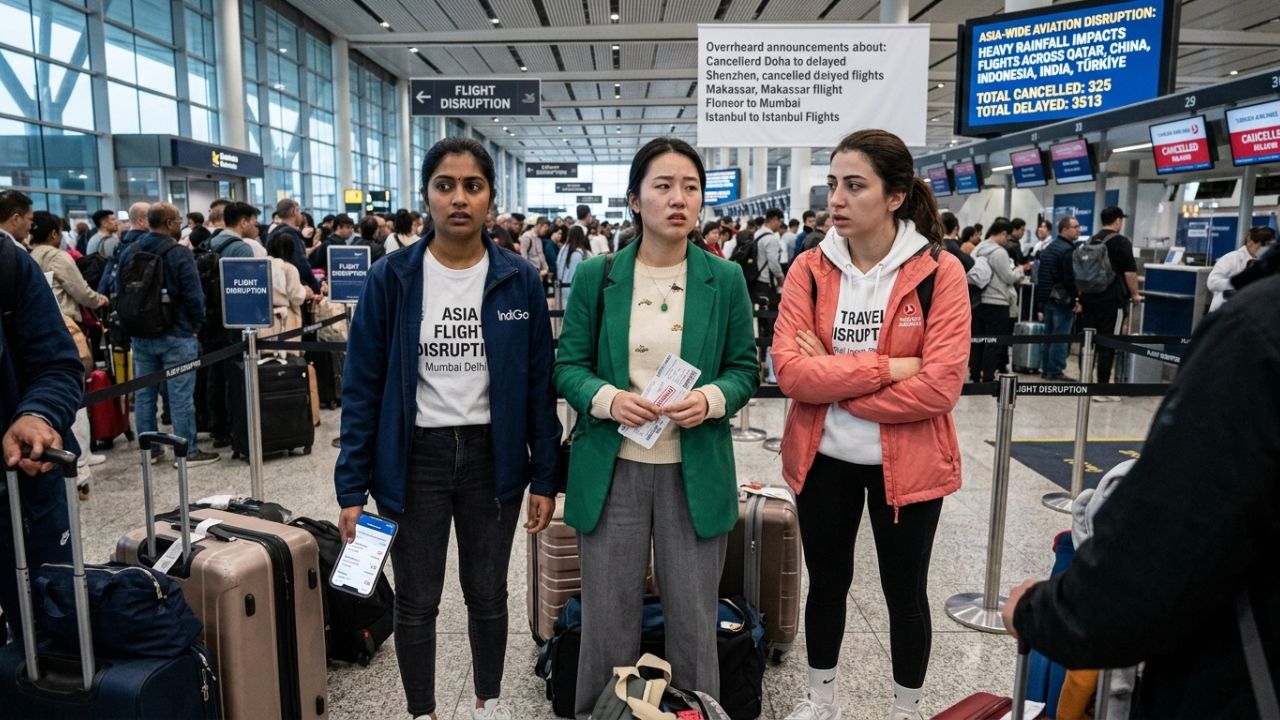
Image representing the unprecedented travel chaos paralyzing the Asian aviation network, where severe convective weather has triggered 325 flight cancellations and 3,513 delays, severely crippling connectivity from China and India to the Middle East. (Image Credit: Asian Aviation Network)
Massive Asian Monsoon Gridlock Sparks Global Travel Chaos With Over 3,800 Flight Cancellations and Delays
Severe Weather Systems Paralyze Massive International Hubs Across China, India, and the Middle East
The interconnected global aviation network is currently buckling under the immense pressure of severe atmospheric instability. According to the latest breaking airline news and massive-scale aviation tracking telemetry, intense convective weather systems and monsoon-driven rainfall have plunged the entire Asian continent into a state of absolute travel chaos. On June 15, 2026, operations across key international corridors in East, Southeast, and South Asia essentially collapsed, officially triggering an overwhelming 325 absolute flight cancellations alongside an incredibly catastrophic 3,513 flight delays. This massive operational meltdown, totaling 3,838 disruption events, has weaponized transit networks against millions of passengers. Massive global gateways—spanning from Shenzhen, Guangzhou, and Shanghai to Jakarta, Delhi, Mumbai, and Tokyo—are experiencing total terminal gridlock as airlines struggle fruitlessly to maintain network punctuality.
This sprawling logistical nightmare perfectly illustrates how rapidly severe weather at a primary geographic epicenter can destabilize global travel. When major carriers such as China Eastern, China Southern, IndiGo, Hainan Airlines, Japan Airlines, and AirAsia suffer simultaneous schedule setbacks due to overlapping weather systems, the resulting shockwaves violently destroy connectivity far beyond Asia. Because modern aviation relies on continuous aircraft rotation, the massive airport disruptions originating in China and Indonesia instantly spread into the Middle East, heavily impacting mega-hubs like Istanbul, Dubai, and Doha. Thousands of international passengers found their meticulously planned corporate itineraries and global leisure holidays completely obliterated. As airline operational control centers desperately attempt to untangle congested airspace and reroute flights, the terrifying reality inside these terminals highlights the extreme vulnerability of the international aviation grid to acute monsoon activity.
Section-Wise Breakdown: The Anatomy of the Pan-Asian Disruption
The operational collapse radiating across the Asian continent reveals how quickly severe weather paralyzes major carriers across the global aviation spectrum:
The Chinese Aviation Meltdown According to real-time aviation updates, China remains the absolute epicenter of the current disruption wave. Persistent rainfall and convective weather systems have ravaged the country's primary departure banks. Guangzhou Baiyun International Airport recorded a staggering 58 cancellations and 507 delays, making it the most heavily impacted airport in the dataset. Shenzhen Bao’an International followed closely, absorbing 30 cancelled flights and 516 delays. The Shanghai corridor was equally crippled, with Pudong International reporting 20 cancellations and 212 delays, and Hongqiao logging 18 cancellations and 171 delays. Even the capital was not spared; Beijing Daxing recorded 14 cancellations (117 delays) while Beijing Capital saw 8 cancellations (95 delays). Secondary airport disruptions across Xi’an, Chongqing, Hangzhou, Kunming, Chengdu, Zhengzhou, and Wuhan confirm a catastrophic nationwide operational slowdown. Chinese carriers unsurprisingly dominated the impact list, with Hainan Airlines executing 38 cancellations and China Eastern executing 32 cancellations alongside 334 delays.
Southeast Asia and Indian Subcontinent Gridlock The intense weather patterns dragged Southeast and South Asian networks into the travel chaos. In Indonesia, Jakarta Soekarno–Hatta International Airport reported 17 cancellations and 212 delays, while Sultan Hasanuddin (Makassar) and Halim Perdanakusuma airports experienced strong secondary interruptions. The Indian subcontinent felt severe pressure: Indira Gandhi International Airport (Delhi) recorded 4 cancelled flights and 165 delays, and Chhatrapati Shivaji Maharaj (Mumbai) suffered 3 cancellations and 47 delays. Indian low-cost giant IndiGo recorded an incredible 200 delays and 1 cancellation—the absolute highest delay count in the region. Other South Asian operators including SpiceJet, Akasa Air, and Pakistan International Airlines were all caught in the massive operational backlog. In Southeast Asia, Batik Air suffered 22 cancellations and 52 delays, while AirAsia absorbed 2 cancellations and 112 rolling delays.
The Middle Eastern and Japanese Ripple Effect The disruption proved completely indiscriminate, heavily impacting interconnected networks geographically distant from the monsoon zones. In East Asia, Tokyo Haneda Airport experienced 4 cancellations and 153 delays, severely penalizing Japan Airlines (3 cancellations, 126 delays) and All Nippon Airways (2 cancellations, 124 delays). Cathay Pacific was also caught in the regional crossfire, absorbing 90 delays and 1 cancellation. Most terrifyingly, the travel chaos penetrated the Middle East due to severe inbound aircraft delays and rerouted traffic. Istanbul Airport recorded a massive 202 delays and 2 cancellations, Dubai International Airport absorbed 119 delays and 1 cancellation, and Hamad International (Doha) reported 54 delays and 1 cancellation. Additional gridlock was recorded across Riyadh, Jeddah, Dammam, and Bahrain, proving that a monsoon in Guangzhou can instantly paralyze a transit hub in the UAE. Middle Eastern carriers felt the strain, with Qatar Airways logging 50 delayed flights.
Operational Infrastructure Details: The Pan-Asian Disruption Matrix
To provide exact, factual clarity on the immense scale of this systemic failure, aviation analysts have mapped the specific delay and cancellation metrics impacting major carriers across the affected zones. The following factual matrix details the precise breakdown of the massive disruption:
Factual Pan-Asian Airline Disruption Matrix
| Major Airline | Cancelled Flights | Delayed Flights | Primary Geographic Zone |
|---|---|---|---|
| Hainan Airlines | 38 | 107 | China / East Asia |
| China Eastern Airlines | 32 | 334 | China / East Asia |
| China Southern Airlines | 25 | 381 | China / East Asia |
| Batik Air | 22 | 52 | Southeast Asia |
| Air China | 15 | 115 | China / East Asia |
| Shenzhen Airlines | 5 | 205 | China / East Asia |
| Japan Airlines | 3 | 126 | Japan / East Asia |
| AirAsia | 2 | 112 | Southeast Asia |
| All Nippon Airways | 2 | 124 | Japan / East Asia |
| flyadeal | 2 | 3 | Middle East |
| IndiGo | 1 | 200 | India / South Asia |
| Cathay Pacific | 1 | 90 | East Asia Hub |
| Qatar Airways | 1 | 50 | Middle East Transit Hub |
| Saudia | 1 | 29 | Middle East |
| flydubai | 1 | 29 | Middle East |
Data recorded during the peak disruption period. (Source: FlightAware)
Passenger Impact: Surviving Intercontinental Terminal Gridlock
For the hundreds of thousands of passengers trapped inside massive global mega-hubs like Shenzhen, Jakarta, and Dubai, this disruption represents an unparalleled form of travel chaos. Enduring rolling delays across multiple continents creates intense psychological exhaustion, while sudden flight cancellations generate immense logistical and financial liability. The immediate impact is staggering: missed onward intercontinental connections, extended airport layovers reaching well past 12 hours, and the agonizing reality of overwhelmed airline customer service desks. Because replacement capacity on long-haul routes connecting Asia to Europe and the Middle East is highly rigid, passengers faced the terrifying reality of ruined itineraries and strictly compromised visa entry timings. Early arrival at airports in China and India has been highly mandated due to extreme security backlogs and overflowing departure halls.
Industry Analysis: Network Interdependency Under Weather Pressure
The global aviation sector is currently wrestling with the extreme physical limits of network dependency during severe weather events. The incredible volume of airport disruptions radiating from China into Türkiye and the Gulf States highlights the fragility of intercontinental scheduling. When intense monsoon-driven rainfall simultaneously grounds China Eastern, IndiGo, and Japan Airlines, the entire global timetable collapses. Because aircraft utilized for Middle Eastern routes are trapped on the tarmac in Guangzhou or Mumbai, flights out of Istanbul and Dubai are subsequently delayed. Airlines must continuously attempt to prioritize recovery, but overlapping weather systems and highly congested regional airspace make immediate stabilization impossible.
Conclusion: A Fractured Asian Transit Grid
The severe operational disruptions striking the Asian and Middle Eastern aviation networks serve as a terrifying reminder of the absolute volatility of modern commercial flight. By suffering a combined wave of 325 outright flight cancellations and 3,513 severe delays, the region inadvertently plunged the global aviation network into deep travel chaos. The resulting delays crippled tightly choreographed itineraries connecting massive hubs like Guangzhou, Delhi, and Istanbul, deeply impacting China Southern, IndiGo, and Japan Airlines. While airlines desperately scramble to execute phased recovery plans, offering dynamic rebooking options for stranded international passengers, the meltdown brutally highlights how rapidly a widespread atmospheric event can metastasize, transforming routine global transit into a highly expensive logistical nightmare. (Source: FlightAware via Nomad Lawyer)
Key Takeaways
- Massive Systemic Breakdown: Severe weather across Asia triggered 325 flight cancellations and 3,513 delays, severely crippling global connectivity.
- Chinese Aviation Meltdown: Guangzhou Baiyun (58 cancels) and Shenzhen Bao'an (30 cancels, 516 delays) were the most heavily impacted airports globally.
- Carrier Devastation: China Southern (381 delays), China Eastern (334 delays), and IndiGo (200 delays) absorbed massive operational shockwaves.
- Middle Eastern Contagion: The travel chaos severely disrupted inbound aircraft connecting to massive transit hubs like Istanbul (202 delays) and Dubai (119 delays).
- Regional Ripple Effects: Japan Airlines, All Nippon Airways, Batik Air, and AirAsia were all caught in the severe airspace gridlock.
✈️ Frequently Asked Questions (Factual Aviation Data)
What was the primary cause of the massive flight disruptions across Asia? The massive disruptions were triggered by severe convective weather systems, monsoon-driven rainfall, and intense atmospheric instability across the region.
Exactly how many flights were cancelled and delayed during this widespread event? Aviation tracking data recorded an incredible 325 absolute flight cancellations alongside 3,513 severe flight delays, totaling 3,838 impact events.
Which specific airport was the most heavily impacted by flight cancellations? Guangzhou Baiyun International Airport was the most heavily impacted, recording 58 flight cancellations and 507 delays.
Which major Chinese airline recorded the highest number of flight cancellations? Hainan Airlines recorded the highest absolute cancellation volume with 38 cancelled flights.
Which airline in the South Asian region absorbed the highest delay volume? IndiGo recorded the absolute highest delay count in the South Asian region with 200 severe delays and 1 cancellation.
Did the flight disruptions impact Japanese aviation operations? Yes, Tokyo Haneda Airport experienced 153 delays and 4 cancellations, heavily impacting Japan Airlines (126 delays) and All Nippon Airways (124 delays).
Which Middle Eastern transit hubs were most severely affected by the delayed inbound traffic? Istanbul Airport recorded 202 delays, while Dubai International Airport registered 119 delays due to the severe regional flow-on effects.
Where was this specific flight disruption data officially sourced from? All specific delay metrics and cancellation statistics regarding the Pan-Asian disruption were officially sourced from FlightAware and affected airports.
🌍 Related Travel Guides & Flight Resources
- Navigate Airport Disruptions Like a Pro Master the art of surviving unexpected travel chaos with our expert strategies.
- Breaking Airline News & Evasion Routes Stay ahead of the delays with our real-time aviation updates and route intelligence.
- Global Flight Cancellation Defense Grid Essential legal rights and compensation tactics when your flight goes down.
⚖️ Disclaimer
The aviation safety statistics, flight tracking data, and airport delay reports provided in this report are for informational purposes only. Aircraft operational statuses, specific delay metrics regarding China Eastern, IndiGo, Japan Airlines, Qatar Airways, and other carriers at affected Asian and Middle Eastern airports, and the subsequent global recovery timeline are highly volatile and subject to ongoing review by airline operational control centers. All data regarding the Pan-Asian weather disruption has been officially sourced from live aviation tracking platforms (FlightAware) as of June 15, 2026, and remains completely fluid as airlines restore normal operations. NomadLawyer does not guarantee the absolute accuracy or current validity of the information provided and assumes no liability for travel disruptions, sudden flight cancellations, missed intercontinental connections, altered itineraries, or any financial consequences resulting from the use of this content. Passengers affected by the systemic delays are strongly advised to monitor airline mobile apps for dynamic rebooking options and expect extended layovers at major transit hubs.
Disclaimer
This article is for informational and educational purposes only. It does not constitute legal, financial, or professional advice. While we strive to provide accurate and up-to-date information, travel policies, regulations, and conditions change rapidly. Always verify information with official sources before making travel decisions. Nomad Lawyer makes no representations about the accuracy, reliability, completeness, or suitability of the information provided. Readers should consult qualified professionals for advice specific to their circumstances. The views expressed in this article are those of the author and do not necessarily reflect the views of Nomad Lawyer.
Kunal K Choudhary
Co-Founder & Contributor
A passionate traveller and tech enthusiast. Kunal contributes to the vision and growth of Nomad Lawyer, bringing fresh perspectives and driving the community forward.
Learn more about our team →