
Asia Plunged Into Travel Chaos as 61 Flights Cancelled Across Jakarta, Kuala Lumpur, and Tokyo: Batik Air and AirAsia Ground Hundreds of Desperate Passengers: Latest Airline News
A massive wave of 61 flight cancellations has violently swept across major Asian mega-hubs, stranding thousands of passengers at Jakarta Soekarno-Hatta, Kuala Lumpur, and Tokyo Haneda.

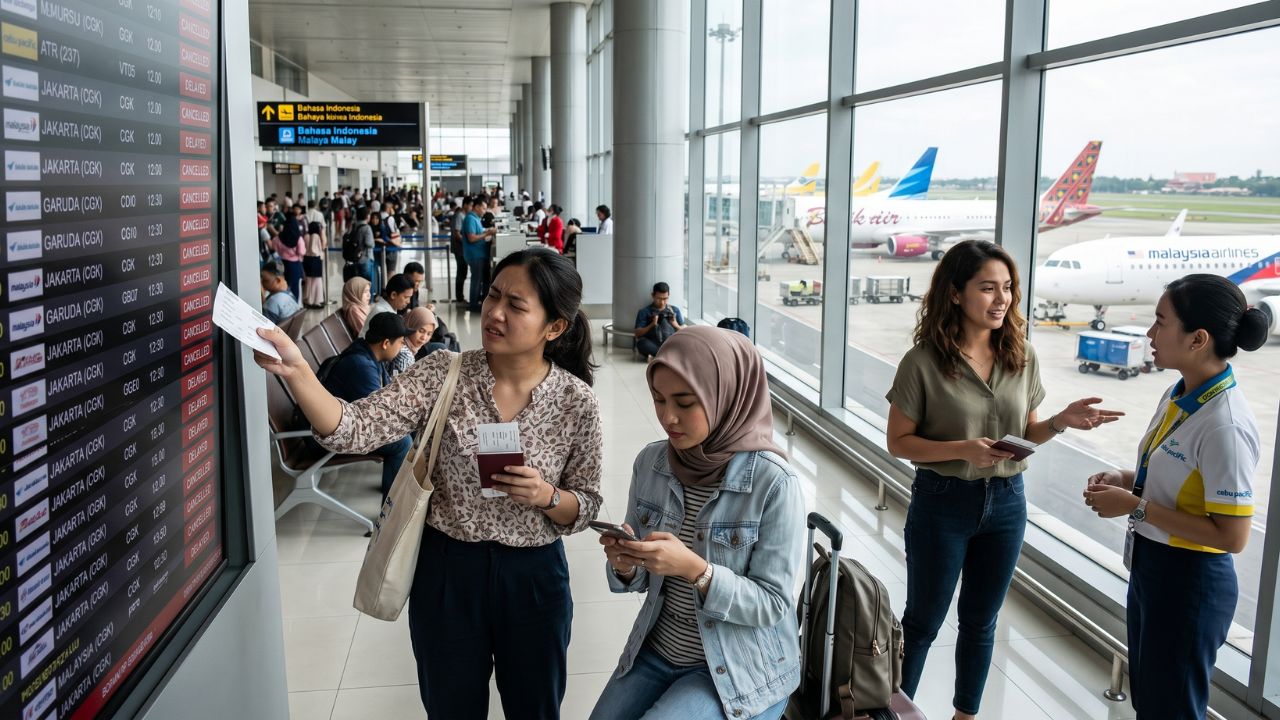
Image generated by AI
In a massive, cascading operational collapse that has violently fractured the entire Asian aviation corridor, a staggering 61 flights have been outright cancelled, generating crippling travel chaos and stranding thousands of passengers across the continent's most critical transit hubs. Originating on June 16, 2026, the sweeping disruptions have paralyzed massive mega-hubs including Sultan Hasanuddin International Airport, Jakarta Soekarno-Hatta International Airport, Kuala Lumpur International Airport, Indira Gandhi International Airport, and Tokyo Haneda Airport. Heavyweight carriers such as Batik Air (BTK), AirAsia (AXM), Garuda Indonesia (GIA), and Citilink (CTV), alongside global titans like Japan Airlines (JAL) and Air India (AIC), are buckling under intense operational pressure. This devastating wave of massive flight cancellations and unyielding airport disruptions represents the premier headline in today's breaking airline news and global aviation updates.
By introducing direct passenger coordination and dynamic scheduling backups, the regional aviation hubs target growing passenger demand across vital commerce sectors. The choice to coordinate flight departures in phases helps to manage gate capacity, supporting the country's broader regional transportation network.
Context: The Collapse of the Asian Transit Corridor
The scale of this aviation crisis is staggering, highlighting the brutal fragility of interconnected Asian airspace. When major hubs like Jakarta and Kuala Lumpur experience simultaneous schedule degradation, the ripple effects instantly infect connecting long-haul networks.
Currently, passengers attempting to navigate these corridors are facing fully severed itineraries, hours-long terminal congestion, and a complete lack of available rebooking options. The disruptions have decimated a massive roster of airlines; beyond regional operators like Batik Air and AirAsia, legacy carriers including Philippine Airlines (PAL), SpiceJet (SEJ), All Nippon Airways (ANA), and American Airlines (AAL) have suffered severe schedule collapses. These grounded flights span both high-frequency domestic domestic hops and ultra-lucrative international sectors.
To view live flight schedules, real-time terminal maps, or check-in rules at the epicenter of the crisis, travelers can consult the official Jakarta Soekarno-Hatta Airport (CGK) directory. For direct booking access, specific rebooking policies, and passenger baggage rules, passengers can check the official Batik Air or AirAsia portals. To explore live flight tracking, check delay maps, or monitor exact fleet routing, passengers can consult the official FlightAware tracking service.
Section-Wise Breakdown of the Asian Aviation Meltdown
Devastation at Jakarta Soekarno-Hatta (CGK)
Indonesia's premier mega-hub is experiencing the absolute highest volume of localized destruction. Jakarta Soekarno-Hatta International Airport faced extensive disruptions across routes linking Penang, Kuala Lumpur, Bali, Lombok, and Surabaya. Both incoming arrivals and outbound departures were aggressively gutted, heavily impacting Citilink, Garuda Indonesia, and Batik Air operations, forcing thousands of domestic and international travelers into holding pens at the terminals.
Kuala Lumpur and Sultan Hasanuddin Grounded
The crisis seamlessly spread across the archipelago. Sultan Hasanuddin International Airport (Makassar) recorded multiple cancellations targeting Jakarta, Mutiara, and Pattimura-bound services, entirely stalling regional connectivity. Simultaneously, Kuala Lumpur International Airport (Sepang) saw its regional AirAsia network violently disrupted, with massive cancellations concentrated on high-frequency Penang and Senai shuttle services.
Haneda and New Delhi Suffer Long-Haul Collapses
The contagion of flight cancellations successfully infected the outer edges of the Asian network. Indira Gandhi International Airport (New Delhi) experienced grounded arrivals from Incheon, Mumbai, Kolkata, Nagpur, and Kangra, heavily impacting Air India and SpiceJet. In Japan, Tokyo Haneda Airport reported critical disruptions to premium inbound flights originating from New York, London, Hachijojima, and Yamaguchi Ube, paralyzing operations for JAL, ANA, and American Airlines.
Technical Roster: The 61 Cancelled Asian Flights
To ensure absolute factual accuracy regarding this massive operational collapse, the following tables strictly reproduce the exact flight numbers, aircraft types, and routing details of the cancelled services across the affected hubs:
Cancelled Departures – Sultan Hasanuddin International Airport (WAAA, Makassar)
| Flight No. | Aircraft | Destination | Scheduled Departure |
|---|---|---|---|
| BTK6555 | A320 | Jakarta–Soekarno-Hatta (CGK / WIII) | Wed 06:35 PM WITA |
| BTK6231 | A320 | Jakarta–Soekarno-Hatta (CGK / WIII) | Tue 09:05 PM WITA |
| BTK6708 | B738 | Jakarta–Soekarno-Hatta (CGK / WIII) | Tue 12:15 PM WITA |
| BTK6231 | A320 | Jakarta–Soekarno-Hatta (CGK / WIII) | Mon 09:05 PM WITA |
| BTK6235 | B738 | Jakarta–Soekarno-Hatta (CGK / WIII) | Mon 06:35 PM WITA |
| BTK6708 | B738 | Jakarta–Soekarno-Hatta (CGK / WIII) | Mon 12:15 PM WITA |
Cancelled Arrivals – Jakarta Soekarno-Hatta International Airport (WIII)
| Flight No. | Type | Origin | Scheduled Arrival |
|---|---|---|---|
| BTK7058 | A320 | Sultan Mahmud Badaruddin II (PLM / WIPP) | Wed 08:00 PM WIB |
| BTK6555 | A320 | Sultan Hasanuddin Int’l (UPG / WAAA) | Wed 08:55 PM WITA |
| GIA187 | B738 | Kuala Namu International (KNO / WIMM) | Wed 03:15 PM WIB |
| BTK6863 | A320 | Hang Nadim (BTH / WIDD) | Wed 08:45 AM WIB |
| BTK7066 | A320 | Sultan Syarif Qasim II Int’l (PKU / WIBB) | Wed 08:15 AM WIB |
| CTV9665 | A320 | Ngurah Rai/Bali Intl (DPS / WADD) | Wed 12:35 AM WITA |
| BTK6231 | A320 | Sultan Hasanuddin Int’l (UPG / WAAA) | Tue 11:20 PM WITA |
| CTV413 | A320 | Supadio (PNK / WIOO) | Tue 08:35 PM WIB |
| CTV993 | A320 | Radin Inten II (TKG / WILL) | Tue 07:05 PM WIB |
| BTK7040 | A320 | Adisumarmo International (SOC / WAHQ) | Tue 06:45 PM WIB |
| BTK6709 | A320 | Radin Inten II (TKG / WILL) | Tue 05:20 PM WIB |
| BTK6659 | A320 | Lombok International (LOP / WADL) | Tue 03:10 PM WIB |
| BTK6708 | B738 | Sultan Hasanuddin Int’l (UPG / WAAA) | Tue 02:30 PM WITA |
| CTV941 | A320 | Hang Nadim (BTH / WIDD) | Tue 09:25 AM WIB |
| CTV961 | A320 | Sultan Thaha (DJB / WIJJ) | Tue 09:15 AM WIB |
| CTV175 | A320 | Juanda Int’l (SUB / WARR) | Tue 09:00 AM WIB |
| BTK7066 | A320 | Sultan Syarif Qasim II Int’l (PKU / WIBB) | Tue 08:15 AM WIB |
Cancelled Departures – Jakarta Soekarno-Hatta International Airport (WIII)
| Flight No. | Type | Destination | Scheduled Departure |
|---|---|---|---|
| BTK7059 | A320 | Sultan Mahmud Badaruddin II (PLM / WIPP) | Wed 05:00 PM WIB |
| GIA108 | B738 | Sultan Mahmud Badaruddin II (PLM / WIPP) | Wed 01:45 PM WIB |
| BTK6863 | A320 | Juanda Int’l (SUB / WARR) | Wed 01:30 PM WIB |
| GIA184 | B738 | Kuala Namu International (KNO / WIMM) | Wed 09:30 AM WIB |
| BTK6554 | A320 | Sultan Hasanuddin Int’l (UPG / WAAA) | Wed 09:00 AM WIB |
| CTV9664 | A320 | Ngurah Rai/Bali Intl (DPS / WADD) | Tue 07:10 PM WIB |
| BTK6142 | A320 | Sultan Hasanuddin Int’l (UPG / WAAA) | Tue 06:45 PM WIB |
| BTK6709 | A320 | Yogyakarta International Airport (YIA / WAHI) | Tue 06:05 PM WIB |
| BTK7065 | A320 | Sultan Syarif Qasim II Int’l (PKU / WIBB) | Tue 06:00 PM WIB |
| CTV412 | A320 | Supadio (PNK / WIOO) | Tue 05:00 PM WIB |
| CTV992 | A320 | Radin Inten II (TKG / WILL) | Tue 04:50 PM WIB |
| BTK7041 | A320 | Adisumarmo International (SOC / WAHQ) | Tue 03:30 PM WIB |
| BTK6708 | A320 | Radin Inten II (TKG / WILL) | Tue 03:00 PM WIB |
| BTK6658 | A320 | Lombok International (LOP / WADL) | Tue 09:30 AM WIB |
| BTK6860 | A320 | Hang Nadim (BTH / WIDD) | Tue 08:20 AM WIB |
| CTV170 | A320 | Juanda Int’l (SUB / WARR) | Tue 05:25 AM WIB |
| CTV940 | A320 | Hang Nadim (BTH / WIDD) | Tue 05:15 AM WIB |
| PAL536 | A333 | Manila Int’l (MNL / RPLL) | Tue 12:55 AM WIB |
Cancelled Arrivals – Kuala Lumpur International Airport (WMKK, Sepang)
| Flight No. | Type | Origin | Scheduled Arrival |
|---|---|---|---|
| AXM6125 | A320 | Penang International (PEN / WMKP) | Tue 02:25 PM +08 |
| AXM6041 | A320 | Senai International (JHB / WMKJ) | Tue 10:45 AM +08 |
| AXM6052 | A320 | Senai International (JHB / WMKJ) | Tue 07:50 AM +08 |
Cancelled Departures – Kuala Lumpur International Airport (WMKK, Sepang)
| Flight No. | Type | Destination | Scheduled Departure |
|---|---|---|---|
| AXM6126 | A320 | Penang International (PEN / WMKP) | Tue 11:50 AM +08 |
| AXM6040 | A320 | Senai International (JHB / WMKJ) | Tue 11:15 AM +08 |
| AXM6051 | A320 | Senai International (JHB / WMKJ) | Tue 08:20 AM +08 |
Cancelled Arrivals – Indira Gandhi International Airport (VIDP, New Delhi)
| Flight No. | Type | Origin | Scheduled Arrival |
|---|---|---|---|
| AIC174 | B77W | Incheon International (ICN / RKSI) | Thu 12:10 AM KST |
| AIC466 | A320 | Dr. Babasaheb Ambedkar International (NAG / VANP) | Wed 08:35 PM IST |
| AIC4174 | B77W | Netaji Subhash Chandra Bose International (CCU / VECC) | Tue 07:55 PM IST |
| SEJ2446 | DH8D | Gaggal (Kangra) (DHM / VIGG) | Tue 11:10 AM IST |
| SEJ252 | B738 | Chhatrapati Shivaji International (BOM / VABB) | Tue 08:35 AM IST |
Cancelled Arrivals – Tokyo International Airport (Haneda) (RJTT, Ota, Tokyo)
| Flight No. | Type | Origin | Scheduled Arrival |
|---|---|---|---|
| JAL5 | B77W | John F Kennedy International (KJFK) | Tue 03:40 AM EDT |
| AKX1896 | B738 | Hachijojima (HAC / RJTH) | Mon 06:30 PM JST |
| JAL44 | A35K | London Heathrow (LHR / EGLL) | Mon 09:20 AM BST |
| AKX1894 | B738 | Hachijojima (HAC / RJTH) | Mon 02:50 PM JST |
| AAL167 | B789 | John F Kennedy International (KJFK) | Mon 12:55 AM EDT |
| AKX1892 | B738 | Hachijojima (HAC / RJTH) | Mon 10:05 AM JST |
| ANA692 | A321 | Yamaguchi Ube (UBJ / RJDC) | Mon 09:15 AM JST |
Passenger Impact: The Eradication of Regional Mobility
For the thousands of travelers stranded in these massive Asian mega-hubs, the psychological and financial devastation is profound.
A passenger attempting to commute from Kuala Lumpur to Penang on AirAsia, or an international tourist connecting through Jakarta Soekarno-Hatta on Garuda Indonesia, is now trapped indefinitely. When 61 high-frequency flights are abruptly removed from the schedule, alternative seats simply do not exist. Stranded passengers are being forced to absorb thousands of dollars in emergency hotel expenses, lost business meetings, and ruined vacation bookings. Because these massive cancellations hit both origin and destination airports simultaneously, the ability to independently reroute is mathematically impossible, leaving travelers entirely at the mercy of collapsing airline customer service desks.
Industry Analysis: The Cascading Failure of Asian Aviation
Aviation industry analysts view this massive 61-flight collapse as a glaring symptom of profound schedule instability across the Asian aviation sector.
While individual airlines rarely disclose the exact catalyst for such widespread cancellations, flight disruptions of this intense magnitude are typically driven by a lethal combination of acute operational factors: severe regional weather systems, sudden air traffic control (ATC) restrictions, or cascading crew availability failures. In heavily congested airspace like Jakarta or Tokyo Haneda, a single delayed arrival can force an outbound crew past their legal operating hours. Because airlines like Batik Air and Citilink operate with hyper-compressed turnaround times, one grounded aircraft instantly destroys the entire daily rotation, creating a massive, unstoppable domino effect across the entire continent.
Actionable Advice for Stranded Asian Travelers in 2026
If you are currently holding a ticket on Batik Air, AirAsia, or any of the affected carriers during this massive wave of cancellations, execute this tactical survival checklist:
- Never Go to the Airport Blindly: Do not travel to Jakarta or Kuala Lumpur without explicitly confirming your flight status on the official airline app; cross-reference your specific aircraft tail number on FlightAware to see if the plane actually exists.
- Exploit Call Centers Instantly: If your flight is officially cancelled, do not join the 500-person line at the airport customer service desk. Instantly call the airline's international reservations number to secure the last remaining seats on alternative flights.
- Demand Compensation: Familiarize yourself with local passenger rights regulations. Depending on the jurisdiction and cause of the cancellation (e.g., airline fault vs. weather), carriers may be legally obligated to provide hotel accommodations and meal vouchers.
- Pack for Multiday Delays: With 61 flights removed from the network, rebooking could take days. Always pack vital medications, charging cables, and essential toiletries directly in your carry-on bag, as checked luggage will be inaccessible.
- Consider Ground Transportation: If you are stranded on a short-haul regional route (e.g., Kuala Lumpur to Penang), abandon the airline completely and immediately book a high-speed train or private car before the thousands of other stranded passengers do the same.
FAQ: The Asian Flight Cancellation Crisis
How many flights were affected during this massive travel crisis?
A catastrophic operational breakdown across Asia resulted in exactly 61 flight cancellations, paralyzing major transit hubs and regional connections.
Which specific Asian airports are experiencing the worst disruptions?
Jakarta Soekarno-Hatta (CGK), Sultan Hasanuddin (UPG), Kuala Lumpur (KUL), Tokyo Haneda (HND), and New Delhi (DEL) are facing the most severe cancellations.
Which major airlines are driving the highest number of cancellations?
Regional heavyweights like Batik Air, AirAsia, and Citilink are driving massive domestic cancellations, while legacy carriers like Japan Airlines, Air India, and Philippine Airlines are suffering severe long-haul disruptions.
The Fragility of the Asian Corridor
The staggering collapse of 61 flights across the Asian airspace serves as a brutal reminder of the extreme fragility of the modern aviation network. As thousands of exhausted passengers sleep on the floors of Jakarta Soekarno-Hatta and Tokyo Haneda, airlines like Batik Air and AirAsia are fighting a losing battle to regain control of a completely fractured flight schedule. Until these massive carriers can successfully reset their aircraft rotations and secure adequate operational slack, travelers navigating the Asian transit corridor must remain highly vigilant, prepared at any moment to have their itineraries completely destroyed by the unrelenting threat of modern travel chaos.
Key Takeaways
- Massive Continental Collapse: Asia was paralyzed by 61 abrupt flight cancellations across all major and secondary mega-hubs.
- Jakarta Epicenter: Jakarta Soekarno-Hatta (CGK) suffered the absolute worst disruptions, gutting operations for Batik Air, Citilink, and Garuda Indonesia.
- Kuala Lumpur Paralyzed: AirAsia suffered concentrated cancellations on its high-frequency regional routes out of KUL.
- Long-Haul Devastation: Tokyo Haneda and New Delhi experienced severe inbound cancellations affecting JAL, ANA, Air India, and American Airlines.
- Systemic Failures: Industry analysts blame the widespread chaos on cascading operational challenges, hyper-compressed turnaround times, and severe schedule instability.
Related Travel Guides
Los Angeles Labor Crisis Triggers Massive Flight Disruptions for Global Airlines
Canada Paralyzed by Massive Travel Chaos Across Toronto and Vancouver
Asia Flight Cancellations Jakarta Kuala Lumpur Review on Reddit
Disclaimer
This article is for informational and educational purposes only. It does not constitute legal, financial, or professional advice. While we strive to provide accurate and up-to-date information, travel policies, regulations, and conditions change rapidly. Always verify information with official sources before making travel decisions. Nomad Lawyer makes no representations about the accuracy, reliability, completeness, or suitability of the information provided. Readers should consult qualified professionals for advice specific to their circumstances. The views expressed in this article are those of the author and do not necessarily reflect the views of Nomad Lawyer.
Kunal K Choudhary
Co-Founder & Contributor
A passionate traveller and tech enthusiast. Kunal contributes to the vision and growth of Nomad Lawyer, bringing fresh perspectives and driving the community forward.
Learn more about our team →