
1,333 Flights Delayed and 126 Canceled Across Asia as Jakarta, Beijing, Shanghai, New Delhi, Mumbai, Kuala Lumpur, Osaka and Fukuoka Face Massive Airport Disruptions Hitting Batik Air, Air China, AirAsia, SpiceJet, ANA Wings and Dozens More on May 20, 2026
Asia's aviation network records 126 cancellations and 1,333 delays across nine major airports on May 20, 2026, with New Delhi logging 281 delays and Shanghai Pudong suffering 56 cancellations.

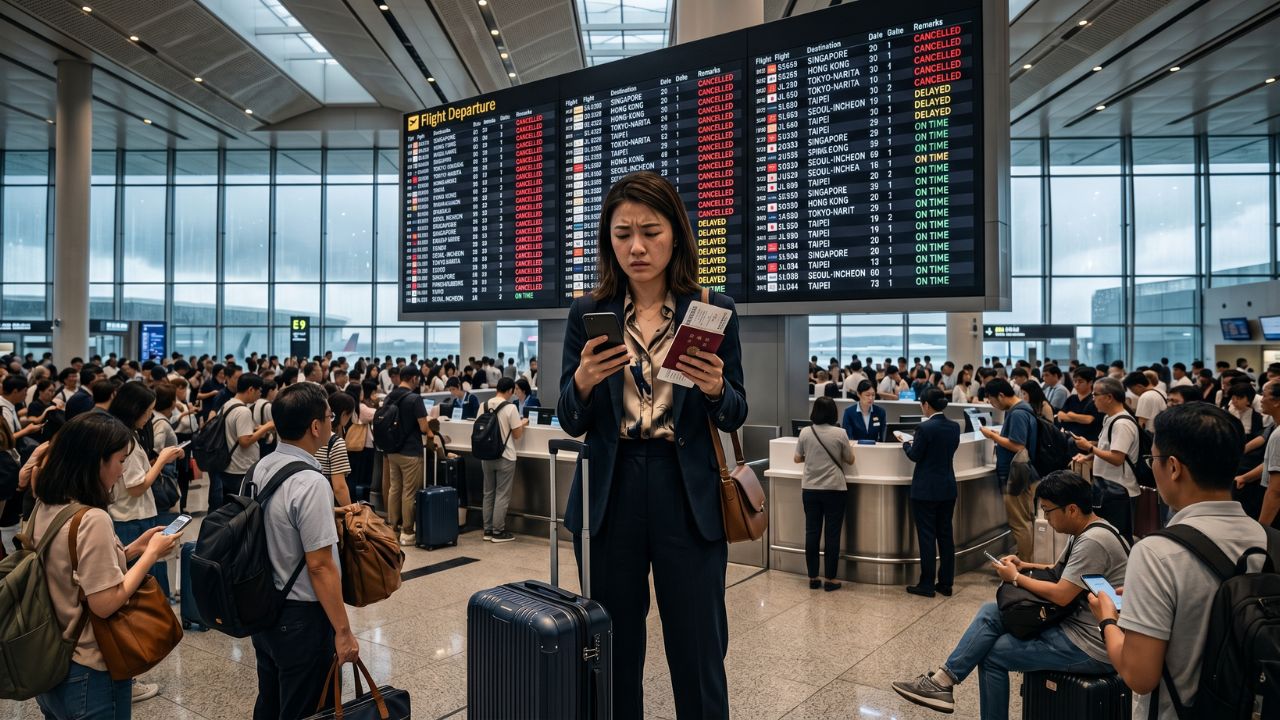
Image generated by AI
A punishing wave of flight cancellations and scheduling failures swept across Asia's busiest aviation corridors on May 20, 2026, as a combined 126 cancellations and 1,333 delays were recorded across nine major airports spanning Indonesia, China, Malaysia, Japan, and India — stranding thousands of passengers, fracturing international connections, and exposing the structural fragility of the region's most congested air travel networks during one of the year's heaviest demand periods.
Scale of Disruption: Five Countries, Nine Airports, 1,459 Affected Flights
The disruption was not concentrated at a single chokepoint. It unfolded simultaneously across the full breadth of Asian commercial aviation, from Shanghai Pudong and Beijing Capital in China's eastern seaboard to Jakarta-Soekarno-Hatta and Sultan Hasanuddin in Indonesia, from Indira Gandhi International and Chhatrapati Shivaji International in India to Kuala Lumpur International in Malaysia and Fukuoka and Osaka Itami in Japan.
The carriers caught in the disruption wave read like a roll call of the region's most critical operators: Batik Air, Air China, China Eastern, AirAsia, Garuda Indonesia, SpiceJet, Air India, IndiGo, ANA Wings, Malaysia Airlines, Japan Airlines, and dozens of international carriers with services transiting the affected hubs. The sheer geographic spread — from Tokyo Bay to the Arabian Sea — meant that the disruption's downstream effects reached well beyond Asia, impacting connecting passengers bound for Europe, the Middle East, and Oceania.
Airport-by-Airport Breakdown
Indira Gandhi International Airport, New Delhi — 281 Delays, 8 Cancellations
New Delhi absorbed the highest delay volume of any airport in the region, with 281 flights delayed and 8 canceled. SpiceJet bore the heaviest cancellation burden at New Delhi with 6 cancellations (8% of its schedule) and 27 delays (38%), while Kuwait Airways Corporation recorded 2 cancellations (50%). The delay impact was dominated by India's largest carriers: Air India posted 108 delays (23%), IndiGo recorded 84 delays (15%), and Air India Express logged 33 delays (27%). International carriers including Air France, ITA Airways, Jazeera Airways, Kam Air, and Ariana Afghan all recorded delays at New Delhi.
Shanghai Pudong International Airport — 254 Delays, 56 Cancellations
Shanghai Pudong recorded the highest cancellation count in Asia on May 20, with 56 flights canceled and 254 delayed. China Eastern led cancellations with 24 (5% of schedule) alongside 64 delays (14%). Shanghai Airlines canceled 13 flights (8%) with 31 delays (19%). Hainan Airlines posted 6 cancellations (19%), Shenzhen Airlines canceled 5 (25%), and Air China recorded 5 cancellations (4%) with 21 delays (16%). Juneyao Airlines (3 cancellations), China Southern (2 cancellations), and Spring Airlines (16 delays) were also significantly affected. International carriers disrupted at Pudong included British Airways, Austrian Airlines, Delta Air Lines, Lufthansa, Singapore Airlines, Qatar Airways, Etihad Airways, EVA Air, Korean Air, Malaysia Airlines, Thai Airways, and Asiana.
Chhatrapati Shivaji International Airport, Mumbai — 202 Delays, 5 Cancellations
Mumbai's main airport suffered 202 delays and 5 cancellations. SpiceJet again featured prominently with 2 cancellations (4%) and 16 delays (34%). Kuwait Airways Corporation posted 2 cancellations (50%), and Norse Atlantic Airways recorded 1 cancellation (16%) alongside 3 delays. The delay burden fell heavily on India's domestic majors: IndiGo logged 74 delays (19%), Air India Express recorded 33 delays (63%), and Air India posted 29 delays (11%). International disruptions at Mumbai touched British Airways, Cathay Pacific, Lufthansa, Etihad, KLM, Swiss, Virgin Atlantic, Air France, Kenya Airways, and Malaysia Airlines.
Beijing Capital International Airport — 160 Delays, 19 Cancellations
Beijing Capital registered 160 delays and 19 cancellations. Air China — operating from its primary hub — posted 11 cancellations (1% of schedule) and 64 delays (8%). Hainan Airlines contributed 5 cancellations (2%) with 24 delays (14%), and Shenzhen Airlines recorded 3 cancellations (7%) alongside 15 delays (36%). Shandong Airlines (15 delays, 39%) and China Eastern (11 delays) added to the domestic pressure. International carriers disrupted at Beijing included Emirates, Air France, United, Korean Air, Asiana, and Egypt Air.
Jakarta-Soekarno-Hatta International Airport — 159 Delays, 16 Cancellations
Indonesia's primary gateway recorded 159 delays and 16 cancellations. Batik Air led cancellations with 7 (4%) alongside 26 delays (14%). Citilink posted 5 cancellations (3%) and 14 delays (8%), Garuda Indonesia recorded 3 cancellations (1%) with 30 delays (14%), and Lion Air contributed 1 cancellation with 16 delays (15%). Super Air Jet posted a notable 23 delays (19%), while TransNusa logged 12 delays (33%). International carriers impacted at Jakarta included Singapore Airlines, China Airlines, Cathay Pacific, Japan Airlines, Malaysia Airlines, EVA Air, Saudia, and Scoot.
Kuala Lumpur International Airport — 159 Delays, 14 Cancellations
Kuala Lumpur experienced 159 delays and 14 cancellations, with AirAsia accounting for all 14 cancellations (3% of its KUL schedule) alongside 53 delays (14%). Malindo Air posted the second-highest delay count at 42 delays (32%), followed by Malaysia Airlines at 38 delays (14%). TransNusa recorded 5 delays (83%), while Air India, IndiGo, China Southern, Shenzhen Airlines, Korean Air, Thai Airways, Garuda Indonesia, and AirAsia X also reported disruptions.
Sultan Hasanuddin International Airport, Makassar — 56 Delays, 6 Cancellations
Regional connectivity within Indonesia was further damaged at Makassar, where 56 delays and 6 cancellations were logged. Batik Air posted 5 cancellations (7%) and 14 delays (20%), while Lion Air recorded 1 cancellation and 27 delays (16%). Wings Abadi (7 delays, 28%) and Sriwijaya Air (4 delays) added to the regional pressure.
Fukuoka Airport, Japan — 34 Delays, 1 Cancellation
Japan's disruptions were comparatively contained. Fukuoka recorded 34 delays and 1 cancellation, with ANA Wings posting the sole cancellation (2%) alongside 9 delays (21%). Japan Airlines and All Nippon Airways each recorded 4 delays, while Jin Air, Korean Air, Skymark, and Peach Aviation also experienced scheduling pressure.
Osaka International Airport (Itami) — 28 Delays, 1 Cancellation
Osaka Itami logged 28 delays and 1 cancellation. ANA Wings again recorded the sole cancellation alongside 12 delays (9%). Japan Airlines posted 11 delays (6%) and All Nippon added 5 delays (8%).
Master Disruption Summary: Asia May 20, 2026
| Airport | Country | Delays | Cancellations |
|---|---|---|---|
| Indira Gandhi Int'l (DEL) | India | 281 | 8 |
| Shanghai Pudong Int'l (PVG) | China | 254 | 56 |
| Chhatrapati Shivaji Int'l (BOM) | India | 202 | 5 |
| Beijing Capital Int'l (PEK) | China | 160 | 19 |
| Jakarta-Soekarno-Hatta Int'l (CGK) | Indonesia | 159 | 16 |
| Kuala Lumpur Int'l (KUL) | Malaysia | 159 | 14 |
| Sultan Hasanuddin Int'l (UPG) | Indonesia | 56 | 6 |
| Fukuoka (FUK) | Japan | 34 | 1 |
| Osaka Int'l Itami (ITM) | Japan | 28 | 1 |
| ASIA TOTAL | — | 1,333 | 126 |
Data sourced from FlightAware as of May 20, 2026. Figures may be subject to real-time revision.
Passenger Impact: Cascading Connections and Compounding Costs
For the thousands of travelers caught inside this continent-wide disruption, the consequences extended far beyond gate-side waiting. Asia's aviation network is built on tight hub-and-spoke connections — a structure that means a delayed departure at Shanghai Pudong or Jakarta can cascade into a missed connection at Singapore, Dubai, or Tokyo within hours.
Passengers on complex multi-city itineraries — particularly those routing through multiple affected hubs on the same day — faced the highest exposure. A traveler connecting through both New Delhi and Kuala Lumpur, for example, encountered compounding delay probabilities that made on-time arrival at a final destination statistically unlikely. The financial burden of unplanned overnight stays, rebooking fees, and missed hotel reservations at destination adds up rapidly in a region where airport hotel pricing spikes during mass disruption events.
Under the aviation consumer protection frameworks operating in India (DGCA regulations), China (CAAC), and Malaysia (MAVCOM), airlines are generally required to provide duty-of-care provisions — including meals, refreshments, and accommodation — during extended delays and cancellations, though specific entitlements vary by country and disruption classification.
What This Means for Travelers: Actionable Advice
- Monitor carrier apps in real time — Air India, IndiGo, AirAsia, Air China, and Garuda Indonesia all offer live disruption alerts that push notifications before public departure board updates.
- Retain all documentation — boarding passes, delay notices, and expense receipts are essential for compensation claims under Indian DGCA rules, Chinese CAAC regulations, or Malaysian MAVCOM guidelines.
- Build buffer time into Asian connecting itineraries — the May 20 data shows that multi-hub routings through New Delhi, Shanghai, and Kuala Lumpur carry structurally elevated delay risk.
- Contact your airline directly for rebooking before attempting to purchase replacement tickets independently — most carriers will reroute at no charge during declared disruption events.
- Request duty-of-care provisions including meal vouchers and hotel accommodation during overnight delays — these are regulatory requirements in India, China, and Malaysia, not discretionary airline gestures.
FAQ: Asia Flight Cancellations May 20, 2026
Q: Which Asian airport had the most flight cancellations on May 20, 2026? Shanghai Pudong International Airport recorded the highest cancellation total with 56 flights canceled, led by China Eastern (24 cancellations), Shanghai Airlines (13), Hainan Airlines (6), Shenzhen Airlines (5), and Air China (5).
Q: Which Asian airport had the most flight delays on May 20, 2026? Indira Gandhi International Airport in New Delhi recorded the highest delay total with 281 flights delayed, dominated by Air India (108 delays), IndiGo (84 delays), Air India Express (33 delays), and SpiceJet (27 delays alongside 6 cancellations).
Q: Which airlines were most affected by cancellations across Asia? China Eastern (24 cancellations at Shanghai), AirAsia (14 at Kuala Lumpur), Shanghai Airlines (13 at Shanghai), Air China (16 combined across Shanghai and Beijing), Batik Air (12 across Jakarta and Makassar), SpiceJet (8 across New Delhi and Mumbai), and Hainan Airlines (11 across Shanghai and Beijing) recorded the highest cancellation volumes.
Industry Analysis: Structural Congestion Meets Seasonal Demand
The May 20 disruption pattern across Asia reflects the collision of structurally constrained airport infrastructure with aggressive post-pandemic demand recovery. Airports in New Delhi, Shanghai, Jakarta, and Kuala Lumpur are all operating at or near design capacity during peak periods, leaving minimal buffer when weather events, air traffic flow restrictions, or ground handling bottlenecks emerge.
In India specifically, the combination of Air India's ongoing fleet integration following the Tata Group acquisition and IndiGo's continued capacity expansion has pushed Delhi and Mumbai's runway and gate utilization to levels where even minor upstream delays cascade rapidly through the daily schedule. At Shanghai Pudong, China's complex airspace management protocols — which allocate significant capacity to military operations — continue to constrain commercial throughput during peak windows, a dynamic that IATA has flagged repeatedly as a systemic bottleneck for Chinese aviation growth.
The simultaneous appearance of disruptions across five countries and nine airports underscores the interconnected fragility of Asian aviation: when major hubs in China and India simultaneously experience schedule compression, the downstream effects ripple through connecting traffic at Singapore, Bangkok, Dubai, and Hong Kong within hours.
Key Takeaways
- 1,333 flights delayed and 126 canceled across nine major Asian airports on May 20, 2026.
- New Delhi (281 delays, 8 cancellations) recorded the highest delay count; Shanghai Pudong (254 delays, 56 cancellations) posted the most cancellations.
- Mumbai logged 202 delays and 5 cancellations; Beijing Capital posted 160 delays and 19 cancellations.
- Jakarta (159 delays, 16 cancellations) and Kuala Lumpur (159 delays, 14 cancellations) were the most disrupted Southeast Asian hubs.
- AirAsia accounted for all 14 KUL cancellations; China Eastern led Shanghai with 24 cancellations; Air China posted 16 cancellations across Beijing and Shanghai.
- Batik Air recorded 12 cancellations across Jakarta and Makassar; SpiceJet posted 8 cancellations across New Delhi and Mumbai.
- Japan's disruptions were contained — Fukuoka (34 delays, 1 cancellation) and Osaka Itami (28 delays, 1 cancellation), with ANA Wings the sole airline posting cancellations.
- International carriers including British Airways, Lufthansa, Singapore Airlines, Qatar Airways, Emirates, Delta, Korean Air, and Cathay Pacific all recorded delays at affected hubs.
Related Travel Guides
- Boeing 777X Emerges as Game-Changer in Ultra-Long-Haul Aviation, Challenging Airbus A380's Dominance
- Bypassing Travel Chaos: Emirates, Lufthansa, and 35 Global Airlines Forge Massive Doha Megahub Alliance to Shield Passengers from International Gridlock: Airline News
- Unprecedented Asian Aviation Meltdown: 6,424 Flights Delayed and 349 Canceled as Travel Chaos Paralyzes Cathay Pacific, Japan Airlines, and ANA Across Tokyo, Bangkok, and Kuala Lumpur: Latest Airline News
Disclaimer
This article is for informational and educational purposes only. It does not constitute legal, financial, or professional advice. While we strive to provide accurate and up-to-date information, travel policies, regulations, and conditions change rapidly. Always verify information with official sources before making travel decisions. Nomad Lawyer makes no representations about the accuracy, reliability, completeness, or suitability of the information provided. Readers should consult qualified professionals for advice specific to their circumstances. The views expressed in this article are those of the author and do not necessarily reflect the views of Nomad Lawyer.
Kunal K Choudhary
Co-Founder & Contributor
A passionate traveller and tech enthusiast. Kunal contributes to the vision and growth of Nomad Lawyer, bringing fresh perspectives and driving the community forward.
Learn more about our team →