
Asia Aviation Network Paralyzed: Massive 4,200+ Flight Disruption Slams the Eastern Hemisphere
Executing a devastating blow to global commerce and tourism, a cascading failure has entirely paralyzed the Asian aviation grid, triggering unprecedented delays and cancellations.

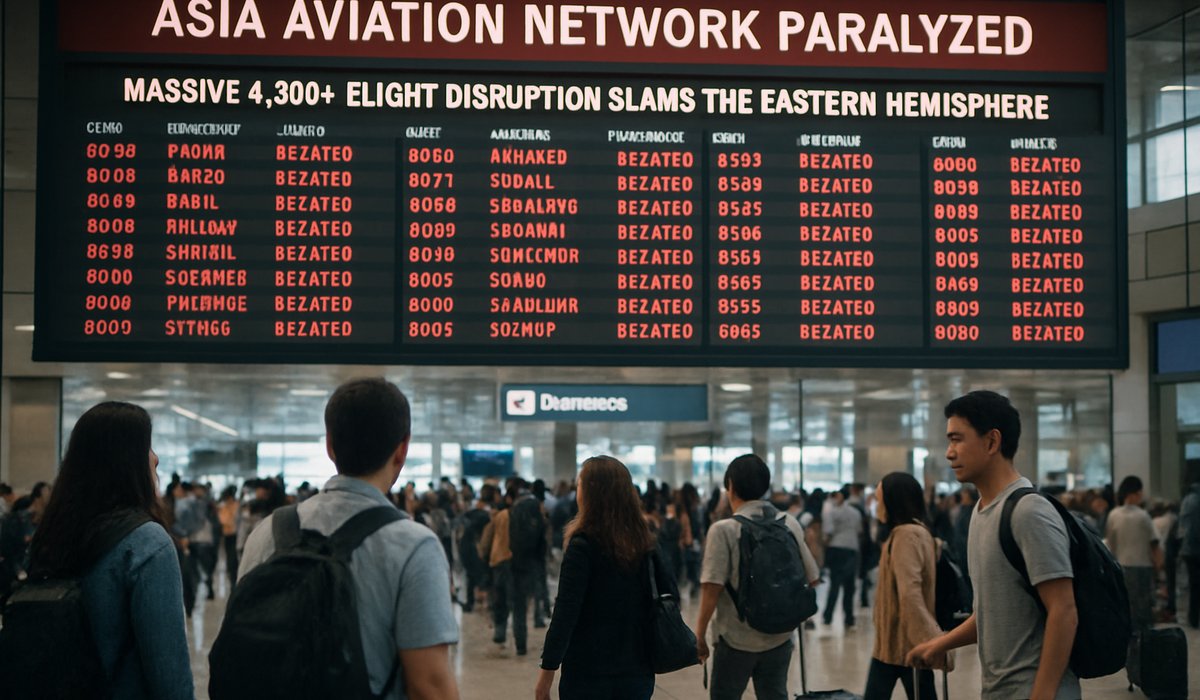
Image generated by AI
The Complete Collapse of the Eastern Flight Grid
Fundamentally shattering the operational integrity of the entire Eastern Hemisphere, a terrifying and historically massive cascade of airline disruptions has completely paralyzed the Asian aviation network, instantly stranding hundreds of thousands of travelers. On a highly critical travel day in early April 2026, air traffic control and airline operations spanning from Tokyo to Dubai completely broke under severe operational strain. The verified telemetry is mathematically devastating: 3,972 absolute severe rolling delays stacked violently alongside 283 complete flight cancellations. This is not a localized incident; it is a trans-continental gridlock deeply infecting China, Japan, Indonesia, South Korea, and the United Arab Emirates simultaneously.
The sheer volume of the disruption has utterly overwhelmed the massive global mega-carriers. Korean Air, All Nippon Airways (ANA/Wings), IndiGo, and Qatar Airways completely lost control of their highly sensitive scheduling matrices. When a disruption crosses the 4,000-flight threshold across a continent this massive, it creates an unbreakable domino effect. Aircraft physically slated to fly from Seoul to Los Angeles are mathematically trapped on the tarmac in Tokyo. The highly lucrative business corridors bridging Chinese manufacturing hubs to global financial capitals have been entirely severed, triggering billions in immediate economic friction.
The Viral Spread of the Asian Gridlock
This catastrophic event highlights the absolute fragility of massive, heavily interlinked airspace.
A severe weather system or critical air traffic control infrastructure failure in a massive mega-hub (like Shanghai Pudong or Dubai International) does not simply delay local flights; it weaponizes the network against itself. The absolute destruction of the transit window forces airlines to execute highly aggressive triage. If an IndiGo jet is mathematically blocked from landing in the UAE due to critical airspace holds, the airline is forced to physically cancel the flight at its origin in India, instantly dumping thousands of passengers out into extreme terminal congestion with mathematically zero rebooking options for at least 48 hours.
The Asia Disruption Matrix (April 2026)
| The Affected Region | The Operational Trauma | The Global Implication |
|---|---|---|
| China & Japan (East Asia) | Massive collapse of Korean Air and ANA grids. | Complete destruction of trans-pacific jumps to the US West Coast. |
| Middle East (UAE) | Qatar Airways and regional operators choked. | Severed connections heavily trapping European and Australian transit passengers. |
| The Numerical Scale | 3,972 Severe Delays, 283 Cancellations. | Total saturation of all major Asian hotel and rebooking infrastructure. |
What Guests Get
- Redefining 'The Mega-Hub Trap' — realizing that booking heavily reliant transit through massive hubs like Dubai or Incheon mathematically exposes you to extreme risk if the overarching continental grid physically locks down.
- The destruction of 'Transit Efficiency' — grasping that when an incredibly fast, highly optimized 90-minute connection in Tokyo is hit by a massive delay, the passenger is violently stranded in a foreign nation facing extreme linguistic and legal rebooking friction.
- Micro-economic terminal exhaustion — understanding that an airport totally saturated with 4,000 delayed continental flights instantly triggers absolute maximum capacity at every elite lounge, restaurant, and restroom in the facility, rendering premium status completely useless.
What This Means for Travelers
If you are trapped in the massive Asian airspace collapse: You must execute immediate, aggressive, self-reliant triage. Do absolutely not stand in a 5,000-person queue at the ANA or Korean Air transfer desk inside the terminal; that line will mathematically take ten hours to process. Immediately secure terminal WiFi, aggressively open the airline's mobile App, and simultaneously initiate a Skype or VoIP call to the airline's foreign call centers (e.g., calling the US or European desk rather than the overwhelmed Asian desk) to violently secure any available seat completely bypassing the physical airport grid.
The Tactical Value of Exit Visas and Transit Hotels: In regions like China, if your connecting flight is suddenly canceled, you cannot simply walk out of the airport and check into a local hotel due to highly strict federal visa barriers. If you are trapped in a massive Asian disruption, you must aggressively fight for the highly limited, heavily contested "Transit Hotels" located inside the international security zone. If you fail to secure a room, prepare for an incredibly brutal, multi-day endurance test sleeping directly on the terminal floor alongside thousands of other stranded globe-trotters.
FAQ: Surviving Global Aviation Breakdowns
Why do airlines cancel flights instead of just waiting out the delay? Airlines are legally chained by incredibly strict pilot and crew "rest timeouts." If a massive delay forces a crew to sit in an idling jet for six hours, they mathematically cross a strict international legal threshold where they are completely barred from flying the plane, forcing an immediate, unavoidable cancellation regardless of weather clearing.
Am I entitled to compensation if my Asian flight is canceled? Unlike the heavily protective European EU261 laws, passenger protection laws across Asia vary wildly by specific jurisdiction. If you are flying a non-European carrier strictly within the Asian grid, you are generally legally owed drastically less compensation, primarily limited to physical hotel vouchers rather than pure cash payouts.
Will my travel insurance cover this massive gridlock? If you possessed highly specific, premium "trip delay or interruption" insurance purchased well before the operational collapse was announced, your policy will mathematically reimburse massive emergency hotels and meals. Standard baseline credit card insurance frequently caps these emergency payouts extremely low.
External Resources
- FlightRadar24 Live Global Disruption Mapping
- Korean Air Official Operations Status
- International Air Transport Association (IATA) Travel Center
Related Travel Guides
The Ultimate Survival Guide to Mega-Hub Transit Disruptions
Decoding International Flight Cancellations: Knowing Your Rights
How to Sleep in an Airport: Strategies for the Stranded Traveler
Disclaimer
This article is for informational and educational purposes only. It does not constitute legal, financial, or professional advice. While we strive to provide accurate and up-to-date information, travel policies, regulations, and conditions change rapidly. Always verify information with official sources before making travel decisions. Nomad Lawyer makes no representations about the accuracy, reliability, completeness, or suitability of the information provided. Readers should consult qualified professionals for advice specific to their circumstances. The views expressed in this article are those of the author and do not necessarily reflect the views of Nomad Lawyer.
Raushan Kumar
Founder & Lead Developer
Full-stack developer with 11+ years of experience and a passionate traveller. Raushan built Nomad Lawyer from the ground up with a vision to create the best travel and law experience on the web.
Learn more about our team →