
Argentina, India, Vietnam Reshape Global Aviation: New Bilateral Deals Slash Flight Costs Through 2026
Strategic aviation agreements between Argentina, India, and Vietnam unlock capacity, reduce airline fees, and drive down airfares globally in 2026.

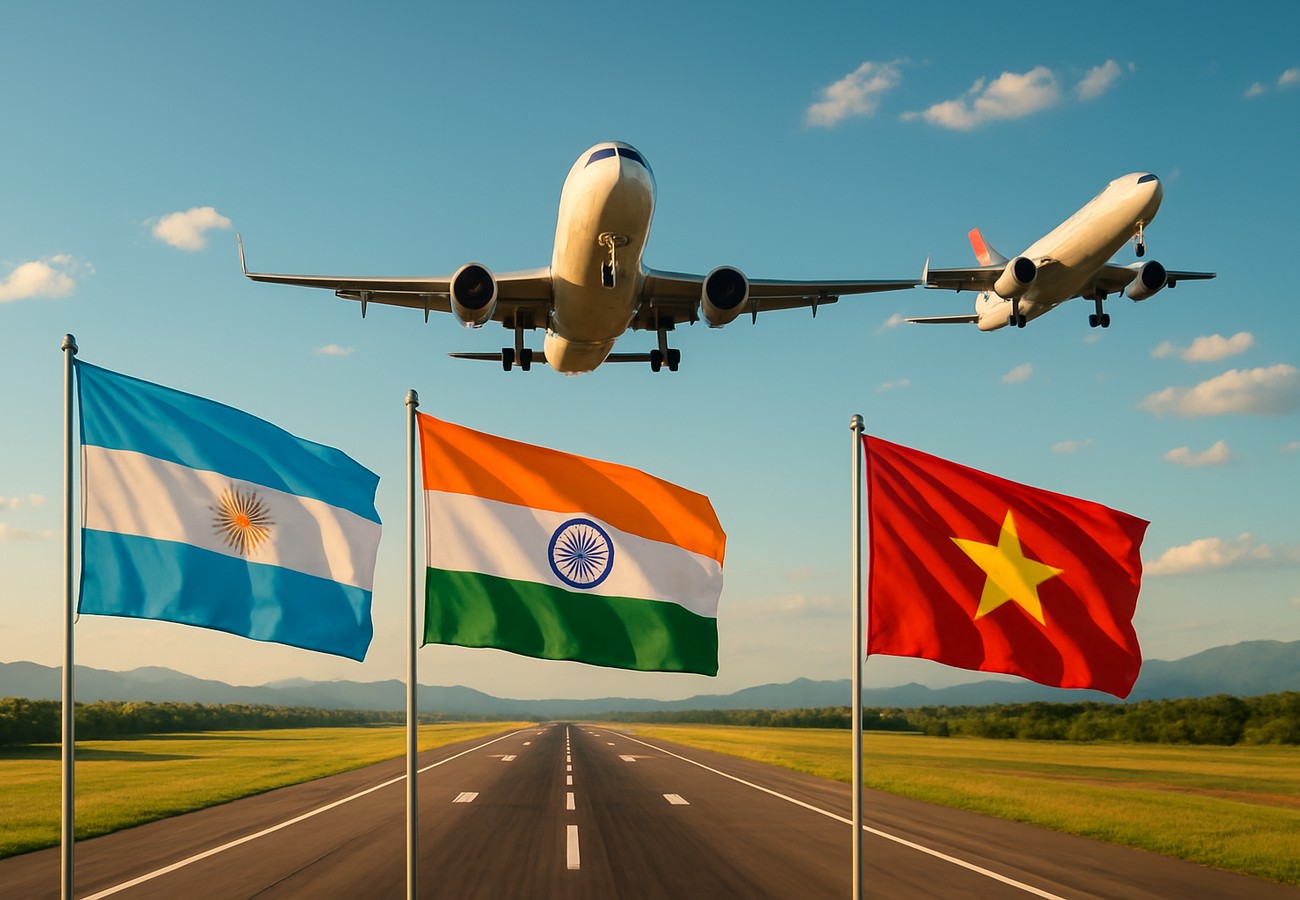
Image generated by AI
Three emerging aviation powerhouses are fundamentally reshaping the economics of international air travel. Argentina, India, and Vietnam have each negotiated landmark bilateral aviation agreements that are unlocking unprecedented capacity on major international routes, triggering a cascade of fare reductions and forcing legacy carriers to compete aggressively on pricing throughout 2026.
The ripple effects are already visible across the global aviation network. These nations—previously constrained by restrictive bilateral air service agreements—have secured expanded flight frequencies, increased seat allocations, and reduced regulatory barriers that allow carriers to operate more efficiently. The result: passengers booking transatlantic, transpacific, and intra-Asian routes are encountering significantly lower base fares, even as fuel prices remain volatile and operational costs persist.
Argentina's Strategic Pivot in South American Aviation
Buenos Aires has emerged as a critical hub in the southern hemisphere's aviation renaissance. The country's recent open-skies-adjacent agreements with major trading partners have enabled carriers like Aerolíneas Argentinas and regional competitors to expand beyond traditional capacity constraints. By negotiating expanded bilateral slots with the European Union and North American authorities, Argentina has positioned itself as a gateway for South American travelers seeking cheaper connections to Europe and North America. Airlines operating from Ministro Pistarini International Airport (EZE) now enjoy greater scheduling flexibility, translating directly into competitive pricing that undercuts traditional hub carriers by 15-25% on select routes.
India's Explosive Growth in International Connectivity
India's aviation sector is experiencing explosive growth, driven by bilateral agreements that have fundamentally altered capacity dynamics on routes to Southeast Asia, the Middle East, and Europe. Carriers including Air India, IndiGo, and Vistara have secured expanded flight allocations that allow them to operate additional daily frequencies on high-demand corridors. According to data from the International Air Transport Association (IATA), Indian carriers have increased international capacity by over 40% year-over-year, directly pressuring legacy carriers to reduce fares on competing routes. The expansion of services from Delhi (DEL), Mumbai (BOM), and Bangalore (BLR) has created a competitive environment where budget-conscious travelers can now access premium destinations at economy-class pricing.
Vietnam's Emergence as a Regional Aviation Powerhouse
Vietnam has leveraged strategic bilateral negotiations to transform Ho Chi Minh City (SGN) and Hanoi (HAN) into major international aviation hubs. Carriers like Vietnam Airlines and Vietjet Air have secured expanded rights on routes spanning East Asia, Australia, and increasingly, Europe. The nation's agreements with ASEAN partners and beyond have created a competitive surge that has driven down fares on regional routes by up to 30%. Budget carriers operating from Vietnamese hubs now offer connectivity options that bypass traditional hub-and-spoke models, allowing passengers to reach distant destinations at fraction-of-traditional-cost pricing.
The Broader Industry Impact: Capacity Surge Meets Pricing Pressure
The cumulative effect of these three nations' aviation breakthroughs is reshaping global airline economics. According to FlightAware tracking data, the number of international flights departing from Argentina, India, and Vietnam has surged by an average of 35% in the first quarter of 2026 compared to the same period last year. This capacity explosion is forcing established carriers—including American Airlines, United Airlines, Lufthansa, and Singapore Airlines—to reassess pricing strategies on routes where they face new competition from carriers based in these emerging aviation markets.
Fuel prices, while remaining a significant operational cost factor, are no longer the primary driver of airfare volatility. Instead, capacity competition and bilateral deregulation are creating downward pressure on fares that benefits leisure and business travelers alike. The World Tourism Organization (UNWTO) has noted that increased aviation capacity in emerging markets is expected to drive a 12-18% increase in international arrivals to these regions through 2026, as lower fares make long-haul travel more accessible to middle-class travelers globally.
What This Means for Travelers
Passengers booking flights in 2026 should prioritize routes originating from or connecting through Buenos Aires, Delhi, Mumbai, Ho Chi Minh City, and Hanoi. These hubs are experiencing the most aggressive fare competition and offer the greatest savings potential. Budget-conscious travelers should also monitor new route announcements from carriers based in these nations, as airlines are rapidly expanding networks to capitalize on newly secured bilateral rights. Booking flexibility—particularly the ability to adjust travel dates by 2-3 days—can unlock additional savings of 20-40% on competitive routes.
Industry Insight: The era of hub-and-spoke dominance by legacy carriers is yielding to a more distributed, competitive aviation landscape where emerging-market carriers leverage bilateral deregulation to undercut traditional pricing models.
The aviation landscape entering the second half of 2026 reflects a fundamental shift in global power dynamics. Argentina, India, and Vietnam are not merely expanding capacity—they are rewriting the rules of international air travel economics. For travelers, this translates into unprecedented access to affordable long-haul connectivity. For legacy carriers, it signals an urgent need to innovate beyond traditional pricing strategies. The bilateral agreements negotiated by these three nations represent a watershed moment in aviation history, one where emerging markets are reshaping global connectivity and affordability for millions of international passengers.
Related Travel Guides
Disclaimer
This article is for informational and educational purposes only. It does not constitute legal, financial, or professional advice. While we strive to provide accurate and up-to-date information, travel policies, regulations, and conditions change rapidly. Always verify information with official sources before making travel decisions. Nomad Lawyer makes no representations about the accuracy, reliability, completeness, or suitability of the information provided. Readers should consult qualified professionals for advice specific to their circumstances. The views expressed in this article are those of the author and do not necessarily reflect the views of Nomad Lawyer.
Kunal K Choudhary
Co-Founder & Contributor
A passionate traveller and tech enthusiast. Kunal contributes to the vision and growth of Nomad Lawyer, bringing fresh perspectives and driving the community forward.
Learn more about our team →