
Aviation Updates: Argentina Aviation Network Plunged into Travel Chaos as Flybondi, Paranair, JetSMART, Aerolineas Argentinas, GOL and LATAM Face 15 Flight Cancellations and 25 Delays at Jorge Newbery Buenos Aires and Salta Airport on June 24, 2026
Argentina's aviation network suffered a sweeping operational collapse on June 24, 2026, with 15 flight cancellations and 25 delays recorded at Jorge Newbery Airport in Buenos Aires and Martin Miguel de Güemes International Airport in Salta, disrupting Flybondi, Paranair, JetSMART, Aerolineas Argentinas, GOL Linhas Aéreas, LATAM Peru and LATAM Brasil services across the domestic and regional network.

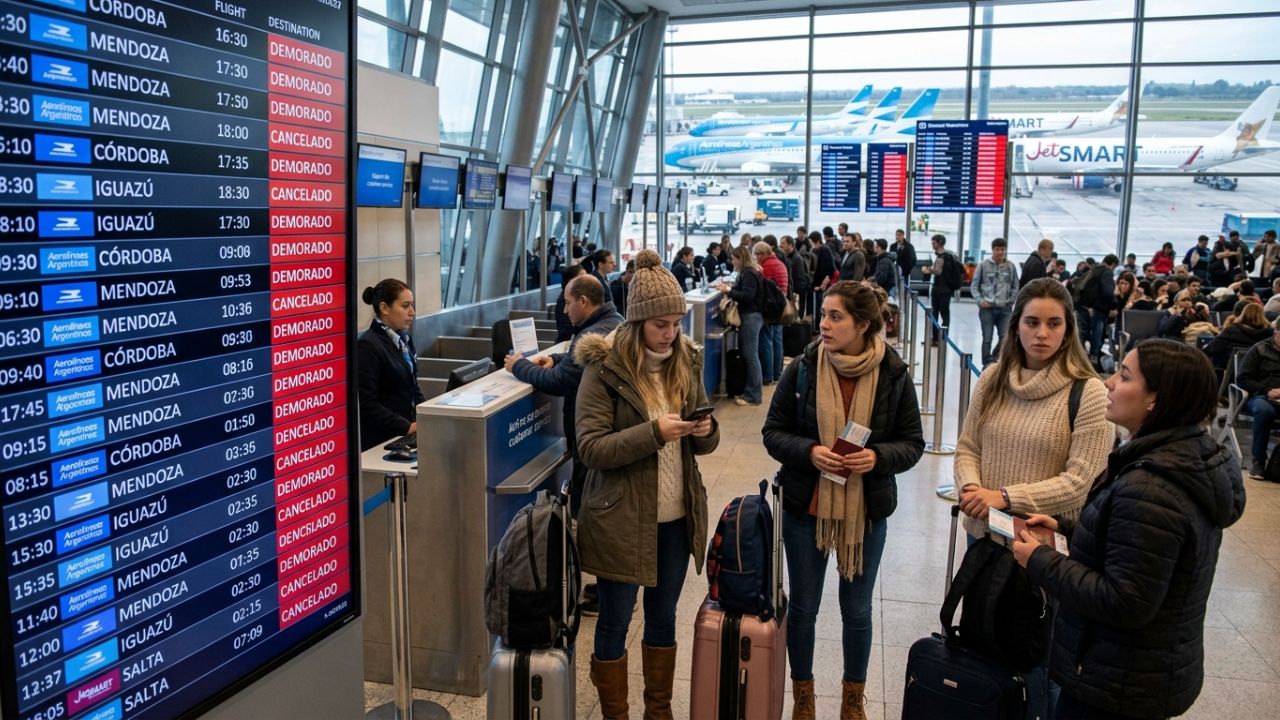
Image generated by AI
Aviation Updates: Argentina Aviation Network Plunged into Travel Chaos as Flybondi, Paranair, JetSMART, Aerolineas Argentinas, GOL and LATAM Face 15 Flight Cancellations and 25 Delays at Jorge Newbery Buenos Aires and Salta Airport on June 24, 2026
As South America's most densely connected domestic aviation network buckled under simultaneous operational pressure at its capital hub and a critical northwestern gateway, hundreds of Argentine passengers confronted the defining travel experience of the 2026 southern hemisphere winter — an entire day consumed by cancelled flights, cascading delays, and the exhausting uncertainty of a schedule in collapse.
Breaking airline news confirmed by real-time tracking data sourced from FlightAware reveals that Argentina's domestic and regional aviation network experienced a severe and wide-reaching operational breakdown on June 24, 2026, with a total of 15 flight cancellations and 25 flight delays officially recorded across two of the country's most strategically critical airports. The disruption struck simultaneously at Jorge Newbery Airport (AEP) — Buenos Aires' primary gateway for domestic air travel — and Martin Miguel de Güemes International Airport (El Aybal, SLA) in Salta — the key regional hub serving Argentina's culturally rich northwest — producing travel chaos that cascaded across the schedules of Flybondi, Paranair, JetSMART, Aerolineas Argentinas, GOL Linhas Aéreas Inteligentes, LATAM Peru, and LATAM Brasil simultaneously.
The combined weight of these disruptions — concentrated into a single operational cycle across two airports serving fundamentally different market segments — confirms that the June 24 breakdown was a systemic event rather than a localized anomaly. For the hundreds of passengers whose itineraries were directly affected, the day's airport disruptions translated into missed connections across Argentina's domestic network, collapsed onward tourism itineraries in one of South America's most visited travel destinations, and the immediate financial exposure of unrecoverable hotel bookings, guided tour reservations, and regional transport arrangements that a sudden cancellation renders immediately worthless.
Expanded Overview: The Scale of Argentina's June 24 Aviation Crisis
Argentina's domestic aviation network operates on a hub-and-spoke architecture in which Buenos Aires functions as the irreplaceable operational center. Jorge Newbery Airport — situated directly within the city's Palermo district along the banks of the Río de la Plata — handles the overwhelming majority of intra-Argentina point-to-point traffic, operating at consistently high load factors that leave the schedule with minimal capacity to absorb operational disruptions without cascading delay accumulation. When 11 cancellations are recorded at a single airport in one day — as happened at Jorge Newbery on June 24 — the downstream consequences for the broader network are immediate and severe.
Flybondi's dominant role in the cancellation data is operationally significant. The ultra-low-cost carrier, which has rapidly expanded its domestic Argentina network since its founding, contributed all 11 cancellations at Jorge Newbery — a figure that represents 23% of its scheduled departures for the day. In an operating environment where Flybondi has been building its domestic market share on the promise of affordable point-to-point connectivity, a 23% cancellation rate on a single day is a material reputational and operational event. The simultaneous 2 additional Flybondi cancellations at Salta — representing 33% of the carrier's Salta schedule — confirm that the disruption was network-wide rather than airport-specific.
Paranair's situation in Salta was even more stark. With 2 cancellations against its scheduled Salta operations — representing a 100% cancellation rate for the day — the Paraguayan regional carrier lost its entire Argentine gateway presence at this airport on June 24. For passengers depending on the Paranair-operated regional link, there was no operational fallback within the same carrier.
Section-Wise Breakdown: Two Airports, Two Distinct Disruption Profiles
Jorge Newbery Airport, Buenos Aires: The Capital's Domestic Hub in Crisis
Jorge Newbery Airport (AEP) absorbed the overwhelming majority of the June 24 disruption, recording 11 cancellations and 21 delays in a single operational cycle. As the primary departure point for Argentina's domestic network — serving destinations across Patagonia, the northwest, the Cuyo region, and the Mesopotamia — any severe disruption at Jorge Newbery sends immediate schedule consequences across the country's entire air transport system.
The 21 delays recorded alongside the cancellations tell a story of accumulated schedule pressure throughout the day. Airlines that were not directly cancelling services — including Aerolineas Argentinas (8 delays), JetSMART (5 delays), LATAM Brasil (4 delays), and LATAM Peru (2 delays) — were absorbing the operational overpressure generated by the Flybondi cancellations through extended turnaround times, compressed boarding windows, and gate sequencing delays that backed up through the afternoon and evening departure banks.
Martin Miguel de Güemes International Airport, Salta: Northwest Argentina Severed
Martin Miguel de Güemes International Airport (El Aybal, SLA) in Salta is the primary aviation gateway for Argentina's most visited cultural tourism region — a highland destination whose colonial architecture, Andean landscapes, wine country access, and indigenous cultural heritage draw substantial inbound domestic and international visitor flows year-round. On June 24, the airport recorded 4 cancellations and 4 delays, with the combined impact falling hardest on the regional services operated by Paranair and Flybondi.
For Salta-bound tourists whose planned arrival on June 24 was cancelled, the consequences extended well beyond the inconvenience of a delayed flight. The city's tourism infrastructure — including guided Andean excursions, Cafayate wine tours, and pre-booked accommodation in the city's colonial center — operates on tight daily schedules that do not accommodate same-day rebooking in the way that major urban hub visits sometimes can. A cancelled Flybondi or Paranair service into Salta is not merely a delayed arrival — it is, for many tourism-focused passengers, the loss of an irreplaceable component of a carefully planned regional itinerary.
Flight Details and Verified Disruption Impact Matrices
Jorge Newbery Airport (Buenos Aires) — Confirmed Disruption Data, June 24, 2026
| Airline | Cancelled | Cancelled (%) | Delayed | Delayed (%) |
|---|---|---|---|---|
| Flybondi | 11 | 23% | 1 | 2% |
| GOL Linhas Aéreas Inteligentes | 0 | 0% | 1 | 8% |
| JetSMART | 0 | 0% | 5 | 9% |
| LATAM Peru | 0 | 0% | 2 | 25% |
| Aerolineas Argentinas | 0 | 0% | 8 | 4% |
| LATAM Brasil | 0 | 0% | 4 | 25% |
Martin Miguel de Güemes International Airport (Salta) — Confirmed Disruption Data, June 24, 2026
| Airline | Cancelled | Cancelled (%) | Delayed | Delayed (%) |
|---|---|---|---|---|
| Paranair | 2 | 100% | 0 | 0% |
| Flybondi | 2 | 33% | 0 | 0% |
| JetSMART | 0 | 0% | 1 | 16% |
All data sourced directly from FlightAware, reflecting the operational situation at Jorge Newbery Airport and Martin Miguel de Güemes International Airport on June 24, 2026. Total network disruption: 15 cancellations and 25 delays.
Passenger Impact: Tourism Itineraries and the Human Cost of Argentine Aviation Chaos
For passengers directly ensnared in the June 24 disruption, the practical consequences fell into two distinct categories: those stranded at Jorge Newbery in Buenos Aires — a major urban center with extensive accommodation, dining, and rebooking infrastructure — and those affected at Salta, where the combination of a smaller airport, limited inbound flight frequency, and a tourism-dependent local economy amplified every individual cancellation's impact.
Passengers holding Flybondi cancellations at Jorge Newbery faced the immediate challenge of securing rebooking on an already-compressed domestic Argentina schedule. With 11 services cancelled simultaneously, the resulting demand for alternative seats on subsequent Flybondi, Aerolineas Argentinas, or JetSMART departures overwhelmed the available capacity on short-notice services. Business travelers with time-sensitive obligations in Patagonian provinces, families with hotel check-in deadlines, and connecting passengers transiting toward international departures all competed for the same limited replacement inventory.
In Salta, Paranair's 100% cancellation rate meant that every passenger holding a Paranair boarding pass for June 24 needed an entirely different carrier and routing. In a regional airport serving a destination where international visitor flows are substantial and travel logistics are more complex than at a major city, that is not a problem that resolves itself quickly.
Under Argentine aviation consumer regulations, passengers whose flights are cancelled are entitled to rebooking on the next available service, a full refund for the unused portion of their ticket, and — depending on the duration of the delay — meals, communications access, and hotel accommodation arranged and funded by the operating carrier. Passengers are strongly advised to obtain written cancellation confirmation from their carrier, retain all receipts for self-funded expenses incurred during the disruption period, and file formal compensation claims directly with the operating airline.
Industry Analysis: Why Argentina's Network Is Under Pressure
The June 24 disruption at Jorge Newbery and Salta reflects structural pressures that have been accumulating across Argentina's domestic aviation market throughout the 2026 southern hemisphere winter season. Several factors converge to create exactly this type of multilateral, multi-airport disruption event.
Flybondi's operational concentration risk is the most immediately visible structural issue. When a single carrier contributes 13 of 15 total network cancellations across two airports on the same day — with cancellation rates of 23% at Buenos Aires and 33% at Salta — the airline's operational resilience is being tested against the maximum demands of its route network. Ultra-low-cost carriers operating at high utilization rates with lean reserve aircraft and crew inventories are inherently more exposed to cascading cancellation events when any significant operational constraint — weather, mechanical, or ATC-related — begins compressing the schedule.
Argentine winter weather patterns — particularly the cold fronts that sweep across the Andean precordillera toward Salta and the persistent low cloud that can reduce Jorge Newbery's visual approach minimums — provide a consistent seasonal context for aviation disruptions during the June-August period. Whether meteorological factors contributed to the June 24 breakdown is not specified in the available operational record, but winter weather remains the most common trigger for unannounced schedule revisions in the Argentine domestic network at this time of year.
Conclusion: Recovery and the Resilience of Argentina's Aviation Sector
The operational breakdown across Argentina's aviation network on June 24, 2026 — encompassing 15 cancellations and 25 delays spread across Buenos Aires and Salta — will require 24–48 hours of concentrated operational recovery before affected carriers fully reabsorb stranded passengers and restore their aircraft to standard rotation sequences. For Flybondi, the most critical recovery task is the repositioning of aircraft and crews displaced by the day's extensive cancellation activity, while maintaining the next day's schedule commitments across its growing domestic network.
For Argentina's tourism sector — which depends on reliable air connectivity to deliver international and domestic visitors to destinations like Salta, Bariloche, Mendoza, and Patagonia — the June 24 disruption is a reminder that the country's aviation infrastructure, while rapidly expanding in capacity and carrier diversity, remains sensitive to the cascading consequences of single-carrier operational stress events. Sustained investment in network redundancy, reserve aircraft availability, and passenger rights enforcement will be essential as Argentina continues developing its domestic tourism offering for a global audience.
Key Takeaways
- Total Network Disruption: Argentina's aviation network recorded 15 flight cancellations and 25 delays across two airports on June 24, 2026 — one of the most disruptive single-day events of the southern hemisphere winter season.
- Flybondi Dominates Cancellations: Flybondi contributed all 11 cancellations at Jorge Newbery (23% cancellation rate) and 2 additional cancellations at Salta (33% rate), accounting for 13 of 15 total network cancellations.
- Paranair 100% Cancelled at Salta: Paranair recorded a 100% cancellation rate at Salta — losing its entire Argentine gateway presence at the airport for the day.
- Aerolineas Argentinas Most Delayed: Aerolineas Argentinas recorded 8 delays at Jorge Newbery — the highest delay count of any carrier not recording cancellations.
- Tourism Impact in Salta: Salta's travel chaos carries disproportionate tourism consequences, with cancelled services directly disrupting pre-booked Andean excursions, wine country tours, and cultural itineraries that cannot be recovered through simple rebooking.
- Passenger Rights Apply: Affected passengers in Argentina are entitled to rebooking, full refunds, and carrier-funded meals and accommodation under Argentine aviation consumer regulations — and must obtain written cancellation confirmation to support compensation claims.
Related Travel Guides
Austria Travel Chaos Austrian Airlines Eurowings 39 Cancellations 569 Delays
Travel Chaos Cripples Spain as Iberia and Ryanair Suffer 1,079 Delays
Global Flight Cancellation and Compensation Guide 2026
Disclaimer: This article is strictly for informational purposes only. All flight cancellation and delay data is sourced directly from FlightAware and reflects the operational situation at Jorge Newbery Airport (Buenos Aires) and Martin Miguel de Güemes International Airport (Salta) on June 24, 2026. Airline schedules, rebooking availability, and route recovery timelines are subject to continuous, real-time revision. Passengers are advised to verify their flight status directly via their carrier's official platform and to contact their airline immediately to confirm rebooking arrangements.
Disclaimer
This article is for informational and educational purposes only. It does not constitute legal, financial, or professional advice. While we strive to provide accurate and up-to-date information, travel policies, regulations, and conditions change rapidly. Always verify information with official sources before making travel decisions. Nomad Lawyer makes no representations about the accuracy, reliability, completeness, or suitability of the information provided. Readers should consult qualified professionals for advice specific to their circumstances. The views expressed in this article are those of the author and do not necessarily reflect the views of Nomad Lawyer.
Preeti Gunjan
Contributor & Community Manager
A passionate traveller and community builder. Preeti helps grow the Nomad Lawyer community, fostering engagement and bringing the reader experience to life.
Learn more about our team →