
Ancient Agora vs Roman Agora: A Visitor's Guide to Athens' Historic Centers in 2026
Navigate the differences between the Ancient and Roman Agoras in Athens, comparing their historical significance, architectural highlights, and practical visiting tips for 2026 travelers.

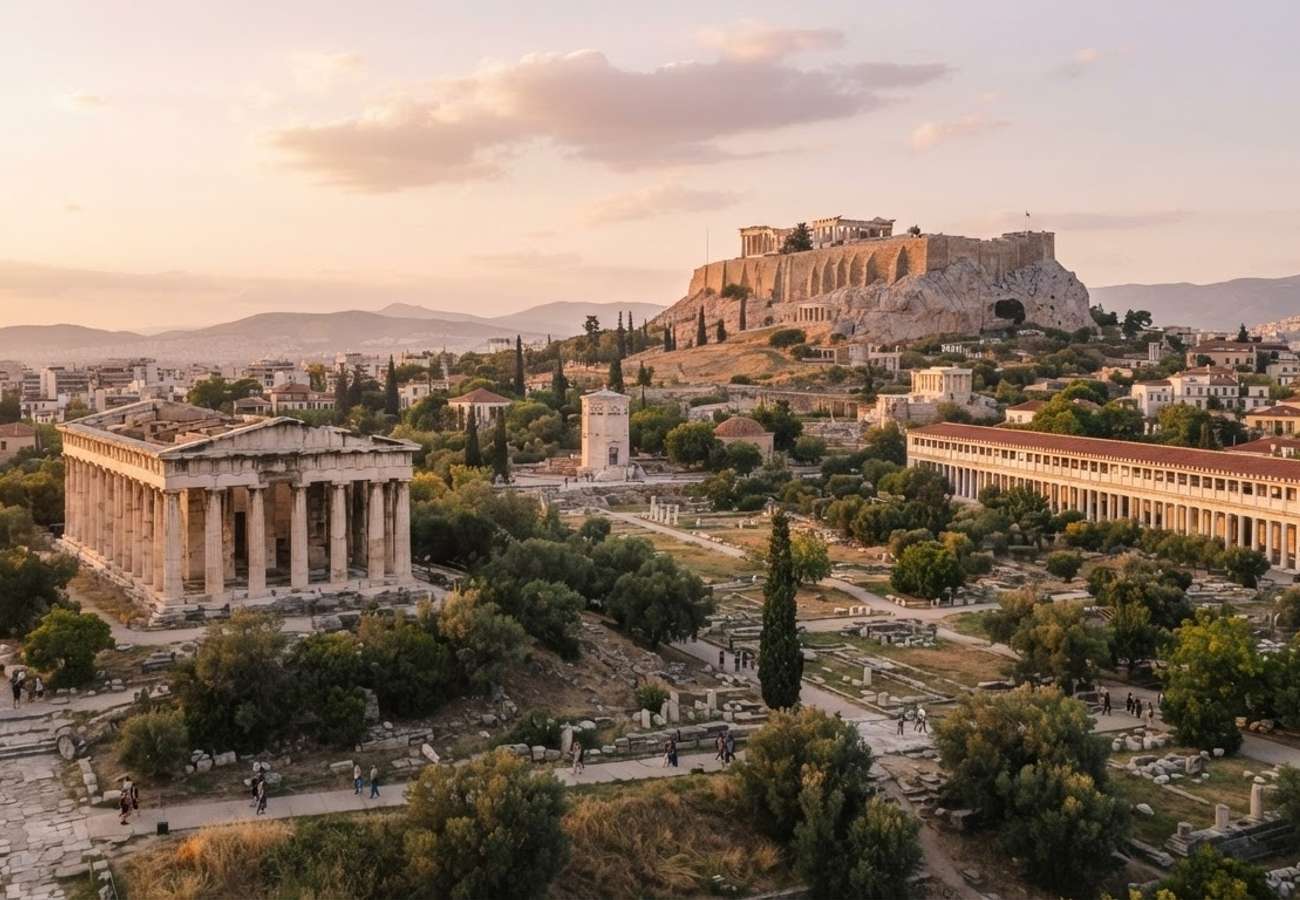
Image generated by AI
Athens hosts two distinct "agoras" within walking distance of each other, yet they represent entirely different eras of human governance and urban design. While one was the cradle of democracy, the other was a precision-engineered imperial marketplace.
For travelers navigating the historic core of Athens, the Ancient Agora and the Roman Agora are often conflated due to their proximity and similar appearances of marble columns and ruins. However, these sites served fundamentally different roles in the evolution of the city. Understanding the distinction between the two is essential for optimizing a tight itinerary and avoiding confusion with the updated 2026 ticketing systems.
Comparing the Two Agoras: A Quick Reference
The primary difference lies in the era and intent. The Ancient Agora was the civic heart of classical Athens, functioning from the 6th century BC through the Hellenistic period. It was a multipurpose space where politics, law, and social life intersected.
In contrast, the Roman Agora was established later, during the 1st century BC and early 1st century AD. Built under Roman administration and funded by imperial wealth, it was designed specifically as a commercial hub, emphasizing trade and regulation over civic debate.
Site Comparison Overview
| Feature | Ancient Agora | Roman Agora |
|---|---|---|
| Primary Era | 6th Century BC – Hellenistic Period | 1st Century BC – 1st Century AD |
| Core Function | Political, Social, and Religious Center | Commercial Hub and Marketplace |
| Atmosphere | Expansive, park-like, contemplative | Compact, urban, integrated with city |
| Key Monument | Temple of Hephaestus & Stoa of Attalos | Tower of the Winds & Gate of Athena Archegetis |
| Avg. Visit Time | 1.5 to 2 hours | 30 to 60 minutes |
| Vibe | The "Birthplace of Democracy" | Imperial Roman Order |
Strategic Location and Urban Integration
Both sites are situated in central Athens, but they interact with the modern city differently. The Ancient Agora sprawls northwest of the Acropolis, tucked below the Thissio neighborhood. Visitors typically enter via the Thissio metro station or the Apostolou Pavlou promenade. Once inside, the urban noise of Athens recedes, replaced by olive groves and open vistas of the Acropolis.
The Roman Agora is positioned further east, sandwiched between the Monastiraki district and the Plaka quarter. Its entrance opens directly onto narrow streets filled with tavernas and shops. This proximity makes the Roman Agora feel like a seamless extension of the modern city's commercial energy.
For those planning a walking route, a logical loop starts at the Acropolis, descends through Plaka to the Roman Agora, and concludes at the Ancient Agora and Thissio.
Civic Democracy vs. Imperial Commerce
The Ancient Agora was the tangible manifestation of Athenian democracy. It housed the Bouleuterion (the council of 500) and various law courts. It was a space of organic growth where philosophers like Socrates and Plato engaged with citizens amidst a chaotic mix of pottery stalls and religious shrines.
The Roman Agora represents a shift toward structured administration. Funded by Julius Caesar and finalized under Augustus, it followed a rational, rectangular layout. This site focused on the efficiency of trade, featuring dedicated measuring tables and administrative offices to regulate the flow of goods. While the Ancient Agora evokes the "messy" vitality of a free city-state, the Roman Agora reflects the tidy, controlled nature of an imperial province.
Architectural Highlights and On-Site Experience
The Ancient Agora is defined by its scale and the preservation of the Temple of Hephaestus. Built in the 5th century BC, this Doric temple remains one of the most intact structures in Greece. Visitors can also explore the reconstructed Stoa of Attalos, a two-story colonnade that now houses a museum, providing a clear sense of how ancient public walkways functioned.
The Roman Agora is smaller but contains high-impact architectural gems. The Gate of Athena Archegetis serves as a monumental entrance, while the Tower of the Winds stands as a marvel of ancient engineering. This octagonal structure functioned as a water clock and sundial, emphasizing the Roman focus on precision and timekeeping.
2026 Visiting Logistics and Ticketing
Travelers should be aware that ticketing structures in Athens have evolved. As of mid-2026, the traditional combined tickets that covered multiple sites have largely been phased out. Visitors now typically purchase separate tickets for the Acropolis and each individual archaeological site.
The Ancient Agora carries a higher entry price than the Roman Agora, reflecting its vast size and the inclusion of the Stoa of Attalos museum. While the Roman Agora is a more affordable, shorter visit, the Ancient Agora requires a more significant time and financial commitment.
Key Takeaways for Visitors
- Prioritize the Ancient Agora if you are interested in the origins of democracy, philosophy, and expansive ruins.
- Visit the Roman Agora for a quick, high-impact look at imperial architecture and ancient timekeeping.
- Budget your time accordingly: allow 2 hours for the Ancient site and 1 hour for the Roman site.
- Check current tickets locally, as the 2026 shift toward individual site ticketing replaces older bundled passes.
Frequently Asked Questions
Can I visit both agoras in one day? Yes. They are within a few hundred meters of each other. A common route includes the Acropolis, Roman Agora, and Ancient Agora in a single morning or afternoon.
Which one is more "impressive"? The Ancient Agora is more impressive in terms of scale and the preservation of the Temple of Hephaestus. The Roman Agora is more impressive for its specific architectural detail, like the Tower of the Winds.
Is the Stoa of Attalos open to the public? Yes, the reconstructed Stoa of Attalos in the Ancient Agora functions as a museum and is included with the site's entry ticket.
Walking through these two sites offers a physical timeline of how power shifted from the citizens of Athens to the emperors of Rome.
Related Travel Guides
Disclaimer
This article is for informational and educational purposes only. It does not constitute legal, financial, or professional advice. While we strive to provide accurate and up-to-date information, travel policies, regulations, and conditions change rapidly. Always verify information with official sources before making travel decisions. Nomad Lawyer makes no representations about the accuracy, reliability, completeness, or suitability of the information provided. Readers should consult qualified professionals for advice specific to their circumstances. The views expressed in this article are those of the author and do not necessarily reflect the views of Nomad Lawyer.
Preeti Gunjan
Contributor & Community Manager
A passionate traveller and community builder. Preeti helps grow the Nomad Lawyer community, fostering engagement and bringing the reader experience to life.
Learn more about our team →