
Aviation Updates: Queen Alia Airport Reports 21 Delays as Royal Jordanian and Emirates Navigate Middle East Travel Chaos
As severe airport disruptions infect the Middle Eastern transit grid, Queen Alia International Airport recorded 21 delayed flights and 2 sudden cancellations, impacting major international carriers.

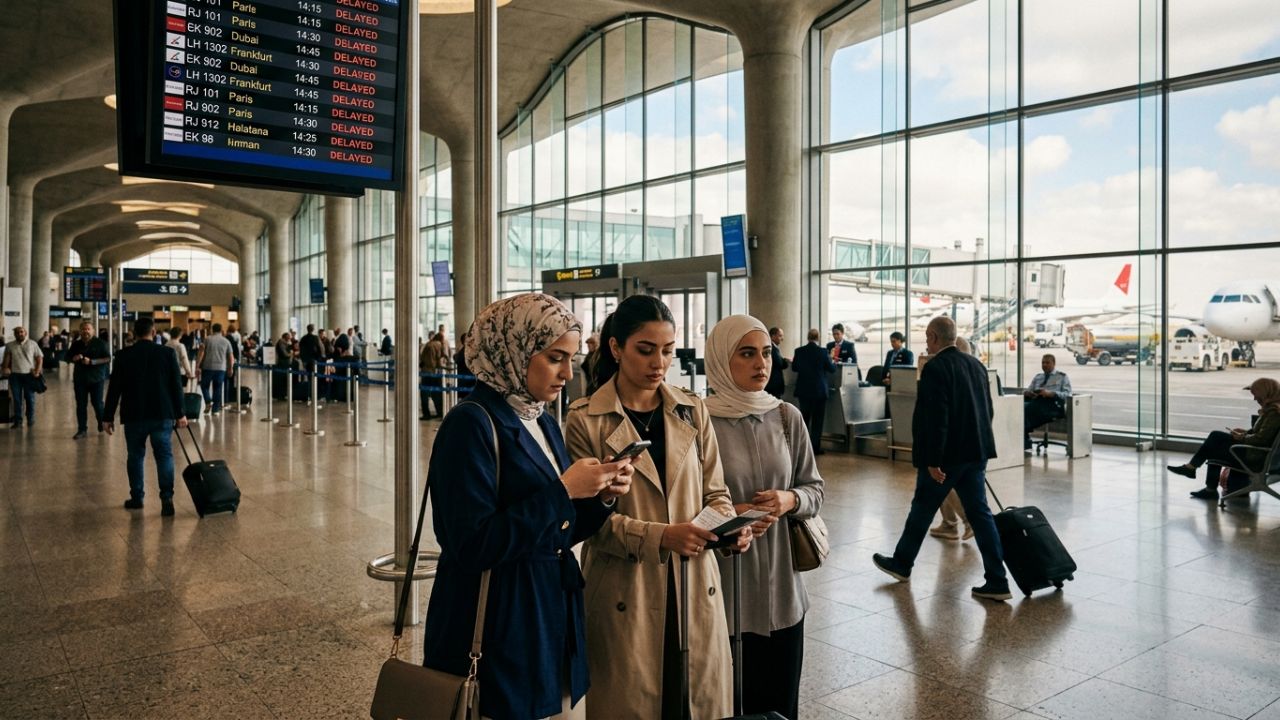
Image generated by AI
Aviation Updates: Queen Alia Airport Reports 21 Delays as Royal Jordanian and Emirates Navigate Middle East Travel Chaos
As catastrophic logistical failures and suddenly compounding infrastructure bottlenecks continue to terrorize the global transit network, a severe wave of operational friction has officially struck Jordan’s primary aviation gateway.
Image generated by AI
As high-impact airline news platforms rapidly issue continuous aviation updates regarding the intense fragility of the Middle Eastern transit grid, travelers passing through Amman on Tuesday experienced an incredibly unsettled day. Queen Alia International Airport (AMM) registered a sudden, highly disruptive spike in terminal gridlock, officially recording 21 delayed flights and two outright flight cancellations. This unexpected wave of travel chaos aggressively impacted massive global carriers, heavily disrupting operations for Royal Jordanian, flydubai, Turkish Airlines, Qatar Airways, and Emirates. Consequently, highly lucrative, high-frequency routes connecting Amman to Dubai, Doha, Istanbul, Riyadh, London, and Paris were thrown into operational disarray. For families beginning highly anticipated vacations and corporate executives racing against tight international schedules, these severe airport disruptions created massive uncertainty inside one of the busiest international terminals in the Middle East.
Expanded Overview: The Ripple Effect in Amman
To fully comprehend the sheer scale of this localized friction, aviation analysts must examine the massive strategic importance of Queen Alia International Airport.
As Jordan’s absolute primary international gateway, the airport handles thousands of passengers daily and serves as a vital, hyper-connected hub linking the Middle East directly with Europe, Asia, North America, and Africa. Even a relatively small number of delayed flights instantly destroys the terminal's operational flow. As the 21 delayed flights compounded throughout Tuesday, it severely affected passenger movement at check-in counters, immigration facilities, boarding gates, and baggage claim areas. While airport authorities have explicitly confirmed that no major, localized operational incident occurred at AMM itself, the cascading delays forced thousands of transit passengers to frantically adjust their itineraries and fiercely monitor departure boards to avoid missing onward connections.
Section-Wise Breakdown: Managing the Cascading Delays
Flight delays of this magnitude are rarely caused by a single isolated factor; they are the devastating result of a highly interconnected, fragile global network.
Aviation experts explicitly note that the severe disruptions hitting Royal Jordanian and Emirates on Tuesday resulted from several operational elements crashing together simultaneously. These included aircraft arriving extremely late from previous destinations, massive air traffic congestion in regional international airspace, and severe weather conditions affecting distant departure airports. Furthermore, technical inspections and frantic crew scheduling adjustments forced individual airlines to continuously delay their departures out of Amman. Because commercial aviation operates as an unforgiving global ecosystem, delays originating hundreds or even thousands of kilometers away in London or Istanbul brutally impacted later departures leaving Jordanian airspace.
Section-Wise Breakdown: Strategic Resistance to Cancellations
Despite the severe terminal congestion, the specific disruption telemetry provides a fascinating look into airline recovery strategies.
Out of the massive web of disrupted routes, only two flights were officially cancelled. This incredibly low cancellation metric indicates that legacy carriers like Qatar Airways and Turkish Airlines made a highly strategic choice: they elected to absorb massive, hours-long delays rather than entirely suspend their operations. In modern aviation, airlines heavily prefer delaying departures to minimize the catastrophic financial compensation required when an entire aircraft of passengers is stranded overnight. When those two cancellations became absolutely unavoidable, the affected airlines immediately executed emergency protocols, aggressively assisting stranded travelers with alternative flights, refunds, and rebooking options based on international passenger rights.
Flight Details: Queen Alia International Airport Disruption Matrix
To ensure international travelers and aviation analysts can accurately track the sheer scale of this localized transit failure, the verified disruption telemetry has been consolidated into the mandatory matrix below.
| Operational Metric | Verified Data |
|---|---|
| Total Flight Delays | 21 Flights |
| Total Cancellations | 2 Flights |
| Affected Airlines | Royal Jordanian, flydubai, Turkish Airlines, Qatar Airways, Emirates |
| Impacted Routes | Dubai, Doha, Istanbul, Riyadh, London, Paris |
| Regulatory Authority | Civil Aviation Regulatory Commission (CARC) |
Passenger Impact: Surviving the Terminal Gridlock
For the thousands of passengers attempting to navigate Queen Alia International Airport during this period of extreme travel chaos, hyper-vigilance was absolutely critical.
Because the operational interruptions forced airlines to continually rewrite their schedules throughout the day, passengers were legally and practically required to remain in frequent contact with their carriers. Travelers were heavily encouraged to enable airline push notifications on their mobile devices and rigorously monitor the airport’s live flight information system before even leaving their hotels. If a delay significantly threatened an onward connecting flight in Paris or Dubai, passengers had to aggressively contact airline customer service agents immediately to secure rebooking on alternative alliance carriers before inventory vanished entirely.
Industry Analysis: Regulatory Oversight and Safety
From a macro-aviation perspective, navigating 23 simultaneous operational disruptions requires extreme coordination from national regulators.
Jordan’s civil aviation sector operates under the highly strict oversight of the Civil Aviation Regulatory Commission (CARC), which is completely responsible for maintaining absolute aviation safety, regulatory compliance, and operational standards across the country’s entire aviation network. During Tuesday's disruptions, CARC and Queen Alia International Airport management flawlessly coordinated with frantic airlines and regional air traffic control authorities to ensure safe passenger movement. This regulatory framework successfully prevented a localized delay event from spiraling into a catastrophic national airspace shutdown.
Conclusion: A Fragile but Functional Hub
Ultimately, the 21 delayed flights and two cancellations at Queen Alia International Airport serve as a terrifying reminder that modern aviation remains incredibly fragile. While AMM continued operating without suffering a complete, widespread interruption, the severe travel chaos experienced by passengers flying on Royal Jordanian, flydubai, Turkish Airlines, Qatar Airways, and Emirates highlights the immense pressure on the global transit grid. A single storm in Europe or a sudden ATC bottleneck in the Gulf can instantly trigger severe airport disruptions and unpredictable flight cancellations in Amman. For international travelers navigating this complex ecosystem, staying fiercely informed, aggressively utilizing airline digital applications, and allowing massive amounts of extra travel time remain the only absolute methods to survive unexpected schedule changes.
Key Takeaways
- Sudden Terminal Gridlock: Queen Alia International Airport (AMM) in Jordan suffered a disruptive wave of 21 delayed flights and 2 cancellations on Tuesday.
- Major Carriers Impacted: The travel chaos heavily disrupted massive airlines including Royal Jordanian, flydubai, Turkish Airlines, Qatar Airways, and Emirates.
- Global Routes Severed: Highly lucrative flights connecting Amman to Dubai, Doha, Istanbul, Riyadh, London, and Paris were thrown into severe operational disarray.
- Cascading Failures: The disruptions were caused by late arriving aircraft, regional airspace congestion, and highly complex crew scheduling adjustments, rather than a local airport incident.
- Regulatory Coordination: The Civil Aviation Regulatory Commission (CARC) successfully oversaw the recovery effort, ensuring safety standards were strictly maintained throughout the chaos.
FAQ: Queen Alia International Airport Disruptions
How many flights were delayed or canceled at Amman's airport on Tuesday? Official airport telemetry confirmed a total of 23 disrupted scheduled movements, consisting of 21 delayed flights and two outright cancellations.
Which major airlines were affected by the travel chaos in Jordan? The severe disruptions heavily impacted major international legacy and low-cost carriers, explicitly including Royal Jordanian, flydubai, Turkish Airlines, Qatar Airways, and Emirates.
What specific international routes suffered from these flight delays? The operational gridlock severely impacted high-frequency passenger routes connecting Amman to Dubai, Doha, Istanbul, Riyadh, London, and Paris.
Was there a major security or operational incident at Queen Alia International Airport? No. Airport authorities confirmed that no major localized incident occurred at AMM; the delays were the cascading result of global network issues, late-arriving aircraft, and regional airspace congestion.
Related Travel Guides
Italy Airports 879 Delays ITA Airways Ryanair Travel Chaos 2026
UAE Iran Flights Dubai Tehran Travel Chaos 2026
Middle East Regional Tourism and Transit Survival Guide 2026
Disclaimer: This article is strictly for informational and aviation planning purposes. The specific flight disruption telemetry (21 delays, 2 cancellations), affected airlines (Royal Jordanian, Emirates, etc.), and impacted routes (London, Dubai, Paris) are based on verified operational data available at the time of publication. Middle Eastern airspace conditions, specific airline recovery schedules, and CARC regulatory directives are highly dynamic and subject to immediate modification by the operating carriers and regulatory authorities. Passengers planning international travel through Queen Alia International Airport should explicitly verify their exact flight itineraries, strictly monitor their airlines for sudden flight cancellations, and secure comprehensive travel insurance prior to departure.
Disclaimer
This article is for informational and educational purposes only. It does not constitute legal, financial, or professional advice. While we strive to provide accurate and up-to-date information, travel policies, regulations, and conditions change rapidly. Always verify information with official sources before making travel decisions. Nomad Lawyer makes no representations about the accuracy, reliability, completeness, or suitability of the information provided. Readers should consult qualified professionals for advice specific to their circumstances. The views expressed in this article are those of the author and do not necessarily reflect the views of Nomad Lawyer.
Preeti Gunjan
Contributor & Community Manager
A passionate traveller and community builder. Preeti helps grow the Nomad Lawyer community, fostering engagement and bringing the reader experience to life.
Learn more about our team →