
American Airlines Deploys Boeing 777-300ER on Unusual 142-Mile Fuel Stop Between Buenos Aires and Montevideo During Ezeiza Runway Works
American Airlines will operate a Boeing 777-300ER on a rare 142-mile hop between Buenos Aires and Montevideo as a fuel stop during major runway construction at Ezeiza International Airport in late 2026.

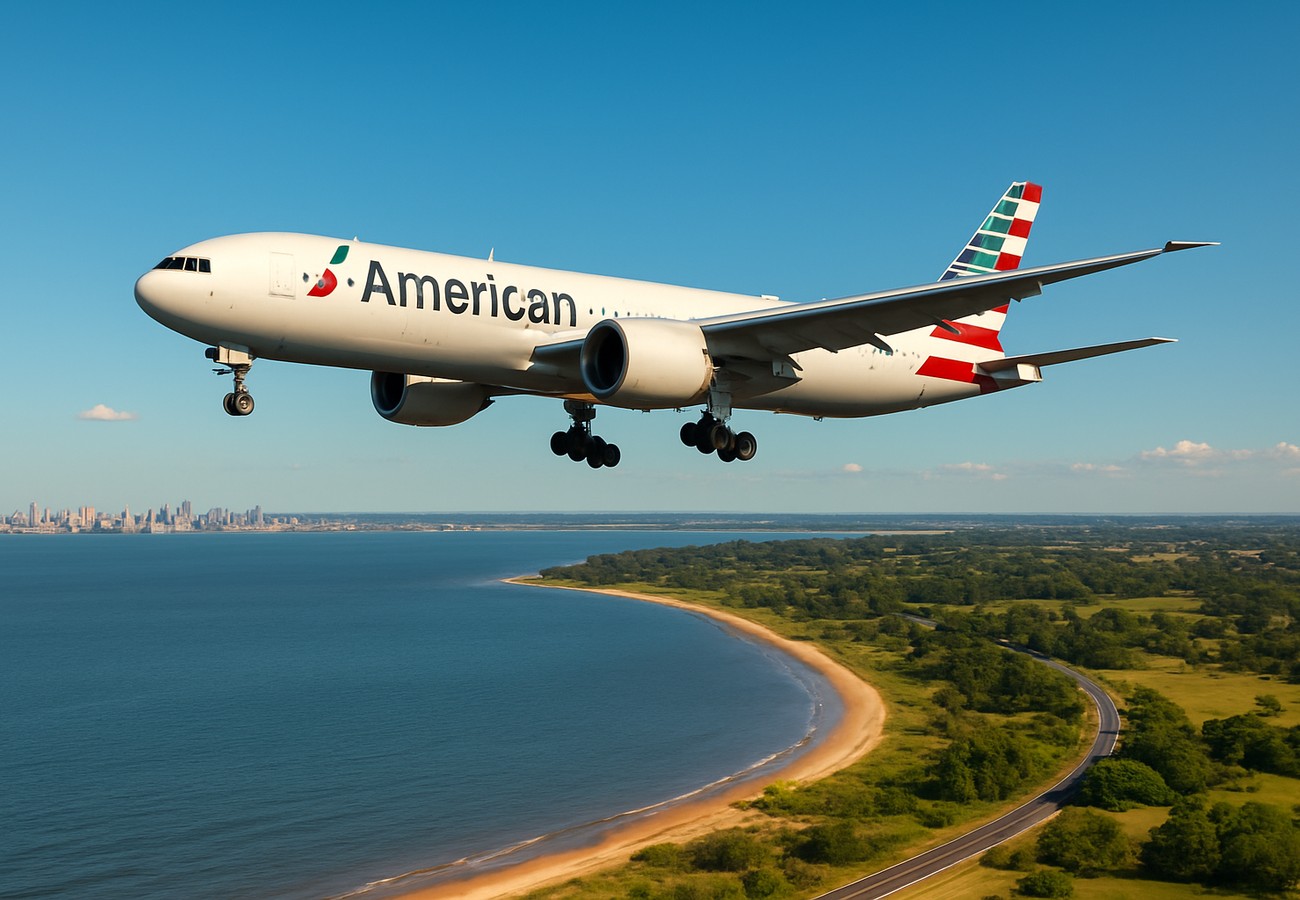
Image generated by AI
Creative Solution to Infrastructure Challenges
American Airlines is preparing to execute one of the most unusual widebody operations in its network. The carrier will temporarily deploy a Boeing 777-300ER on a route spanning barely 142 miles between Buenos Aires and Montevideo. This unconventional routing will serve as a critical fuel stop, allowing the airline to maintain two of its key long-haul services to the United States while major runway works take place at Buenos Aires' Ezeiza International Airport.
For a limited window in late 2026, this short hop across the Río de la Plata will become American's shortest international flight operated by a 777-300ER—far below the typical stage length flown by the long-haul twin-engine jet. Rather than serving as a destination itself, Montevideo will function as a refuelling bridge, enabling aircraft to depart Argentina with reduced fuel loads and then tank up for the transcontinental leg to North America.
Runway Restrictions Force Temporary Operational Changes
The routing adjustment stems from a significant infrastructure programme at Ezeiza, Argentina's primary international gateway. During the most disruptive phase of construction, beginning around late October 2026, the usable length of the airport's main runway 11/29 will be cut from approximately 3,300 meters to about 1,850 meters. For heavily loaded long-haul aircraft, this shortened distance is insufficient to take off safely with full fuel and payload.
American's operational solution involves having its 777-300ER flights to the United States depart Buenos Aires lighter than normal, fly the short hop to Montevideo's Carrasco International Airport, and complete refuelling there. Once fully fuelled in Uruguay, each aircraft can then launch across the equator to either Miami or New York without being constrained by the temporary limits at Ezeiza.
In contrast, other major US carriers serving the Argentine capital have opted for different responses. Airlines such as Delta Air Lines and United Airlines are planning to suspend their Ezeiza operations altogether during the critical period, waiting until the works ease before resuming service.
Affected Routes and Flight Details
American's revised plan affects two of its existing daily departures from Buenos Aires:
- Flight AA908 (Buenos Aires–Miami): Will operate Ezeiza–Montevideo–Miami between approximately October 25 and November 11, using a Boeing 777-300ER
- Flight AA954 (Buenos Aires–New York JFK): Will also be rerouted via Montevideo with the same aircraft type over the same dates
Under normal conditions, both flights operate as nonstop daily services from Buenos Aires with the 777-300ER. During the construction window, however, they will follow a two-leg pattern: a short segment from EZE to MVD with a light fuel load, followed by a fully fuelled transatlantic-style leg from MVD to the United States.
The ultra-short first sector will stand out in American's network as its briefest widebody operation. By comparison, another short-haul widebody pairing, Miami–Charlotte, covers around 651 miles.
American will be the only carrier on the Ezeiza–Montevideo pairing during this period. Argentina's flag carrier, Aerolíneas Argentinas, already connects Buenos Aires with Montevideo several times daily, but operates out of Aeroparque Jorge Newbery, the city's secondary airport closer to the downtown area, rather than Ezeiza.
Challenges for the 787-8 Service
American's second daily EZE–Miami flight, designated AA934 and operated with a Boeing 787-8, initially remains scheduled as a nonstop service. However, runway length constraints affect more than just the heavier 777-300ER.
Although the 787-8 has a notably lower maximum take-off weight of approximately 228 tonnes compared with around 352 tonnes for the larger 777-300ER, it still requires a runway in the range of roughly 2,400 to 2,900 meters for a fully loaded departure on a long-haul mission, depending on conditions.
With Ezeiza's main runway temporarily restricted to around 1,850 meters of usable length, the 787-8 is also likely to face limitations if it attempts to depart fully loaded directly for Miami. American may eventually need to adjust the plan for AA934 as well, whether by adding its own technical stop, placing weight or payload restrictions, or making broader schedule changes to accommodate the infrastructure works.
Ezeiza's Modernization Programme
The short-term disruption occurs against the backdrop of a substantial investment programme at Ezeiza. The airport operator has announced plans to commit more than US$100 million to modernise and expand the facility, with objectives including:
- Improving operational efficiency and safety
- Enhancing passenger comfort and cargo handling capacity
- Construction of a new apron known as Platform Golf, designed to park up to seven narrowbody aircraft
- Full rehabilitation of the secondary runway 17/35
- Work on the intersection between runway 17/35 and the main 11/29 strip
- Taxiway improvements
- Upgrades to airfield lighting systems
All of this is intended to support future growth in traffic while maintaining international safety and performance standards. However, the most challenging phase for airlines will fall between late October and mid-November, when operations will be limited solely to runway 11/29, and only a shortened portion of that runway will be available. Authorities have indicated that the usable length will be capped at approximately 1,850 meters during this interval.
Ezeiza's Strategic Importance to South American Aviation
Ezeiza is far from a minor regional facility; it is Argentina's main long-haul hub and a key gateway to South America. In 2025, the airport handled around 12 million passengers, recording year-on-year growth above 5%. It is served by more than 30 airlines and offers dozens of international destinations alongside a sizeable domestic network that connects the capital to cities across the country.
Because of that central role, the temporary runway restriction has implications well beyond a single airline's unusual 142-mile hop. Many carriers will need to adapt their operations over the affected period, either by pausing services, introducing technical stops, or juggling aircraft types and schedules. American's decision to keep its Ezeiza flights to Miami and New York alive through a short Montevideo detour highlights both the challenges and the creativity required when a major hub enters a concentrated period of construction.
What This Means for Travelers
Passengers booked on American Airlines flights from Buenos Aires to Miami or New York during the October 25–November 11 window should expect:
- An additional stop in Montevideo for refuelling (approximately 1–2 hours)
- Slightly longer total travel times compared to nonstop service
- Possible schedule adjustments or alternative routing options
- Confirmation of final itineraries directly with American Airlines before travel
Travelers using other carriers should verify current schedules, as Delta and United may have suspended or modified their Ezeiza operations during this period. For the most current information, consult the IATA airline schedule database or contact your airline directly.
Related Travel Guides
Disclaimer
This article is for informational and educational purposes only. It does not constitute legal, financial, or professional advice. While we strive to provide accurate and up-to-date information, travel policies, regulations, and conditions change rapidly. Always verify information with official sources before making travel decisions. Nomad Lawyer makes no representations about the accuracy, reliability, completeness, or suitability of the information provided. Readers should consult qualified professionals for advice specific to their circumstances. The views expressed in this article are those of the author and do not necessarily reflect the views of Nomad Lawyer.
Kunal K Choudhary
Co-Founder & Contributor
A passionate traveller and tech enthusiast. Kunal contributes to the vision and growth of Nomad Lawyer, bringing fresh perspectives and driving the community forward.
Learn more about our team →