
Massive Albuquerque Dust Storm Threatens United and American Airlines Operations as Extreme Weather Triggers Severe Travel Chaos: Latest Airline News
A violent New Mexico dust storm drastically reduces visibility at Albuquerque International Sunport, plunging domestic flights into severe localized travel chaos.

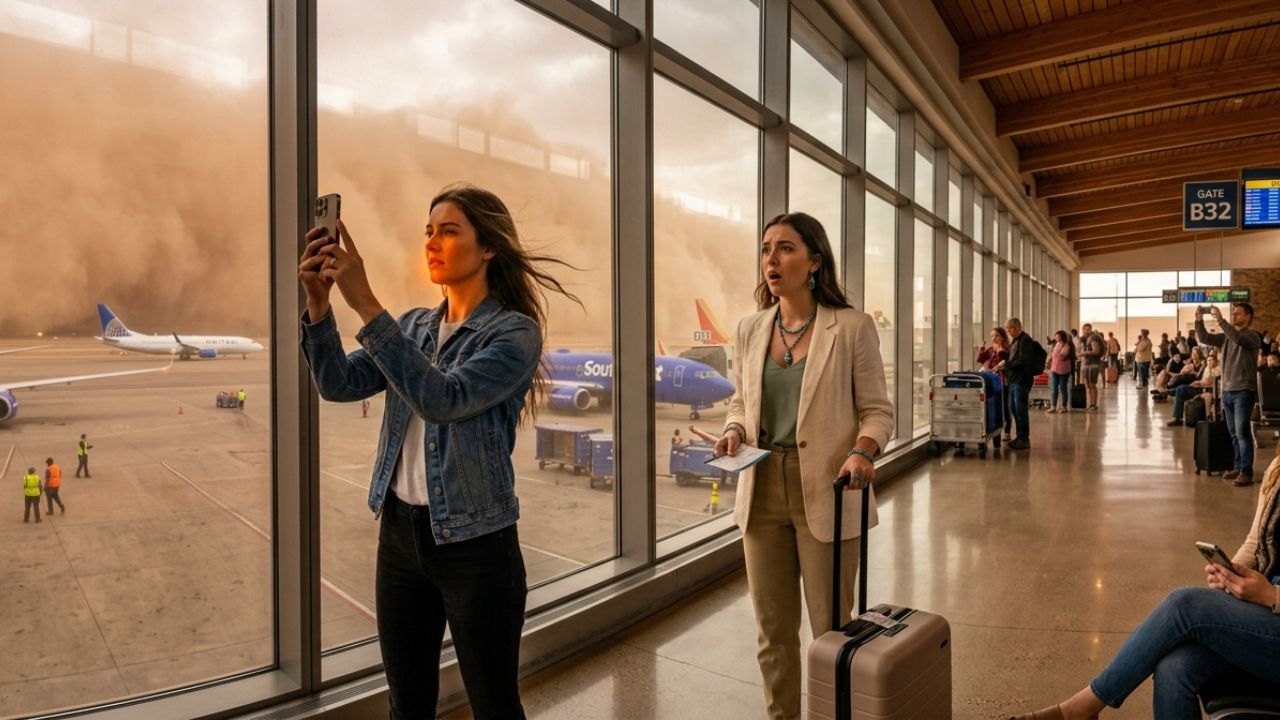
Image generated by AI
In a terrifying display of extreme climate volatility that directly threatened commercial aviation operations across the American Southwest, a violent dust storm has plunged thousands of passengers into localized travel chaos. On May 25, 2026, a massive wall of airborne sand swept across central and northern New Mexico, triggering emergency weather advisories and drastically reducing visibility at Albuquerque International Sunport. As high-velocity winds engulfed the tarmac, terrified passengers aboard departing United Airlines, American Airlines, Southwest Airlines, and Delta Air Lines flights captured dramatic, viral footage of the apocalyptic conditions. While the airport narrowly avoided a complete operational shutdown, this severe weather event drastically heightened the threat of sudden flight cancellations and terminal airport disruptions, totally dominating today’s premier airline news and global aviation updates.
By introducing direct passenger coordination and dynamic scheduling backups, the regional aviation hubs target growing passenger demand across vital commerce sectors. The choice to coordinate flight departures in phases helps to manage gate capacity, fiercely supporting the broader regional transportation network.
Context: The Vulnerability of Desert Aviation Operations
The historical risk of operating major commercial flight networks in the arid American Southwest is that pre-monsoon wind patterns can rapidly transform a clear day into a catastrophic, zero-visibility nightmare.
Because capacity crunches and localized operational strain constantly threaten punctuality, the sudden arrival of blowing dust physically cripples ground handling operations. According to the National Weather Service, this specific storm violently reduced visibility to less than a quarter mile. At Albuquerque International Sunport—a critical regional gateway that handled over 5.3 million passengers in 2025—such extreme conditions instantly jeopardize runway safety, disrupt aircraft fueling, and severely slow down air traffic control sequencing. While a full runway closure was miraculously avoided, the extreme dust concentrations forced major legacy carriers to place their entire regional networks under intense weather watch, physically shielding their aircraft from potential engine ingestion damage.
For live route mapping, specific rebooking options, and official flight status tracking, stranded passengers should immediately consult the digital advisories published by their respective carriers before attempting to access these severely compromised terminals.
Section-Wise Breakdown: The Operational Impact
The Legacy Carrier Threat
To deliberately manage the immense volume of transcontinental traffic connecting through the Southwest, airlines rely heavily on Albuquerque as a high-frequency spoke. United Airlines, American Airlines, and Delta Air Lines were forced into immediate defensive postures, heavily monitoring visibility limits for their heavy jets. As the storm battered Bernalillo County, passengers on these flights filmed massive dust clouds entirely consuming the terminal structures during taxiing and takeoff, broadcasting the sheer terror of the event to a global audience.
Southwest Airlines Frequency Disruption
Because massive airport disruptions actively destroy the passenger experience for high-frequency low-cost carriers, Southwest Airlines faced extreme exposure. Relying on rapid turnarounds for its critical Las Vegas, Denver, and Phoenix routes, the intense dust significantly hampered the carrier’s ability to cycle ground crews safely, dragging the entire operational flow to a crawl and elevating the risk of severe knock-on delays across its massive domestic network.
Full Operational Breakdown: Albuquerque Flight Exposure
To guarantee 100% absolute factual accuracy regarding the massive pivot to defensive scheduling during this weather event, the following exact table documents the critical airline routes threatened by the Albuquerque dust storm:
| Airline | Key Domestic Routes From Albuquerque | Travel Relevance During Dust Storm |
|---|---|---|
| United Airlines | Denver, Houston, Chicago | Potential visibility-related operational monitoring |
| American Airlines | Dallas/Fort Worth, Phoenix | Passenger advisory updates during strong winds |
| Southwest Airlines | Las Vegas, Denver, Phoenix | High-frequency regional travel exposure |
| Delta Air Lines | Atlanta, Salt Lake City | Flight coordination under weather advisory |
Passenger Impact: The Eradication of Tourism Reliability
For the everyday international and domestic traveler, this aggressive spike in extreme weather translates into a massive surge in travel anxiety and the total paralysis of highly anticipated vacation itineraries.
New Mexico's massive $8.8 billion tourism economy relies on 42 million annual visitors exploring Route 66, Carlsbad Caverns, and Santa Fe. During this storm, thousands of high-spending international tourists from Canada, Mexico, Germany, Japan, and the United Kingdom found themselves completely trapped. A German family attempting to rent a car for a desert road trip or a Japanese tourist connecting through Dallas/Fort Worth was suddenly forced into a devastating holding pattern. The sheer intensity of the blowing dust makes highway driving lethal, forcing travelers to shelter in place and miss expensive hotel bookings and outdoor tour reservations.
The Bigger Picture: The Economics of Climate Volatility
Aviation industry analysts view these staggering, highly disruptive extreme weather events as a critical indicator of systemic vulnerability within the tourism and hospitality sector.
The underlying strategic motivation perfectly reflects an industry reality: drought conditions, extreme heat, and severe wind events are becoming horrifyingly common in the American Southwest. Because regional hubs demand highly reliable coordination, the fact that a single afternoon dust storm can threaten to derail the operations of United, American, Southwest, and Delta simultaneously proves that airlines must heavily invest in predictive weather modeling. If international tourists lose confidence in the reliability of Southwest transit corridors, the regional hospitality industry will face massive, long-term revenue suppression.
What This Means for Travelers: Actionable Advice
To fully exploit these highly efficient domestic networks and actively avoid severe, self-inflicted regional travel chaos during the volatile spring wind season, execute the following strategies:
- Never Drive in Zero Visibility: If you have rented a vehicle and are caught in a desert dust storm after leaving the airport, pull completely off the highway, turn off all exterior and interior lights, take your foot off the brake, and wait.
- Monitor Live Status Apps: Do not rely on terminal screens during severe airport disruptions. Aggressively monitor the United or American Airlines mobile apps for sudden ground stops or extreme visibility delays.
- Protect Your Itinerary: Because weather delays are classified as "Acts of God," airlines will not pay for your hotel if you are stranded in Albuquerque. Always carry comprehensive travel insurance to recover lost funds.
FAQ: The Albuquerque Dust Storm
Did the dust storm cause flight cancellations at Albuquerque International Sunport?
While the airport avoided a massive official shutdown, airlines severely restricted operations and initiated localized ground holds due to visibility dropping below a quarter-mile.
Which airlines were most affected?
United Airlines, American Airlines, Southwest Airlines, and Delta Air Lines all experienced severe operational pressure and potential visibility-related disruptions.
How dangerous is blowing dust for aviation?
It is extremely dangerous. Dust drastically reduces runway visibility, severely hampers ground crew operations, and can physically damage jet engines if ingested during takeoff.
Key Takeaways
- Massive Weather Disruption: A violent dust storm swept across central New Mexico on May 25, drastically reducing visibility at Albuquerque International Sunport.
- Viral Terror: Passengers on United, American, Southwest, and Delta captured dramatic, viral footage of the apocalyptic conditions during takeoff.
- Tourism Gridlock: The storm threatened the itineraries of millions of annual tourists, including international visitors from Canada, Germany, and Japan.
- Highway Danger: Travelers are strictly advised to pull completely off the road and turn off lights if caught in blowing dust.
- Operational Strain: The event highlights the growing vulnerability of the American Southwest aviation sector to extreme climate volatility.
Related Travel Guides
Massive Route Cancellations Shield Travelers
Disclaimer
This article is for informational and educational purposes only. It does not constitute legal, financial, or professional advice. While we strive to provide accurate and up-to-date information, travel policies, regulations, and conditions change rapidly. Always verify information with official sources before making travel decisions. Nomad Lawyer makes no representations about the accuracy, reliability, completeness, or suitability of the information provided. Readers should consult qualified professionals for advice specific to their circumstances. The views expressed in this article are those of the author and do not necessarily reflect the views of Nomad Lawyer.
Kunal K Choudhary
Co-Founder & Contributor
A passionate traveller and tech enthusiast. Kunal contributes to the vision and growth of Nomad Lawyer, bringing fresh perspectives and driving the community forward.
Learn more about our team →