
Akasa Air Expands Indian Domestic Network with Increased Delhi, Bengaluru, and Kolkata Flights Alongside New Rajasthan Routes in Late 2026
Akasa Air scales its pan-India operations with 196 weekly Delhi departures, a new Kolkata crew base, increased metro frequencies, and non-stop flights to Rajasthan.

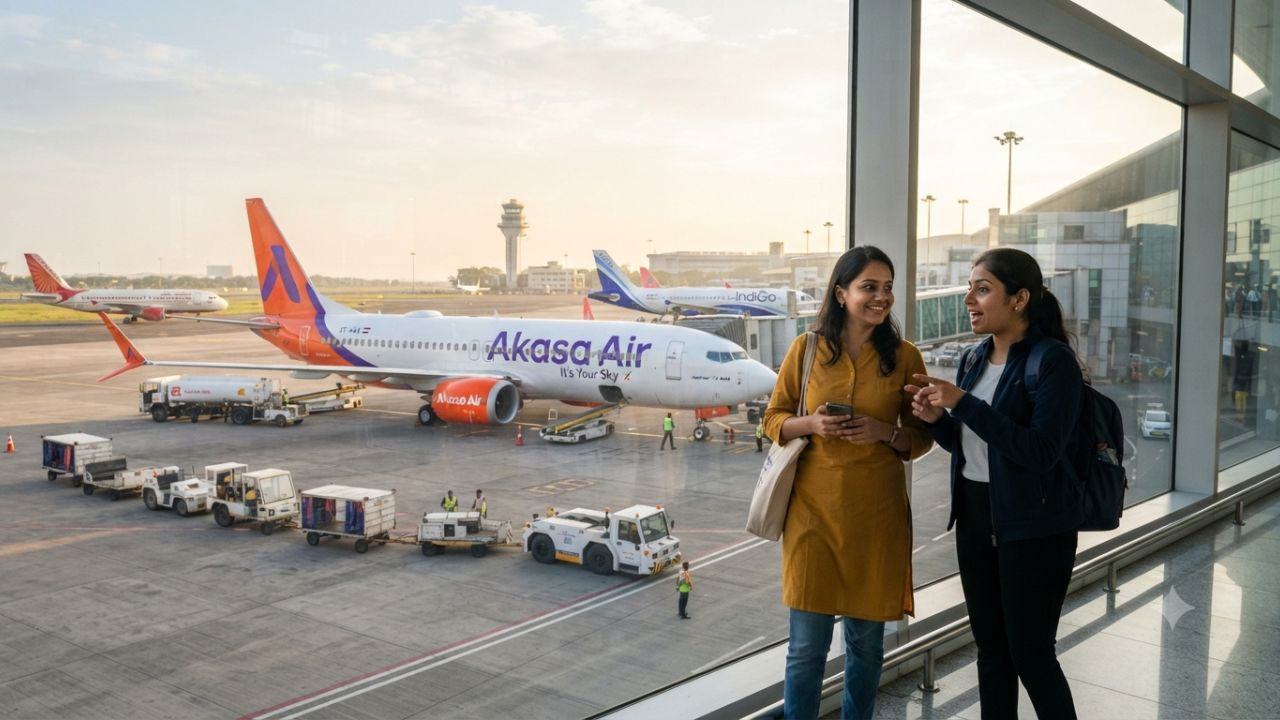
Image generated by AI
Akasa Air has announced a major expansion of its domestic flight schedule across North, South, and East India, scaling operations to 196 weekly departures from Delhi, establishing a dedicated crew base in Kolkata, and deploying new direct services linking Rajasthan and Punjab with southern commercial hubs. The network expansion adds daily flights on major metropolitan routes—including six daily services between Mumbai and Delhi—while broadening regional connectivity to Visakhapatnam, Jaipur, Udaipur, and Kozhikode.
Announced on 23 October 2026, the scheduling overhaul marks a decisive stage in the carrier's growth trajectory four years after its operational launch. By synchronizing high-frequency trunk corridors with emerging secondary industrial and leisure markets, Akasa Air aims to capture business travelers demanding flexible departure options while expanding non-stop air links into high-growth leisure markets.
Akasa Air Network Expansion: Delhi, Bengaluru, and Kolkata Strategic Realignment
In North India, the carrier is consolidating its base at Indira Gandhi International Airport in Delhi, where it now operates 196 weekly departures providing direct connections to 14 cities. The northern schedule introduces one daily service linking Delhi with Visakhapatnam, alongside two additional daily frequencies to Mumbai, one extra daily departure to Bengaluru, and one additional daily frequency to Goa.
Connectivity into Rajasthan expands through new daily non-stop flights linking both Jaipur and Udaipur with Mumbai and Bengaluru. In Punjab, Chandigarh secures enhanced north-south connectivity through daily non-stop rotations to Bengaluru and Goa. These city pairings allow regional business travelers and holidaymakers to bypass congested layovers at intermediate transit hubs.
South India functions as the airline's primary operational engine, anchored by Kempegowda International Airport in Bengaluru. Akasa Air now provides direct services connecting Bengaluru to 19 domestic destinations and three international gateways: Abu Dhabi, Phuket, and Jeddah. Across Kerala, operations expand at Kochi and Kozhikode, with additional domestic frequencies and international capacity scheduled to support Gulf transit demand and regional business travel.
In Eastern India, Netaji Subhash Chandra Bose International Airport in Kolkata experiences significant infrastructure investment. The airline has expanded its timetable to 95 weekly departures out of Kolkata connecting eight direct destinations. To sustain this regional throughput, Akasa Air has opened a permanent operational crew base in Kolkata, stationing dedicated pilots, cabin attendants, and engineering support staff to ensure turnaround punctuality across eastern and northeastern routes.
On metropolitan trunk corridors, flight availability increases to meet corporate booking demand. The high-density Mumbai–Delhi sector now operates with six daily flights, complemented by one daily rotation between Navi Mumbai and Delhi. Services connecting Bengaluru and Delhi scale to five daily flights, while the Delhi–Kolkata sector provides two daily flights timed for morning and evening business commutes.
Reflecting on the network expansion, Anand Srinivasan, Co-Founder and Chief Commercial Officer at Akasa Air, stated that since launching the carrier four years ago, the team identified a compelling opportunity to establish a dependable airline within one of global aviation's fastest-growing domestic markets. He emphasized that the airline's disciplined approach focuses on deepening frequency where passenger demand is consolidating, strengthening connections between major economic centres and emerging destinations, and progressively scaling international routes.
Transit Schedule & Route Specifications
The following table details Akasa Air's expanded domestic frequencies, hub departures, and regional network additions confirmed for the late 2026 operating season:
| Operating Corridor / Hub | Weekly Departures / Daily Frequency | Connected Destinations | Operational Focus & Fleet Alignment |
|---|---|---|---|
| Delhi (DEL Hub Base) | 196 weekly departures | Direct services to 14 cities nationwide | Expanded trunk connectivity; adds 1 daily Visakhapatnam flight, 2 daily Mumbai flights, 1 daily Bengaluru flight, 1 daily Goa flight |
| Mumbai (BOM) – Delhi (DEL) | 6 daily non-stop rotations | Mumbai Central to Delhi Indira Gandhi | High-frequency corporate trunk corridor; supplemented by 1 daily Navi Mumbai (NMI) – Delhi (DEL) service |
| Bengaluru (BLR) – Delhi (DEL) | 5 daily non-stop rotations | Bengaluru Kempegowda to Delhi Indira Gandhi | Business and tech corridor with distributed departure slots throughout morning and evening banks |
| Delhi (DEL) – Kolkata (CCU) | 2 daily non-stop rotations | Delhi Indira Gandhi to Kolkata | Scheduled for morning and evening commercial travel windows |
| Kolkata (CCU Hub Base) | 95 weekly departures | Direct connections to 8 cities | Supported by a newly established permanent operational crew base in Kolkata |
| Bengaluru (BLR Hub Base) | Multi-daily departure schedule | 19 domestic cities; 3 international points (Abu Dhabi, Phuket, Jeddah) | Primary southern transit node for pan-India domestic and short-haul international flights |
| Rajasthan Services (JAI / UDR) | Daily non-stop rotations | Jaipur & Udaipur connected to Mumbai and Bengaluru | Direct point-to-point commercial and tourism links bypassing Delhi connections |
| Chandigarh (IXC Services) | Daily non-stop rotations | Direct connections to Bengaluru and Goa | Direct northern industrial links to southern tech centers and western coastal leisure belts |
| Kerala Operations (CCJ / COK) | Progressive frequency enhancements | Kozhikode and Kochi connected to domestic and Gulf routes | Serving regional commerce and non-stop repatriation/labor transit routes |
Passenger Logistics Guide: Digi Yatra, Hub Layovers, and Airport Navigation
For passengers traveling across Akasa Air's expanded domestic and overseas network, managing airport logistics requires specific transit planning:
- Digi Yatra Biometric Terminal Processing: Travelers departing from Delhi (Terminal 2 and Terminal 3), Bengaluru (Terminal 1), and Kolkata should enroll in the Digi Yatra Foundation facial recognition ecosystem prior to arriving at the airport. Utilizing Digi Yatra dedicated entry gates and security lanes reduces terminal processing times from 25 minutes down to under 5 minutes during peak morning departure banks (06:00 to 09:00).
- Navigating Mumbai Airport Terminals: Passengers booking flights in the Mumbai Metropolitan Region must carefully review their booking confirmation and airport three-letter codes. While primary operations fly out of Chhatrapati Shivaji Maharaj International Airport (BOM), the carrier operates one daily flight via Navi Mumbai International Airport (NMI). Ground transit between BOM and NMI across the Mumbai Trans Harbour Link (Atal Setu) takes between 60 and 90 minutes depending on highway traffic; mixing up airport terminals will result in missed flights.
- Connecting Domestic to International via Bengaluru (BLR): Passengers booking itineraries from tier-2 cities such as Jaipur, Udaipur, or Chandigarh that transit through Bengaluru onto Akasa Air international flights to Abu Dhabi, Phuket, or Jeddah must account for international departures moving through Terminal 2. A minimum connection time of 120 minutes is recommended to allow for baggage transfer verification, security checks, and passport control administered by the Bureau of Immigration.
- Check-In Deadlines and Boarding Protocols: In accordance with regulations issued by the Directorate General of Civil Aviation (DGCA), domestic check-in counters close precisely 60 minutes prior to scheduled departure, and boarding gates shut 20 minutes prior to pushback. Because Akasa Air maintains strict aircraft turnaround times on its Boeing 737 MAX fleet to preserve network punctuality, gate arrival protocols are strictly enforced.
- Managing Pet Travel ("Café Akasa" and Pets on Akasa): Travelers utilizing the airline's popular pet travel program, which permits domesticated dogs and cats in the passenger cabin (under 7 kg including carrier) or cargo hold, must complete veterinary health documentation at airport check-in desks at least two hours prior to departure. Special baggage handlers inspect pet kennels before baggage induction.
Infrastructure Impact Assessment: Reshaping India's Domestic Aviation Market
Akasa Air's network expansion carries important structural implications for India's commercial aviation sector, which is monitored closely by the Ministry of Civil Aviation (MoCA). Over the past three years, the Indian domestic market has tilted toward consolidation, dominated heavily by IndiGo's extensive fleet and the newly integrated Air India Group (encompassing Air India, Vistara, and Air India Express).
By adding 196 weekly flights at Delhi, 95 weekly flights at Kolkata, and deploying point-to-point services connecting Tier-2 cities like Jaipur, Udaipur, and Kozhikode, Akasa Air introduces meaningful fare competition on key regional business routes. Bypassing mega-hubs through direct point-to-point services reduces strain on congested runway slots at Mumbai and Delhi while boosting tourism and commerce in secondary manufacturing and cultural hubs.
Furthermore, the establishment of a dedicated crew base in Kolkata provides critical operational resilience in Eastern India. In an operating environment often disrupted by severe winter fog in the north and pre-monsoon squalls in the east, maintaining distributed crew and engineering stations prevents localized delays from cascading across the airline's national network.
FAQ: Akasa Air Domestic and International Network Expansion 2026
How many weekly flights does Akasa Air operate from Delhi?
Akasa Air operates 196 weekly departures from Delhi, providing direct flights to 14 cities across India, including Mumbai, Bengaluru, Goa, and Visakhapatnam.
Which new destinations in Rajasthan are connected by Akasa Air?
Akasa Air operates daily non-stop flights connecting both Jaipur and Udaipur directly with Mumbai and Bengaluru, providing direct point-to-point business and leisure travel.
Where does Akasa Air fly internationally from Bengaluru?
From its Bengaluru hub, Akasa Air operates non-stop international flights to three destinations: Abu Dhabi, Phuket, and Jeddah, alongside direct domestic services to 19 cities.
Why did Akasa Air establish a crew base in Kolkata?
Akasa Air established a dedicated operational crew base in Kolkata to support its 95 weekly departures, stationing local pilots and cabin crew to enhance on-time performance across Eastern India.
Related Travel Guides
Air India and Singapore Airlines Expand Codeshare Network Across Indian and Southeast Asian Hubs
Disclaimer
This article is for informational and educational purposes only. It does not constitute legal, financial, or professional advice. While we strive to provide accurate and up-to-date information, travel policies, regulations, and conditions change rapidly. Always verify information with official sources before making travel decisions. Nomad Lawyer makes no representations about the accuracy, reliability, completeness, or suitability of the information provided. Readers should consult qualified professionals for advice specific to their circumstances. The views expressed in this article are those of the author and do not necessarily reflect the views of Nomad Lawyer.
Raushan Kumar
Founder & Lead Developer
Full-stack developer with 11+ years of experience and a passionate traveller. Raushan built Nomad Lawyer from the ground up with a vision to create the best travel and law experience on the web.
Learn more about our team →