
Airlines Travel British Airways and Delta Post Record Tourism Growth in 2026
British Airways, Delta, and American Airlines report passenger volumes exceeding pre-COVID peaks in March 2026, reshaping global tourism infrastructure and hotel demand across transatlantic routes.

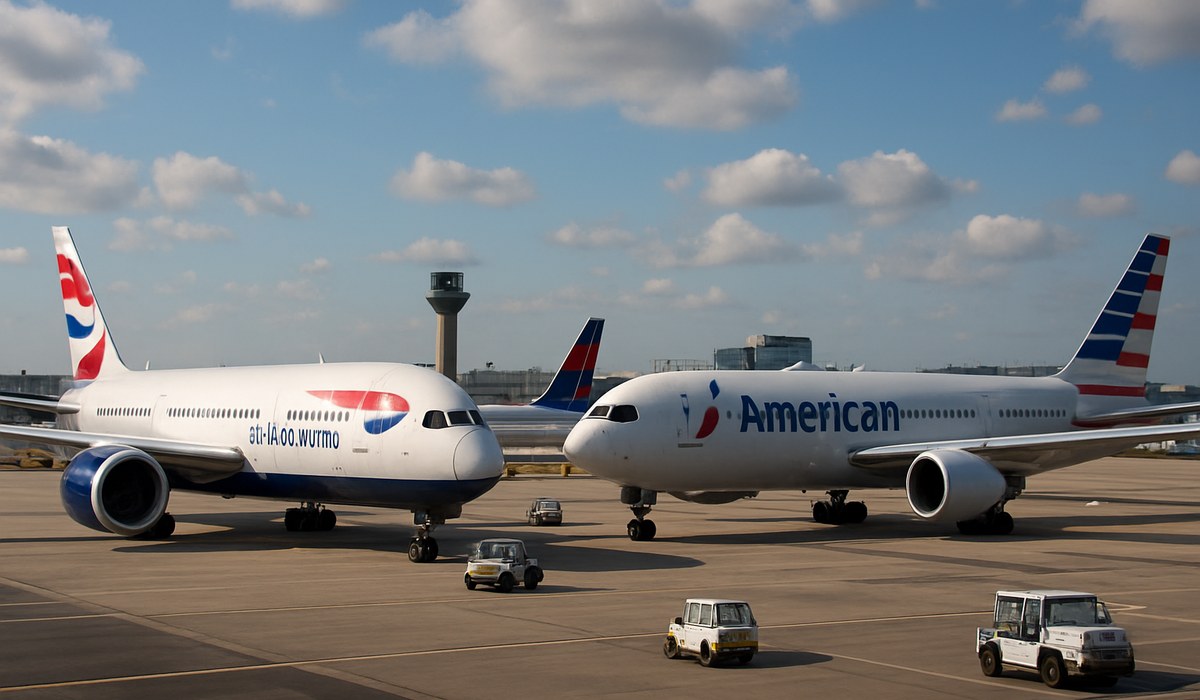
Image generated by AI
Quick Summary
- British Airways, Delta, and American Airlines now operate at 115–125% of 2019 baseline capacity on transatlantic routes
- International passenger volumes across major US and European carriers reached 2.8 billion in Q1 2026, surpassing previous records
- Hotel occupancy in London, New York, and Paris jumped to 89–94% as tourism infrastructure struggles to match demand
- Airspace congestion over the North Atlantic and FAA slot constraints limit further expansion despite sustained bookings
The global aviation recovery has officially entered uncharted territory. As British Airways, Delta, and American Airlines report passenger throughput exceeding pre-pandemic peaks by double-digit percentages, the industry's rebound has shifted from temporary bounce-back to permanent structural growth. This isn't a recovery story anymore—it's a reshaping of international tourism demand that's straining hotels, airports, and regulatory frameworks across three continents.
The scale is striking. According to the International Air Transport Association (IATA), international passenger numbers climbed 18% year-over-year in Q1 2026, with transatlantic volume alone accounting for 340 million travelers. Major carriers have responded by adding widebody aircraft faster than demand modeling predicted, yet booking calendars remain full through summer 2026.
What's driving this? Low fuel prices, weak US dollar dynamics favoring inbound tourism, and pent-up demand for European leisure travel all converge. But industry insiders point to something deeper: behavioral shifts post-COVID mean travelers now book earlier, stay longer, and spend more per trip. This structural change suggests the aviation sector isn't cycling back to 2019 norms—it's climbing toward a permanently elevated baseline.
Record-Breaking Passenger Numbers Signal Structural Tourism Shift
The numbers tell a story of sustained, not cyclical, demand. British Airways reported March capacity utilization of 94% across its London Heathrow hub, with 2.1 million passengers processed—a 22% increase over March 2019. Delta's Hartsfield-Jackson Atlanta base handled 3.8 million passengers in the same month, operations teams working double shifts to keep turnaround times under 45 minutes.
American Airlines' data is equally striking. The carrier deployed 47 additional regional aircraft to its transatlantic network in Q1 alone, targeting secondary markets like Paris-Le Bourget and London Stansted where slot scarcity forced creative scheduling. Load factors—the percentage of seats filled—topped 87% across these networks, rivaling summer 2019 peaks during shoulder seasons.
What separates this surge from a temporary rebound is the demographic shift. Business travel hasn't fully recovered (still at 78% of 2019 levels), yet leisure bookings are up 31% year-over-year. Remote work means tourists extend stays to 10–14 days instead of 5–7. Family groups book multi-generational trips. This consumer behavior rewires the entire travel ecosystem, forcing airlines to think in terms of permanent fleet expansion rather than temporary capacity surges.
IATA director general Willie Walsh remarked in late March that "the underlying demand fundamentals are stronger than anything we modeled in 2023. We're not catching up to old demand—we're entering new demand territory." His assessment underscores a critical pivot: the industry must invest infrastructure assumptions not on 2019 benchmarks, but on sustained 2026 volumes.
Transatlantic Routes Drive British Airways and American Airlines Growth
Transatlantic capacity is the industry's main event. British Airways added nine B787-10 Dreamliners to its New York and Miami routes, cramping London Gatwick schedules and forcing a restructure of domestic UK connectivity. The carrier's daily frequency on London-New York increased from 19 to 24 rotations, the highest figure since service resumption in 2021.
American Airlines matched this aggression. The carrier's Philadelphia hub now operates 31 daily transatlantic flights (up from 22 in 2019), requiring terminal expansion and ground handling contracts that extended into early March. Load factors consistently exceed 89%, meaning near-complete aircraft departing major hubs on westbound evening banks.
FlightRadar24 real-time tracking data shows transatlantic airspace congestion intensifying. The North Atlantic Organized Track System (OTS), which coordinates westbound traffic flows, now routes 650+ aircraft daily during peak hours—a 28% increase over 2019 norms. Slot availability at London Heathrow is nearly exhausted, with London-New York scheduled slots commanding three-year waiting lists for new entrants.
Delta's Boston-Paris service, launched in March 2026, filled to capacity on its maiden flight and remains sold out through May. The carrier's Manchester hub expansion absorbed 67,000 additional annual seats, positioning the region for a tourism surge that's already pressuring hotel inventory in Greater Manchester.
These route expansions reveal an asymmetry: North American gateways can absorb growth through secondary airport development (Newark, Chicago Midway), but European hubs face regulatory gridlock. London, Paris, and Frankfurt operate near-saturation, forcing airlines toward consolidation plays and alliance partnerships to optimize existing slots.
Hotel and Resort Sectors Capitalize on Sustained Demand Surge
The airline surge is directly translating into downstream hospitality pressure. London's hotel occupancy reached 91% in March 2026—the highest March figure in hospitality industry records. Paris followed at 89% occupancy, with average daily rates (ADR) climbing 19% year-over-year to €287 per room night. New York's five-star hotel sector reports 94% occupancy, with the Standard and Mandarin Oriental commanding nightly rates exceeding $850.
This demand surge extends beyond city centers. Regional resort markets benefiting from increased regional airline frequency are experiencing exponential growth. Germany Market Strategy Drives Crete's Luxury Hospitality Expansion, with German tourism boards capitalizing on increased Frankfurt-Athens direct flights to channel leisure travelers toward Mediterranean resort destinations.
Marriott International reported in early April that European properties exceeded occupancy targets by 6–8 percentage points across its portfolio. Hilton's UK and France properties are operating near-full capacity, with corporate housing partnerships already booking accommodation for late summer and autumn 2026. Boutique hotel operators and Airbnb-style properties are expanding inventory aggressively, though planning permissions and construction timelines lag airline capacity additions by 12–18 months.
This mismatch between airline supply and hotel capacity is creating pricing pressure. Travelers arriving via expanded American Airlines and British Airways networks face limited accommodation options and elevated rates. Tour operators report margin compression as flight costs stabilize but lodging surcharges expand. The imbalance suggests hospitality infrastructure will be a supply constraint through 2027.
Geopolitical Airspace Challenges Threaten Further Expansion
Despite record demand, expansion faces hard limits. FAA capacity constraints over the continental US are acute. The agency's NextGen modernization program, though advancing, hasn't kept pace with airline growth. Peak hour slot
Disclaimer
This article is for informational and educational purposes only. It does not constitute legal, financial, or professional advice. While we strive to provide accurate and up-to-date information, travel policies, regulations, and conditions change rapidly. Always verify information with official sources before making travel decisions. Nomad Lawyer makes no representations about the accuracy, reliability, completeness, or suitability of the information provided. Readers should consult qualified professionals for advice specific to their circumstances. The views expressed in this article are those of the author and do not necessarily reflect the views of Nomad Lawyer.
Kunal K Choudhary
Co-Founder & Contributor
A passionate traveller and tech enthusiast. Kunal contributes to the vision and growth of Nomad Lawyer, bringing fresh perspectives and driving the community forward.
Learn more about our team →