
Airline Economy Seat Pitch: 2026 US Carrier Comparison
2026 airline economy seat pitch data reveals widening comfort gaps across US carriers. Major airlines cluster at 30-32 inches while ultra-low-cost options drop to 28 inches, reshaping traveler choices.

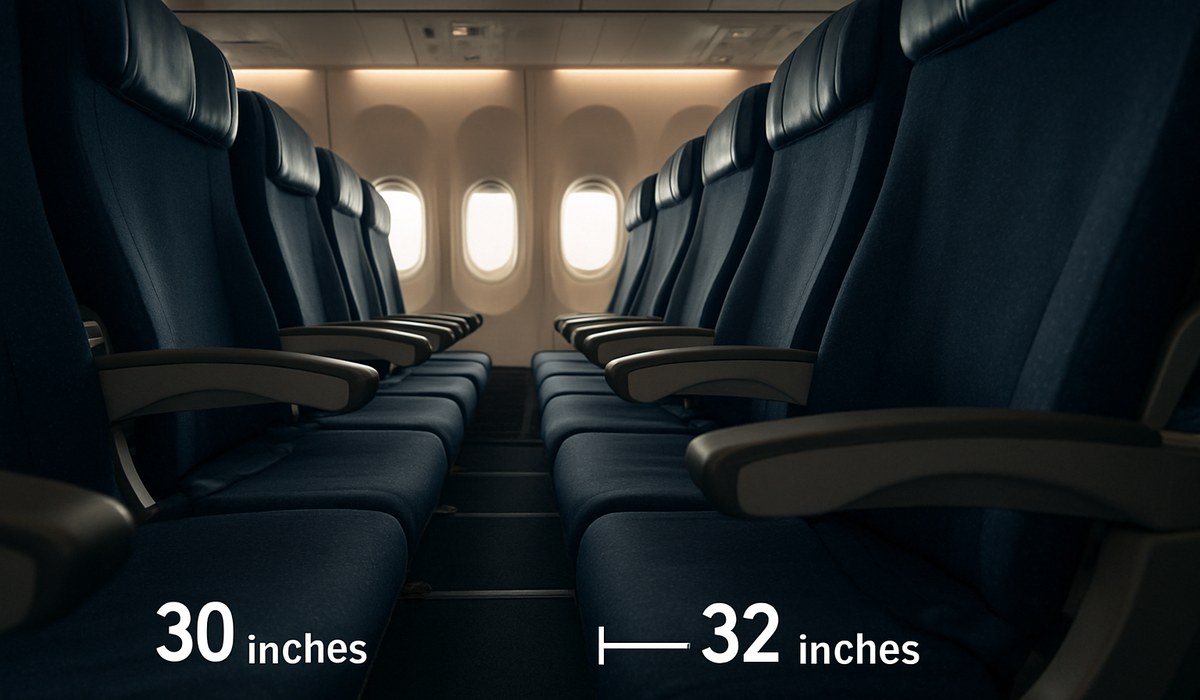
Image generated by AI
How US Airline Economy Seat Pitch Stacks Up in 2026
Airline economy seat pitch—the measurable distance between identical points on consecutive seats—has become the defining comfort metric for US domestic travel in 2026. Fresh data from fleet analyses and cabin configuration tracking reveals a pronounced split between full-service carriers and ultra-low-cost operators. The gap has widened as airlines pursue divergent seating strategies, creating meaningful consequences for passengers on regional and transcontinental routes.
The industry landscape shows consolidation among legacy carriers, where seat pitch now stacks between 30 and 32 inches across mainline fleets. Meanwhile, budget-focused competitors continue compressing cabins to 28-inch pitch, generating revenue through ancillary fees rather than base fares. For travelers, understanding these specifications has never been more critical to flight planning.
JetBlue and Southwest Lead Domestic Legroom Rankings
JetBlue Airways maintains the most generous airline economy seat pitch among major US carriers, with standard cabins averaging 32-34 inches across its domestic network. The New York-based airline uses this legroom advantage as a central brand differentiator, pairing spacious seating with complimentary seatback entertainment and Wi-Fi access. Fleet data compiled through early 2026 shows JetBlue's Airbus A320 and A321neo aircraft consistently exceed competitor legroom standards.
Southwest Airlines ranks closely behind, operating a standardized Boeing 737 fleet where economy seat pitch stacks between 31.5 and 32 inches. The carrier's all-Boeing strategy simplifies cabin consistency while maintaining competitive legroom. Both airlines leverage their seating comfort to justify slightly higher base fares, recognizing that many passengers will pay premium prices for legroom on routes exceeding three hours. Industry analysts note these carriers capture significant market share from business travelers and frequent flyers prioritizing mid-cabin comfort over rock-bottom pricing.
FlightAware seat maps allow passengers to verify pitch specifications before booking either carrier.
Legacy Carriers Converge at the 30-31 Inch Standard
American Airlines, Delta Air Lines, and United Airlines now operate with nearly identical economy seat pitch specifications, clustering their mainline cabins at 30-31 inches for standard seating. This convergence reflects industry-wide cabin retrofit cycles where airlines balance passenger comfort against aircraft density economics. Delta Air Lines occupies the upper range at approximately 31-32 inches on many narrowbody aircraft, while American and United typically pitch at the 30-31 inch mark.
Each legacy carrier has introduced premium economy tiers to segment the market. Delta Comfort Plus, United Economy Plus, and American Main Cabin Extra add 4-6 additional inches of pitch at premium fares. These tiered approaches allow carriers to serve both price-conscious and comfort-seeking passengers on identical aircraft. Fleet retrofits currently underway at all three carriers may temporarily reduce standard pitch by one inch to accommodate additional seats, though newer slimline seat technology helps preserve effective knee room even at lower nominal distances.
Passenger feedback mechanisms through IATA industry standards continue to track comfort perceptions across these carriers.
Ultra-Low-Cost Carriers Maintain Tightest Configurations
Spirit Airlines and Frontier Airlines operate economy cabins with 28-inch seat pitch, representing the industry minimum for basic economy service in the United States. These ultra-low-cost carriers intentionally compress cabin configurations to support headline fares that undercut full-service competitors by 40-60 percent. The approximately four-inch pitch reduction compared to JetBlue translates directly to additional rows and seat count per aircraft.
Both carriers reserve premium extra-legroom sections—typically exit row and bulkhead seating—with pitch approaching 32 inches or higher, though these seats carry substantial additional fees. Passengers seeking adequate legroom on ultra-low-cost flights face mandatory upgrade costs, sometimes exceeding $50 per segment. Consumer advocacy groups highlight this pricing model as a potential hidden cost that offsets apparent fare savings. Industry analysis shows ultra-low-cost passengers often pay total ticket prices comparable to legacy carriers after including checked baggage, seat assignment, and legroom upgrades.
[US Department of Transportation passenger rights resources](https://www.transportation.gov/airconsumer) document ancillary fee disclosures across all carriers.
What This Means for Travelers Booking 2026 Flights
Passengers booking domestic flights in 2026 should expect these concrete outcomes based on carrier selection:
-
Full-service carriers (JetBlue, Southwest, Delta) will provide 31-34 inch economy pitch without upgrade fees, supporting comfortable work or sleep on flights exceeding 2.5 hours.
-
Legacy airline economy cabins (American, United) offer 30-31 inch pitch in standard seating, requiring Economy Plus upgrades for meaningful legroom.
-
Ultra-low-cost bookings (Spirit, Frontier) include 28-inch pitch as baseline, with legroom-focused passengers facing $25-75 per-segment upgrade costs.
-
Aircraft type verification matters significantly—newer aircraft with slimline seats provide better effective comfort even at nominal pitch reductions.
-
Booking direct with airlines allows seat selection review before purchase, enabling pitch verification through interactive seat maps.
Travelers over 6 feet tall consistently report that sub-30-inch pitch creates sustained discomfort on flights exceeding two hours. Mid-range pitch (31-32 inches) accommodates most passengers without legroom anxiety.
Key Industry Data: Economy Seat Pitch Comparison
| Airline | Aircraft Type | Standard Pitch | Premium Pitch | 2026 Market Position |
|---|---|---|---|---|
| JetBlue Airways | A320/A321neo | 32-34 inches | N/A required | Legroom Leader |
| Southwest Airlines | Boeing 737 MAX 8 | 31.5-32 inches | N/A required | Top Tier |
| Delta Air Lines | Boeing 737-900/A220 | 31-32 inches | 38 inches (Comfort Plus) | Upper Standard |
| Alaska Airlines | Boeing 737 MAX 9 | 31 inches | 36 inches (Premium) | Competitive |
| American Airlines | Boeing 737 MAX 8/A320 | 30-31 inches | 35 inches (Main Cabin Extra) | Standard |
| United Airlines | Boeing 737 MAX 9/A321neo | 30-31 inches | 37 inches (Economy Plus) | Standard |
| Frontier Airlines | Airbus A320 | 28-29 inches | 32 inches (stretch seating) | Ultra-Low-Cost |
| Spirit Airlines | A320/A321 | 28 inches | 31-32 inches (Big Front Seat) | Ultra-Low-Cost |
Understanding Pitch Variations Within Single Carriers
Airline economy seat pitch varies meaningfully even within single carriers, depending on aircraft generation, cabin retrofit status, and seating configuration. An American Airlines Boeing 737 MAX 8 configured for high-density routes may offer 30-inch pitch, while the same carrier's Airbus A321 on lower-density routes provides 31 inches. Retrofit timing creates temporary inconsistencies—aircraft undergoing cabin updates may see pitch reduced by one inch during the transition.
Passengers can verify specific pitch before purchasing by accessing carrier seat maps directly. Most airlines now display row-by-row pitch information on booking pages or through dedicated fleet guides. FlightAware provides detailed aircraft specifications including cabin layouts for flights up to six weeks in advance. Booking the same route across different aircraft types can yield 1-3 inch pitch variations, just
Disclaimer
This article is for informational and educational purposes only. It does not constitute legal, financial, or professional advice. While we strive to provide accurate and up-to-date information, travel policies, regulations, and conditions change rapidly. Always verify information with official sources before making travel decisions. Nomad Lawyer makes no representations about the accuracy, reliability, completeness, or suitability of the information provided. Readers should consult qualified professionals for advice specific to their circumstances. The views expressed in this article are those of the author and do not necessarily reflect the views of Nomad Lawyer.
Preeti Gunjan
Contributor & Community Manager
A passionate traveller and community builder. Preeti helps grow the Nomad Lawyer community, fostering engagement and bringing the reader experience to life.
Learn more about our team →