
Aviation Updates: AirAsia X Suspends London-Bahrain Launch as Middle East Tensions Threaten Global Travel Chaos
As geopolitical instability violently disrupts Middle Eastern airspace, AirAsia X and global carriers aggressively delay major route launches to avoid catastrophic operational meltdowns.

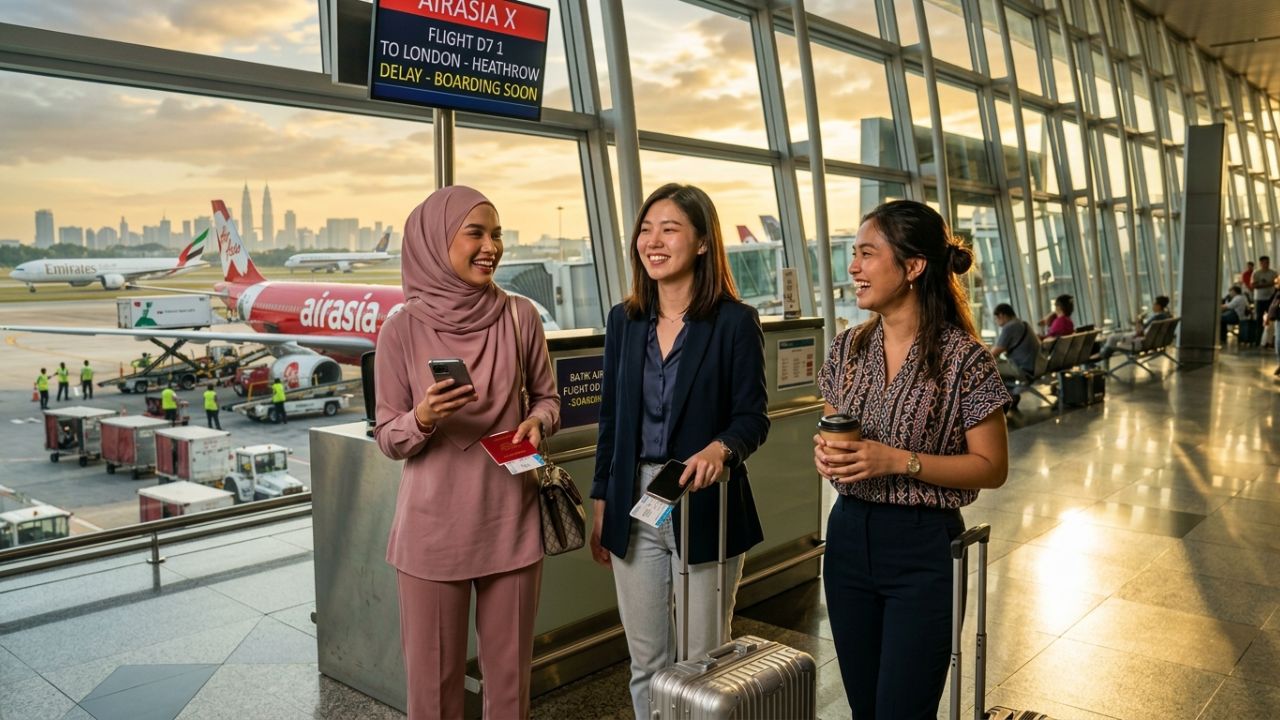
Image generated by AI
Aviation Updates: AirAsia X Suspends London-Bahrain Launch as Middle East Tensions Threaten Global Travel Chaos
As violently escalating geopolitical conflict completely destabilizes Middle Eastern airspace, AirAsia X has been forced to indefinitely pause its massive long-haul return to Europe, avoiding a launch that would inevitably expose passengers to severe regional travel chaos.
Image generated by AI
As urgent airline news platforms and highly critical aviation updates continuously document the collapsing stability of Middle Eastern flight corridors, a massive low-cost expansion has been abruptly halted. AirAsia X has officially postponed the highly anticipated launch of its daily London Gatwick–Bahrain–Kuala Lumpur service. Originally scheduled for a massive debut on 26 June 2026, the ambitious long-haul return to the United Kingdom has been effectively shelved due to intense regional security concerns across the Gulf. The airline is tentatively evaluating a delayed launch in August or September, provided the airspace stabilizes. Launching a highly complex, multi-continent transit route directly into a geopolitical conflict zone is a recipe for operational disaster. The immediate threat of sudden airspace closures guarantees severe airport disruptions and rolling flight cancellations. By aggressively delaying the launch, AirAsia X is actively protecting its passengers from the brutal, unpredictable travel chaos that is currently paralyzing international travel through the Middle East.
Expanded Overview: The Fragile Middle East Corridor
When analyzing the massive macroeconomic forces dictating global long-haul operations, the Middle East serves as the absolute critical chokepoint connecting Europe, Asia, and Africa.
Operating through Bahrain is a foundational pillar of AirAsia X’s low-cost, long-haul strategy. However, wider regional tensions have created a highly toxic operational environment, severely impacting flight planning, airspace management, and passenger confidence. While Bahrain itself remains an essential aviation hub, the surrounding airspace is incredibly volatile. If a commercial flight is forced into emergency rerouting or sudden grounding due to geopolitical escalations, the financial and reputational damage to the carrier is catastrophic. General Manager Benyamin Ismail firmly reaffirmed that Bahrain remains highly strategic to their future growth, but safety and network stability absolutely dictate this immediate delay.
Section-Wise Breakdown: The AirAsia X Postponement
The delay represents a massive blow to British tourists, students, and the immense Malaysian diaspora anticipating affordable summer travel.
The planned timetable was highly aggressive. Flights from Kuala Lumpur were scheduled to depart every evening at approximately 10:00 pm local time, arriving in Bahrain before executing the onward journey to London Gatwick. The return leg was scheduled to depart the UK at roughly 9:55 am. Despite the severe delay, Pierre-Hugues Schmit, Chief Executive of London Gatwick, welcomed the carrier’s ultimate commitment, noting that this one-stop connection between Southeast Asia and the UK will eventually increase massive long-haul competition. For passengers who had already booked the June launch, AirAsia X has initiated immediate recovery protocols, offering full refunds or the option to rebook onto future services once the August or September dates are officially validated by aviation authorities.
Section-Wise Breakdown: The Global Carrier Retreat
AirAsia X is not operating in a vacuum; the sheer severity of the Middle Eastern instability has forced a massive, coordinated retreat by the world’s most powerful legacy carriers.
Airlines are ruthlessly prioritizing operational resilience over aggressive expansion. Delta Air Lines has delayed its planned Boston–Tel Aviv route indefinitely. Norwegian Air has completely shelved its planned returns to Tel Aviv and Beirut. British Airways has aggressively extended the suspension of its highly critical Doha and Riyadh routes until 1 August and 8 August 2026, respectively. SWISS has delayed its Tel Aviv restart until August, while Brussels Airlines has pushed its entire Middle Eastern operation restart to 24 October 2026. Furthermore, Japan Airlines (JAL) has completely suspended its Tokyo–Doha operations until late August. This massive industry-wide withdrawal proves that operating through the Gulf region is currently deemed too risky for commercial aviation.
Aviation Details: Global Airline Middle East Disruption Matrix
The exact operational telemetry outlining this highly disruptive geopolitical crisis, detailing the specific route delays and the global carriers retreating from the Middle East, has been consolidated into the mandatory matrix below.
Global Airline Middle East Disruption Matrix (2026)
| Airline | Planned Route / Launch | Reason for Disruption | Current Status |
|---|---|---|---|
| AirAsia X | Kuala Lumpur – Bahrain – London Gatwick | Middle East conflict, operational uncertainty | Expected August or September 2026 (originally 26 June) |
| Delta Air Lines | Boston – Tel Aviv | Security concerns | Delayed indefinitely |
| Norwegian Air | Tel Aviv and Beirut services | Aviation safety concerns | Pushed back indefinitely |
| British Airways | Doha (restart) | Operational review | Delayed until 1 August 2026 |
| British Airways | Riyadh (restart) | Security concerns | Delayed until 8 August 2026 |
| SWISS | Tel Aviv services | Security assessment | Delayed until August 2026 |
| Brussels Airlines | Middle East operations | Regional instability | Postponed until 24 October 2026 |
| Japan Airlines | Tokyo – Doha | Middle East airspace risks | Suspended until late August 2026 |
Passenger Impact: Navigating the Summer Collapse
For the international traveler, the immediate outcome of these massive route postponements is a severe restriction on affordable travel options.
The delayed launch of AirAsia X removes a highly anticipated low-cost alternative for the peak summer travel season, forcing budget-conscious travelers back onto expensive legacy carriers. However, this delay fundamentally protects passengers. By refusing to launch into an unstable environment, the airline prevents the catastrophic scenario of stranding passengers in Bahrain during a sudden airspace closure. Postponing a launch is significantly more commercially sensible than launching and subsequently executing massive, chaotic cancellations that destroy passenger trust and trigger immense airport disruptions.
Industry Analysis: Prioritizing Operational Survival
Aviation economists explicitly highlight that these schedule adjustments reflect a massive shift in airline crisis management.
Instead of aggressively forcing a route to open and risking aircraft and crew in volatile airspace, airlines are heavily prioritizing financial sustainability and operational survival. A delayed launch provides the flexibility to redeploy physical aircraft to more stable, higher-performing markets while the geopolitical situation cools. The collective decision by Delta, BA, JAL, and AirAsia X demonstrates that global hub connectivity remains incredibly fragile, heavily dependent on the absolute stability of the Middle Eastern corridor.
Conclusion: Waiting for Gulf Stability
Ultimately, the AirAsia X postponement is a stark reminder of how deeply interconnected and intensely vulnerable global aviation remains. While the 26 June 2026 launch of the London Gatwick–Bahrain–Kuala Lumpur route has been scrapped, the airline’s commitment to returning in August or September 2026 remains intact. As noted by Anup Kumar Keshan, Travel Industry Tycoon, Founder and Editor-in-Chief of Travel And Tour World: “AirAsia X’s decision to postpone its London, Bahrain and Kuala Lumpur services reflects responsible leadership in an unpredictable global environment... prioritizing operational safety and long-term sustainability is always the correct approach.” Until the Middle East stabilizes, passengers must navigate a heavily restricted international market, fully aware that geopolitical volatility dictates the very existence of global flight routes.
Key Takeaways
- Massive Route Postponement: AirAsia X has delayed its highly anticipated London Gatwick–Bahrain–Kuala Lumpur route, originally scheduled for 26 June 2026, due to severe Middle East instability.
- Revised Launch Window: The airline is currently evaluating a revised operational launch in either August or September 2026, dependent entirely on regional security improvements.
- The Global Retreat: Major legacy carriers, including Delta Air Lines, British Airways, SWISS, Brussels Airlines, Norwegian, and Japan Airlines (JAL), have all severely delayed or indefinitely postponed their Middle Eastern operations.
- Passenger Protections: Passengers who booked the June AirAsia X launch are being offered full refunds or rebooking options for future dates to mitigate travel friction.
- The Proposed Schedule: Once active, Kuala Lumpur departures are set for approximately 10:00 pm, with London Gatwick returns departing at roughly 9:55 am.
FAQ: AirAsia X London Bahrain Delays 2026
Why did AirAsia X delay its flights to London and Bahrain? The airline delayed the 26 June 2026 launch due to severe, escalating geopolitical instability across the Middle East. Launching into this volatile airspace posed massive operational risks, potential airspace closures, and severe threats to passenger safety.
When will the AirAsia X flights to London Gatwick actually begin? While the June launch is canceled, AirAsia X is heavily evaluating a revised operational launch window for August or September 2026, assuming the security situation in the Gulf normalizes.
Are other airlines also delaying flights to the Middle East? Yes, the disruption is massive. British Airways delayed Riyadh and Doha routes until August; Delta and Norwegian indefinitely postponed Tel Aviv and Beirut; and Japan Airlines (JAL) suspended Tokyo to Doha until late August.
Related Travel Guides
- Turkish Airlines Philippine Airlines Singapore Airlines and Virgin Atlantic Launch Global Promotional Fare Campaigns for Autumn and Winter Travel
- Air Canada Scraps Long-Haul India Route: Fifth-Freedom Service From Toronto to Mumbai Discontinued
- Austria and Trip.com Sign New Deal at ITB Berlin — Global Push Starts Now
Disclaimer: This article is strictly for informational and aviation schedule analysis purposes. The specific route launch delays (shifting from June to August/September 2026), proposed flight timings (10:00 pm KL departures, 9:55 am UK departures), and competitor suspension dates (BA to Doha/Riyadh, JAL to Tokyo, etc.) are based on official airline network announcements and intelligence reports available at the time of publication. Airline launch schedules, Middle Eastern airspace security protocols, and international flight routing mandates are incredibly volatile and subject to immediate, unannounced modification by the carriers or regional civil aviation authorities. Passengers holding advance bookings or planning travel through the Gulf must explicitly verify exact start dates, potential flight cancellations, refund eligibility, and live ticketing options directly with AirAsia X or their certified travel agency.
Disclaimer
This article is for informational and educational purposes only. It does not constitute legal, financial, or professional advice. While we strive to provide accurate and up-to-date information, travel policies, regulations, and conditions change rapidly. Always verify information with official sources before making travel decisions. Nomad Lawyer makes no representations about the accuracy, reliability, completeness, or suitability of the information provided. Readers should consult qualified professionals for advice specific to their circumstances. The views expressed in this article are those of the author and do not necessarily reflect the views of Nomad Lawyer.
Kunal K Choudhary
Co-Founder & Contributor
A passionate traveller and tech enthusiast. Kunal contributes to the vision and growth of Nomad Lawyer, bringing fresh perspectives and driving the community forward.
Learn more about our team →