
Air Japan Bids Farewell: Japan's Hybrid Budget Carrier Ends 36-Year Legacy on March 28
Air Japan, ANA Group's ambitious hybrid low-cost carrier, ceased operations on March 28, 2026, concluding a 36-year history of rebrands. The carrier served nearly one million passengers across Tokyo-Bangkok, Seoul, and Singapore routes in just 26 months.

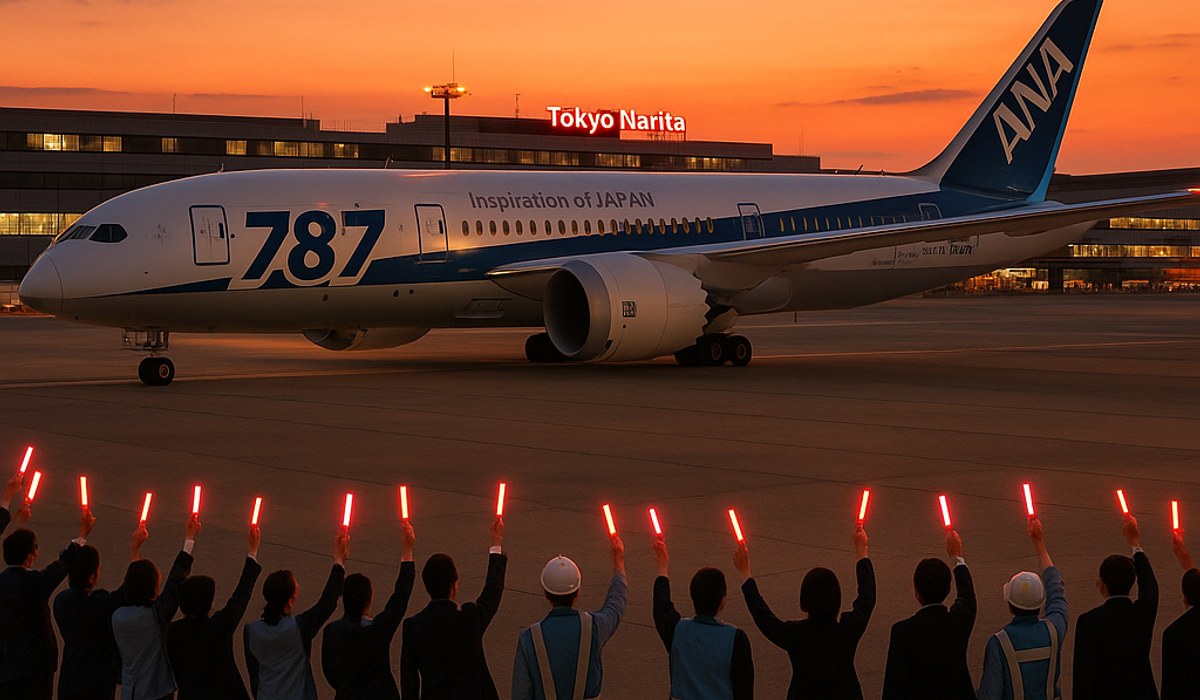
Image generated by AI
Air Japan's Chapter Closes: 26-Month Mission Ends as All Three Aircraft Depart Tokyo
Quick Summary
- ✈️ Air Japan ceased operations March 28, 2026 after 26 months of service
- 📍 Operated routes: Tokyo → Bangkok, Seoul, and Singapore
- 👥 Carried nearly 1 million passengers across 4,124 flights
- 🎌 Final farewell featured staff waving glow sticks as three Boeing 787-8s departed simultaneously
Air Japan, ANA Group's experimental hybrid low-cost carrier, flew its final flights on March 28, 2026, ending an ambitious two-year bid to reinvent affordable Asian travel. All three Boeing 787-8 aircraft simultaneously departed Tokyo Narita, each heading to Bangkok, Seoul, and Singapore—their signature routes—carrying passengers who wanted to witness aviation history. The farewell wasn't just logistical; it was ceremonial. Staff stood on the tarmac waving glow sticks under the evening sky, commemorating a brand that had transported nearly one million travelers despite operating for just over two years.
The closure marks the conclusion of a broader 36-year corporate journey. Air Japan's lineage traces back to 1990 as World Air Network, undergoing multiple rebrands before its final incarnation. This farewell signals the end of an experiment that promised premium Japanese hospitality at budget-airline pricing—an offering that resonated with passengers but ultimately couldn't sustain in ANA Group's portfolio.
The Backstory: From World Air Network to Air Japan's Brief Flight
Building a Hybrid Vision (1990–February 2024)
ANA Group's original carrier, World Air Network, launched in 1990 and spent 34 years operating in the Asia-Pacific market. The company underwent repeated rebranding cycles as market conditions shifted. In February 2024, ANA made a strategic wager: relaunch the carrier as Air Japan, positioning it as a bridge between ANA's premium service expectations and passengers seeking affordability.
The timing felt right. Post-pandemic recovery had created demand for Japan-bound leisure travel combined with budget consciousness. Air Japan would fly Boeing 787-8 aircraft—normally associated with long-haul luxury—but configured in single-class layout with 324 seats to maximize capacity and lower per-seat economics.
The Three-Route Strategy (February 2024–March 2026)
Air Japan's operational network was deliberately focused:
- Tokyo Narita (NRT) ↔ Bangkok Suvarnabhumi (BKK) — Launched February 9, 2024
- Tokyo Narita (NRT) ↔ Seoul Incheon (ICN) — Launched mid-2024
- Tokyo Narita (NRT) ↔ Singapore Changi (SIN) — Launched late 2024
This trifecta connected Japan's capital to three of Southeast Asia's busiest business and leisure hubs. The service filled a specific niche: business travelers seeking flexible pricing, leisure tourists wanting affordable long-haul access, and Asian visitors exploring Japan with budget-conscious expectations.
By The Numbers: Air Japan's 26-Month Impact
Despite its brevity, Air Japan compiled impressive operational metrics that demonstrated genuine market demand:
Route-by-Route Breakdown:
| Route | Flights | Passengers |
|---|---|---|
| Tokyo-Bangkok | 1,514 | ~344,200 |
| Tokyo-Seoul | 1,520 | ~369,500 |
| Tokyo-Singapore | 1,090 | ~255,200 |
| TOTAL | 4,124 | ~968,900 |
Key Achievement: Nearly reaching the 1 million-passenger milestone in under 27 months proved that an affordable, quality-focused hybrid model had market viability—at least in the short term.
Aircraft Utilization: The three Boeing 787-8s flew approximately 1,375 routes per aircraft, averaging respectable load factors in a competitive post-pandemic recovery period. Each aircraft was configured with 324 passenger seats in a single-class layout, maximizing accessibility over cabin differentiation.
The Final Flight: Ceremony Over Cruise Altitude
March 28, 2026 — Last Departure
The airline's closure wasn't handled with typical corporate quiet. Instead, ANA orchestrated a farewell that honored passengers and staff alike. On the final day, three simultaneous departures occurred:
- Flight NQ1 (Tokyo-Bangkok): 298 passengers, 26 seats unsold but symbolically full
- Flight NQ2 (Tokyo-Seoul): Similar configuration with commemorative passengers
- Flight NQ3 (Tokyo-Singapore): Final departure to round out the three-route network
The Emotional Farewell:
Staff members—approximately 70 crew members across Air Japan's operations—gathered on the Narita tarmac as the aircraft prepared for departure. As wheels left the ground, employees waved glow sticks that glowed against the twilight sky. Passengers received commemorative boarding certificates and limited-edition Air Japan stickers marking their participation in the airline's final chapter.
The Lottery Moment:
Seven passengers on the Tokyo-Bangkok flight won special gifts selected by Air Japan's staff. For these travelers, the final flight transcended mere transportation—it became a historic moment.
Naoki Michihiro, General Manager of Flight Operations, addressed the final batch of travelers in Japanese, Thai, and English, acknowledging the global passenger base that had trusted Air Japan's vision. He reflected on the airline's successful execution of its dual mandate: delivering Japanese hospitality standards while maintaining budget-carrier affordability.
What Made Air Japan Different: Japanese Hospitality Meets Budget Travel
Design Philosophy
Air Japan's livery—featuring indigo and dawn blue hues—visually distinguished it from competitors while honoring Japanese aesthetic traditions. This wasn't accidental branding; every design choice communicated the airline's core promise: accessibility without sacrificing cultural identity.
In-Flight Experience
- Meal Service: Japanese-themed cuisine blending traditional and contemporary dishes, rotating menus highlighting regional Japanese culinary heritage
- Innovation: Onboard projection mapping entertainment, gachapon (capsule toy) vending machines—playful touches that personalized the 7–9 hour journey
- Staff Interaction: Crew trained in ANA's legendary hospitality standards, creating a service quality typically reserved for full-service carriers
This approach created loyal passengers. Business travelers appreciated the reliability; leisure tourists valued the affordability; cultural enthusiasts enjoyed the authentic Japanese experience at budget prices.
Why Air Japan Couldn't Sustain: Market Forces and Corporate Strategy
The Closure Question
While Air Japan proved its appeal operationally, sustainability is a different metric. The airline's closure reflects several realities:
- Market Saturation: Competition from established low-cost carriers (Spring Airlines, etc.) and ANA's own Peach Aviation intensified pricing pressure
- Corporate Efficiency: ANA Group likely determined consolidating Air Japan operations into Peach's network would optimize system-wide profitability
- Fuel and Labor Costs: Despite high passenger demand, Boeing 787s consume significant fuel. A more efficient narrowbody fleet (A320, 737) may better serve budget-route economics
ANA Group's decision reflects pragmatic aviation economics rather than a failed concept.
Legacy: What Air Japan Leaves Behind
For Passengers:
Nearly 1 million travelers experienced what an Asian airline could deliver when combining affordability with genuine service quality. This experience resets expectations—passengers now know that budget and hospitality aren't mutually exclusive.
For ANA Group:
Air Japan validated the market opportunity for hybrid positioning in leisure travel. These learnings will inform future ANA Group experiments and Peach Aviation developments. The airline's data—passenger preferences, route profitability, demand elasticity—provides valuable strategic information.
For Aviation Industry:
Air Japan demonstrated that niche positioning, even with a short runway, can fill unmet market demand. The airline's success launching and scaling three intercontinental routes in under 27 months proves agility in legacy carriers is possible when given autonomy.
FAQ: Your Air Japan Questions Answered
Q: Can I still fly the Tokyo-Bangkok route now that Air Japan is closed? A: Yes. ANA and Peach Aviation operate the same route. ANA offers full-service experience; Peach provides budget alternatives. Air Japan occupied the middle ground that Peach will likely expand into.
Q: Will my Air Japan frequent flyer miles be honored? A: Miles transferred to ANA Group accounts before closure. Contact ANA Mileage Club for redemption details. Commemorative boarding passes from final flights are becoming collectors' items.
Q: Why didn't Air Japan expand to more cities before closing? A: Boeing 787 long-haul operations are capital-intensive. Route expansion required sustained profitability. ANA likely prioritized returning aircraft to its full-service operations rather than funding additional hybrid capacity.
Q: Were there layoffs when Air Japan ceased operations? A: Air Japan staff (~70 crew) transitioned to ANA Group positions or Peach Aviation roles. No mass layoffs—an example of thoughtful Japanese corporate culture in aviation.
Q: Could Air Japan be revived in the future? A: Possible but unlikely under the same model. ANA's future hybrid ambitions may come under the Peach Aviation banner rather than a separate entity.
The Farewell Message
Air Japan's 26 months proved a hypothesis: passengers across Asia will embrace a carrier that refuses to pit affordability against quality. The airline's closure doesn't invalidate this finding—it reflects corporate portfolio optimization at ANA Group.
For travelers who flew Air Japan, the final flight was more than an end—it was membership in an aviation exclusive. For the industry, Air Japan's legacy is a reminder that even brief experiments, executed with intention, leave lasting marks on how airlines serve passengers.
The glow sticks on the Narita tarmac illuminated more than a farewell. They signaled that consumer demand for thoughtful, accessible global travel remains stronger than ever.
Disclaimer
This article is for informational and educational purposes only. It does not constitute legal, financial, or professional advice. While we strive to provide accurate and up-to-date information, travel policies, regulations, and conditions change rapidly. Always verify information with official sources before making travel decisions. Nomad Lawyer makes no representations about the accuracy, reliability, completeness, or suitability of the information provided. Readers should consult qualified professionals for advice specific to their circumstances. The views expressed in this article are those of the author and do not necessarily reflect the views of Nomad Lawyer.
Raushan Kumar
Founder & Lead Developer
Full-stack developer with 11+ years of experience and a passionate traveller. Raushan built Nomad Lawyer from the ground up with a vision to create the best travel and law experience on the web.
Learn more about our team →