
Global Energy Crisis 2026: As the Strait of Hormuz Blockade Drives Oil Prices Skyward, Air India Deploys First $400M Retrofitted Boeing B787-8 to Capture Premium Market Share Amidst Rising Gulf Tensions and Mass Shipping Disruptions
With the Strait of Hormuz blockade driving a massive spike in global jet fuel prices, Air India's $400 million widebody retrofit initiative represents a vital strategic countermeasure to protect long-haul profitability and premium connectivity against geopolitical instability.

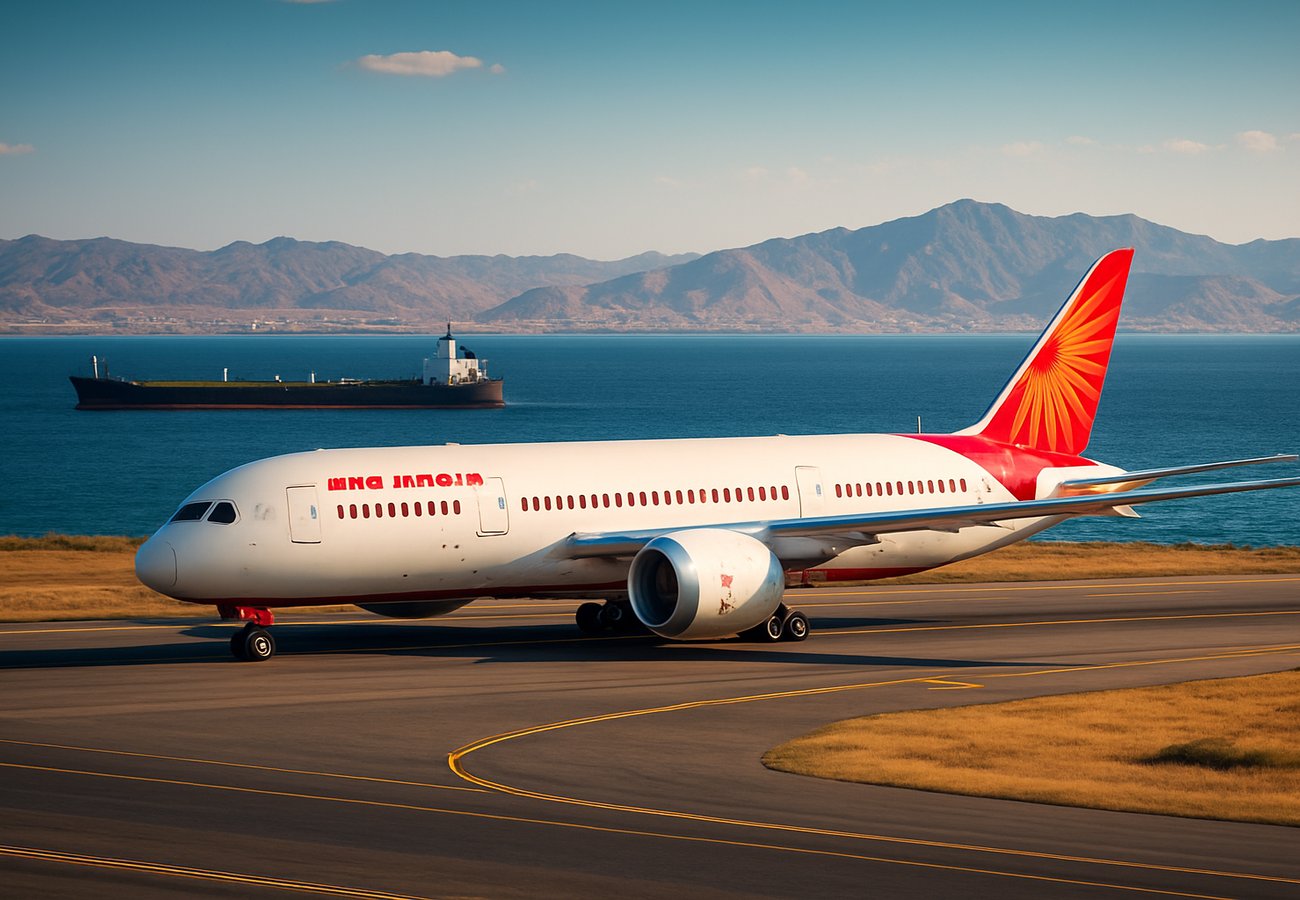
Image generated by AI
Global Energy Crisis 2026: As the Strait of Hormuz Blockade Drives Oil Prices Skyward, Air India Deploys First $400M Retrofitted Boeing B787-8 to Capture Premium Market Share Amidst Rising Gulf Tensions and Mass Shipping Disruptions
Indian Aviation's Strategic Countermeasure to Unprecedented Jet Fuel Highs Includes 12,825 Manhours of Transformation for VT-ANT; Why High-Yield Cabins Are the Ultimate Buffer Against the Middle East Oil Shock
NEW DELHI, India — The global aviation sector is currently caught in a geopolitical crossfire, with the escalating crisis surrounding the Strait of Hormuz blockade triggering a catastrophic global energy crisis. As the standoff severely throttles the Middle East oil supply chain—causing benchmark crude to experience extreme intraday volatility—legacy carriers are scrambling to protect their operational margins. Amidst this unprecedented era of shipping disruption and fuel shock, Air India has made a tactical maneuver that aviation economists denote as highly significant: completing the first phase of its ambitious $400 million fleet modernization program. Through the unveiling of its first fully refurbished Boeing B787-8 Dreamliner (VT-ANT), Air India is demonstrating that extreme cabin efficiency and high-yield premium seats are the most formidable defense against unpredictable Gulf tensions.
EXPANDED OVERVIEW: The Intersection of Airline Efficiency and Fuel Volatility
Historically, periods of extreme fuel scarcity force airlines into defense mechanisms—slashing marginal routes, grounding gas-guzzling legacy airframes, and imposing heavy surcharges on passengers. The current market, strained by nearly 20% of the world's daily oil consumption being trapped due to the Hormuz closures, is seeing exactly that. Yet, instead of retreating, Air India has accelerated a staggering 12,825-manhour structural transformation of its widebody assets across the Pacific in California.
The strategy is clear: when baseline fuel costs become uniformly exorbitantly high globally, the only path to sustainable long-haul operations between India and Europe, the United Kingdom, or Australia is maximizing the revenue yield of every square inch of the aircraft. By stripping out legacy interiors and installing Thales’ AVANT Up IFE alongside a reimagined three-class configuration, Air India’s massive $400 million investment transforms its B787 fleet into highly insulated, revenue-optimized machines.
GEOPOLITICAL CONTEXT: The US-Iran Conflict and the Supply Chokepoint
To understand the urgency behind an airline overhauling its widebody metrics, one must look at the epicenter of the disruption. The ongoing US-Iran conflict has resulted in heavily contested waters throughout the Arabian Gulf. With the Strait of Hormuz acting as the sole sea passage from the Persian Gulf to the open ocean, the effective blockade has paralyzed tanker traffic.
For commercial aviation nodes in the subcontinent, this means relying on heavily taxed, redirected fuel imports and absorbing immense premium surcharges. The military brinkmanship in the region has upended traditional jet-grade kerosene purchasing futures, pushing national carriers toward an existential need to either ground flights or completely reinvent their high-value passenger acquisition strategies.
GLOBAL ENERGY IMPACT: Skyrocketing Oil Prices and Supply Chain Risks
The fallout from these closures is directly dictating airline fleet decisions in 2026. Oil prices have broken multi-year resistance levels, reflecting the severe global supply chain risk that accompanies maritime shipping disruptions.
When jet fuel derivatives double in price, the traditional volume-based economy class model suffers catastrophic margin decay. This energy inflation forces airlines onto a knife's edge. Air India's retrofit addresses this economic reality directly. By reducing reliance on sheer volume and significantly elevating the onboard product—requiring 475 meters of new fabric, 167 meters of synthetic leather, and 169 meters of plush carpeting to elevate comfort—the airline attracts the business-class and premium economy traveler who is structurally less sensitive to fuel-induced ticket price hikes.
SHIPPING & TRADE IMPACT: A Logistical Nightmare Validating Aviation Upgrades
While airlines battle fuel costs, the surface transportation sector is battling total gridlock. Massive container vessels are actively avoiding the Gulf region, choosing instead to execute the lengthy and expensive circumnavigation of the African Cape.
This shipping disruption carries an insidious secondary effect: massive trade delays and exploding insurance premiums for cargo crossing sensitive zones. Consequently, ultra-high-value cargo and critical supply chain elements are increasingly being diverted to air freight. A modernized, efficient widebody aircraft like the B787-8—capable of lifting substantial belly-cargo on long-haul routes—becomes an even more critical asset during periods when sea-lanes are functionally severed.
REGIONAL IMPACT: Stability Concerns Across the Gulf States
The blockade has severe ramifications for the traditional hubs of transit aviation: Saudi Arabia, the UAE, Qatar, Kuwait, Oman, and Bahrain. As regional operations for Middle Eastern "super-connector" airlines deal with airspace restrictions and insurance-related operating constraints, a unique vacuum is opening in the Europe-India and Europe-Asia air bridges.
Air India’s timing of its modernized fleet rollout positions it incredibly favorably. As Gulf states manage complex economic and strategic containment efforts, a resurgent Air India equipped with 26 entirely transformed Boeing 787s (with expected completions driving through 2027) can capture direct point-to-point traffic from passengers looking to bypass the disrupted Middle East hubs entirely.
INDUSTRY / EXPERT ANALYSIS: The "Yield over Volume" Survival Strategy
Aviation economists are viewing the Victorville, California, retrofits not merely as a customer service upgrade, but as a critical financial hedge.
"Air India’s decision to move to a contemporary three-class configuration—including 20 luxurious private suites with 79-inch flat beds and 25 Premium Economy seats—is a textbook response to a global energy crisis," notes a senior London-based aviation consultant covering the Asia-Pacific beat. "When your operational cost base is decimated by a $40 per barrel spike in crude, you have to transition to 'Yield Management.' The people willing to pay for sliding doors, 4K QLED HDR screens, and 38-inch pitch in Premium Economy are the demographic that keeps an airline profitable when the fuel index goes red."
WHAT HAPPENS NEXT: A Compressed Timetable and Market Dominance
As diplomats race to de-escalate the Gulf tensions and stabilize the oil markets, Air India is pushing ahead. The completion of VT-ANT was executed at the FAA Part-145 approved AeroPro center in San Bernardino, utilizing a team of 20 specialists and 646 liters of paint over 18 days.
Looking ahead, the airline faces the massive logistical challenge of pushing the remaining 25 aircraft through this extensive modification pipeline by 2027, followed immediately by the retrofitting of 13 legacy Boeing 777-300ERs. If the geopolitical gridlock in the Middle East persists alongside high fuel costs, Air India will possess one of the youngest and most efficient high-yield widebody fleets capable of direct long-haul intercontinental travel.
CONCLUSION: Efficiency as the Ultimate Hedge Against Uncertainty
The events of 2026 prove that aviation does not exist in a vacuum. A maritime chokehold in the Strait of Hormuz directly dictates the seat configurations of commercial airlines thousands of miles away. As Air India deploys its first $400 million retrofitted B787-8, it marks an aggressive and forward-thinking defense against the era's severe global energy crisis. By maximizing passenger comfort, technological integration, and premium yield, Air India is guaranteeing its ability to navigate the turbulent skies above an unpredictable global landscape.
KEY TAKEAWAYS
- Geopolitical Trigger: The Strait of Hormuz blockade and ensuing US-Iran conflict have caused an unprecedented spike in global jet fuel prices.
- Strategic Fleet Upgrade: Air India has completed the first retrofit of 26 widebody B787-8 aircraft as part of a $400 million investment plan.
- A Shift to Premium: The new aircraft feature a modernized three-class layout, emphasizing high-yield Business Class (20 suites) and Premium Economy (25 seats) as a buffer against volatile ticket pricing.
- Hub Dynamics: Ongoing shipping disruptions and airspace complications in the Gulf states (UAE, Qatar, Saudi Arabia) provide an opening for direct, point-to-point Indian-European connectivity.
- Timeline: The entire B787-8 and B777-300ER retrofit program is heavily accelerated to ensure completion by 2027 amidst growing market demand.
Disclaimer
This article is for informational and educational purposes only. It does not constitute legal, financial, or professional advice. While we strive to provide accurate and up-to-date information, travel policies, regulations, and conditions change rapidly. Always verify information with official sources before making travel decisions. Nomad Lawyer makes no representations about the accuracy, reliability, completeness, or suitability of the information provided. Readers should consult qualified professionals for advice specific to their circumstances. The views expressed in this article are those of the author and do not necessarily reflect the views of Nomad Lawyer.
Raushan Kumar
Founder & Lead Developer
Full-stack developer with 11+ years of experience and a passionate traveller. Raushan built Nomad Lawyer from the ground up with a vision to create the best travel and law experience on the web.
Learn more about our team →