
69 Flights Cancelled Across Canada as Air Canada, Jazz, WestJet Face Major Disruptions on June 9
Heavy rain and operational failures paralyze Canadian aviation with 69 cancellations and 142 delays affecting Toronto, Montreal, Vancouver, and major hubs nationwide.

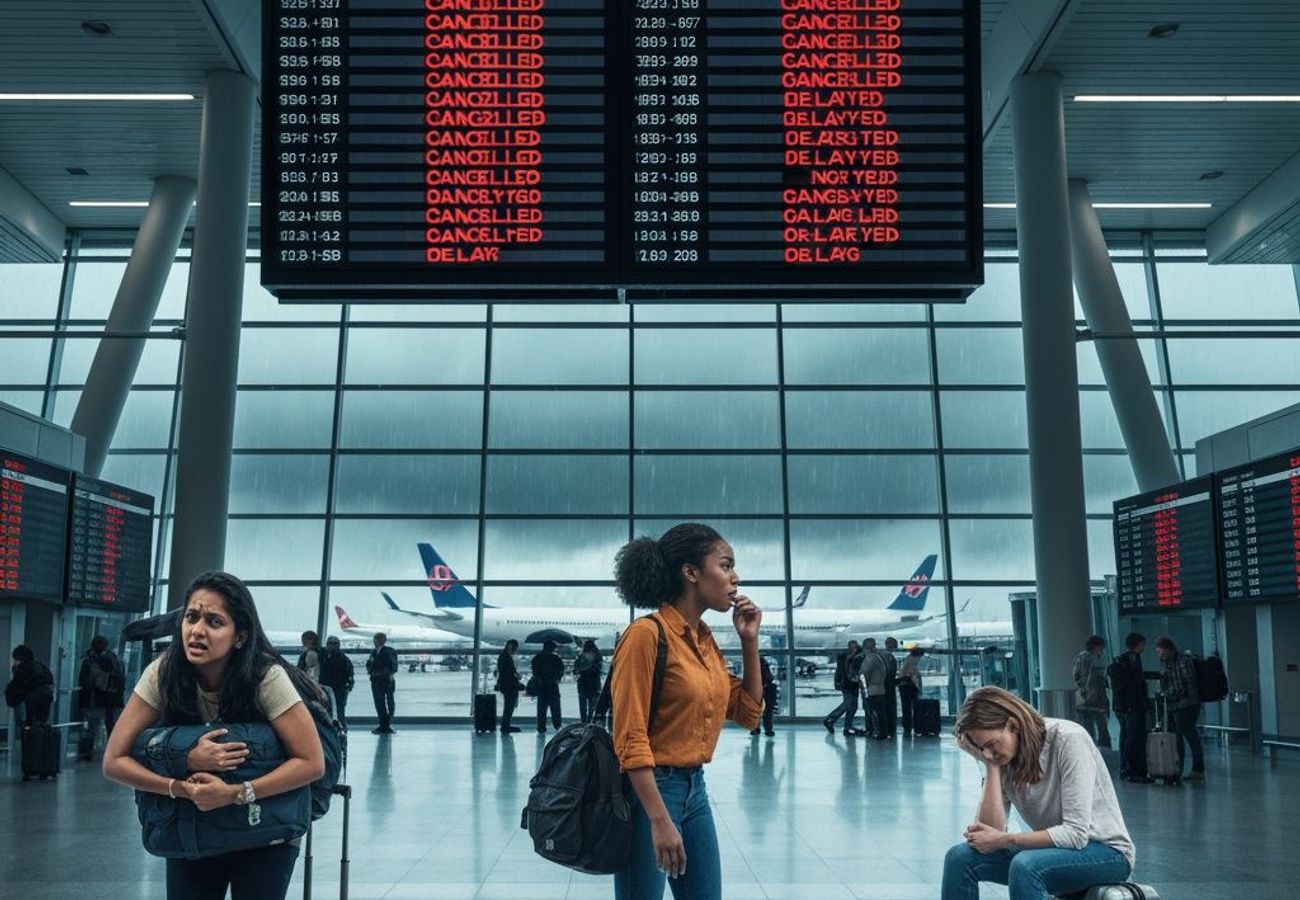
Image generated by AI
A Day of Travel Chaos Across Canada
June 9, 2026 marked one of the worst operational days for Canadian aviation in recent months. Major carriers including Air Canada, Jazz, Air Inuit, WestJet, and regional operators faced a perfect storm of weather and logistics failures. The result? 69 cancellations and 142 delays rippling across the country's busiest airports and smallest remote communities alike.
I've covered airline disruptions for years, but the scale of today's meltdown demands immediate attention. Thousands of passengers found themselves stranded, rerouted, or trapped in airport terminals with no clear answers.
Where the System Broke Down Most Severely
Montreal-Trudeau International (YUL) absorbed the heaviest blow, recording 13 cancellations and 32 delays—making it the epicenter of the disruption. Right behind it, Toronto Pearson (YYZ) reported 7 cancellations and 35 delays, while Toronto City Centre (YTZ) added another 10 cancellations and 13 delays to Ontario's woes.
The geographical spread tells the real story:
Vancouver International (YVR) – 10 cancellations, 23 delays Edmonton International (YEG) – 6 cancellations, 3 delays Calgary International (YYC) – 5 cancellations, 12 delays Ottawa Macdonald-Cartier (YOW) – 4 cancellations, 4 delays Halifax International (YHZ) – 3 cancellations, 2 delays
Even remote northern airports—Kangirsuk, Akulivik, and Kuujjuaq—experienced cascading disruptions with 8 combined cancellations and 17 delays.
The Weather Weapon: Environment Canada's Warning
Here's the critical factor: Environment Canada issued a Special Weather Statement warning of up to 50 millimetres of rain across Simcoe County, hitting Barrie, Collingwood, Orillia, and Owen Sound hard. A slow-moving low-pressure system brought torrential downpours and isolated thunderstorms that transformed roads into temporary waterways.
Reddit: "I was supposed to fly out of Pearson at 2 PM. They just cancelled it. No rebooking available until Thursday. This is insane." — r/canadiantravel
Water pooled on roads and in low-lying areas, creating hazardous conditions for ground transportation to and from terminals. Motorists were advised to avoid flooded routes entirely, which created a secondary bottleneck: passengers couldn't even reach airports safely.
For deeper context on how weather disrupts aviation networks, the FAA's official weather impact resource documents the cascading effects of precipitation on flight operations.
Which Airlines Felt the Pain Most
The disruption wasn't evenly distributed. Jazz (operating as Air Canada Jazz) led the damage report with 23 cancellations and 17 delays. Air Inuit followed with 9 cancellations and 31 delays—a concerning ratio suggesting operational capacity issues beyond just weather.
Air Canada proper reported 7 cancellations and 24 delays, while Air Canada Rouge added 5 cancellations and 4 delays. Regional carriers PAL Airlines (6 cancellations, 5 delays) and Pacific Coastal Airlines (2 cancellations, 3 delays) also felt the squeeze. WestJet escaped with minimal impact: just 1 cancellation and 2 delays.
The pattern suggests that carriers with denser route networks and older fleet aircraft experienced proportionally worse disruptions.
What Passengers Did—And Should Do Next Time
For those caught in the chaos, the immediate playbook matters:
Check real-time flight status through airline apps and websites—delays were being updated hourly as the situation evolved.
Contact customer service directly, not through social media. Phone lines were congested, but email inquiry systems sometimes processed rebooking requests faster.
Evaluate alternate airports in nearby cities. Passengers departing Toronto could have explored Hamilton (YHM) or Buffalo (BUF); Montreal flyers might have considered Quebec City (YQC).
Claim compensation if eligible. Under Canadian air passenger rights regulations, carriers must provide meals, accommodation, and rebooking at no cost for weather-related cancellations—though proving causation requires documentation.
Monitor Environment Canada alerts continuously. Weather forecasts updated every 30 minutes, and smart passengers used that data to decide whether waiting for a later flight made sense.
The Forecast: More Turbulence Ahead
Environment Canada's outlook for the remainder of the week isn't encouraging. Showers and isolated thunderstorms are expected to persist, with temperatures hovering in the high 20s Celsius. This meteorological pattern suggests intermittent delays could continue through at least June 11, especially at Toronto, Montreal, and Vancouver—the three busiest airports in the country.
Airlines have already begun preparing contingency schedules, but with 69 cancellations on a single day, aircraft and crew positioning will remain chaotic for 48 to 72 hours minimum.
The Larger Operational Reality
What today revealed is a system under pressure. Canadian aviation relies on tight scheduling margins, and weather events of this magnitude expose vulnerability in crew logistics, aircraft maintenance windows, and passenger accommodation capacity.
The Federal Government's transportation regulatory framework allows carriers to invoke "force majeure" exceptions during weather events, meaning passengers cannot claim financial compensation. However, airlines remain obligated to provide ground support and rebooking.
For nomadic professionals and frequent business travellers, today's disruption reinforces a hard lesson: build 24-hour buffers into your itinerary when flying domestically within Canada during spring and early summer. Weather patterns are becoming less predictable, and airline capacity cushions continue to shrink.
Stay informed, fly prepared, and never assume a departure time until wheels leave the tarmac.
Related Travel Guides
Disclaimer
This article is for informational and educational purposes only. It does not constitute legal, financial, or professional advice. While we strive to provide accurate and up-to-date information, travel policies, regulations, and conditions change rapidly. Always verify information with official sources before making travel decisions. Nomad Lawyer makes no representations about the accuracy, reliability, completeness, or suitability of the information provided. Readers should consult qualified professionals for advice specific to their circumstances. The views expressed in this article are those of the author and do not necessarily reflect the views of Nomad Lawyer.
Preeti Gunjan
Contributor & Community Manager
A passionate traveller and community builder. Preeti helps grow the Nomad Lawyer community, fostering engagement and bringing the reader experience to life.
Learn more about our team →