
Delta's Record-Breaking 17-Hour Nonstop Flights: How the Airbus A350 Is Reshaping Ultra-Long-Haul Aviation
Breaking airline news and aviation industry updates for 2026.

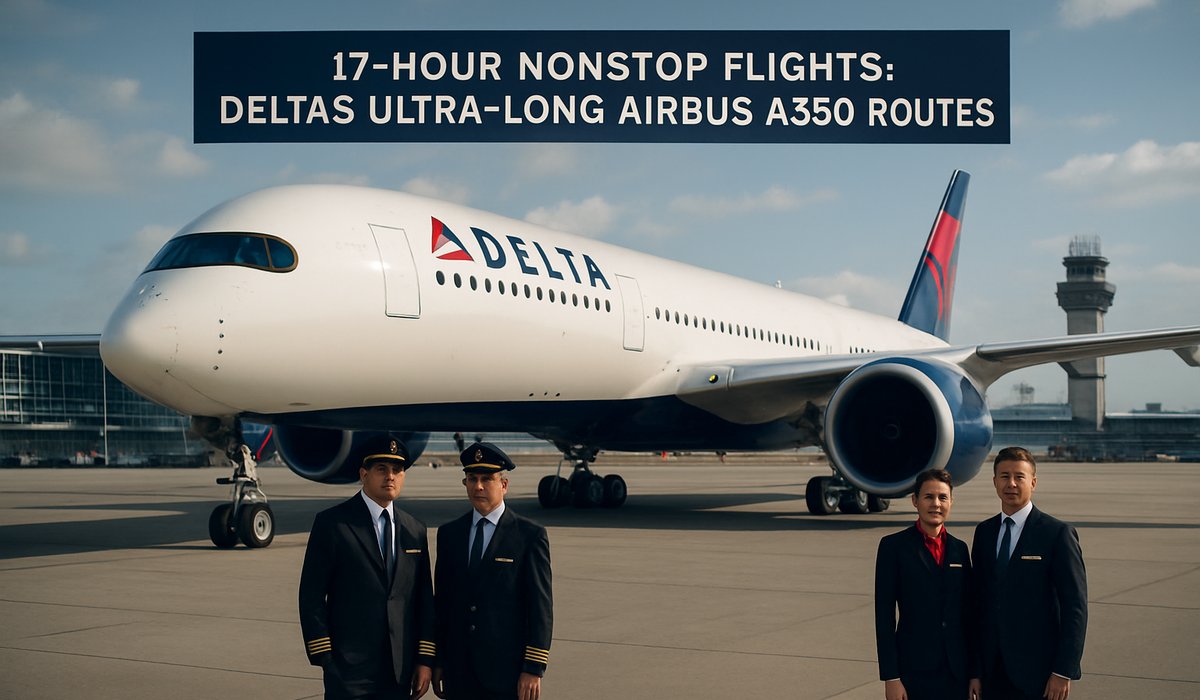
Image generated by AI
Delta's Record-Breaking 17-Hour Nonstop Flights: How the Airbus A350 Is Reshaping Ultra-Long-Haul Aviation
The carrier's newest widebody aircraft is enabling unprecedented direct routes across continents, signaling a major shift in how airlines approach international travel efficiency and passenger comfort
Delta's Bold Expansion into Extreme Long-Distance Travel
Delta Air Lines is aggressively expanding its ultra-long-haul network with the Airbus A350, deploying the advanced widebody aircraft on nonstop routes stretching up to 17 hours—among the longest commercial flights operational today. This strategic deployment marks a turning point in how major carriers approach intercontinental connectivity, eliminating traditional hub-and-spoke routing on premium international corridors.
The A350's capabilities are proving transformative for Delta's global strategy. Unlike conventional widebody aircraft, the twin-engine jet combines exceptional fuel efficiency with superior range and payload capacity, allowing carriers to maintain profitability on routes previously considered economically challenging. This technological advantage is reshaping competitive dynamics across the aviation industry at a time when fuel costs and operational efficiency remain critical to airline margins.
Why the A350 Changes the Long-Haul Game
The Airbus A350's design specifically addresses the evolving demands of 21st-century aviation. The aircraft delivers approximately 25% better fuel economy than older widebody models, a crucial metric given volatile jet fuel prices that have repeatedly pressured airline bottom lines. Simultaneously, the A350 features industry-leading cabin comfort, with direct-aisle seating in premium cabins and expanded leg room across economy sections—amenities that justify premium pricing on these extended journeys.
For Delta, the aircraft serves as the airline's flagship international platform, replacing or supplementing older Boeing 777s and 767s on premium routes. The carrier's deployment of A350s on 17-hour sectors demonstrates confidence in the aircraft's reliability and passenger acceptance, particularly among business travelers willing to pay premium fares for nonstop connectivity.
Broader Industry Implications
Delta's expansion reflects a broader trend reshaping airline route planning. As aircraft technology improves and fuel efficiency gains offset energy costs, carriers can profitably connect distant city pairs directly, reducing passenger travel times and competitive pressure from connecting hubs in the Middle East and Asia-Pacific regions. This shift has implications for airport infrastructure, ground services, and crew scheduling across the global aviation network.
The A350 deployment also signals confidence in transatlantic and transpacific demand recovery post-pandemic, as premium international travel increasingly drives airline revenue. For passengers, the expansion of 17-hour nonstop options offers convenience—albeit at elevated ticket prices reflecting the costs of operating such extended flights.
FAQ: Ultra-Long-Haul Aviation Questions Answered
What is the Airbus A350 designed for? The A350 is engineered specifically for efficient ultra-long-haul operations, combining advanced aerodynamics, composite materials, and twin-engine design to reduce fuel consumption by roughly 25% compared to predecessor widebodies while maintaining capacity for premium and economy seating.
How does jet fuel efficiency affect airline fees and ticket prices? When aircraft burn less fuel per passenger-mile, airlines reduce operational costs, theoretically enabling more competitive pricing. However, most carriers use fuel savings to maintain margins rather than lower fares, while applying fees to offset remaining costs during fuel price volatility.
Are 17-hour flights becoming more common? Yes, improving aircraft technology and demand recovery are enabling carriers to open new ultra-long-haul routes previously considered unprofitable. However, these flights remain selective, connecting only high-demand city pairs with sufficient premium passenger volumes.
What advantages do nonstop flights offer passengers? Nonstop service eliminates connection risks, reduces overall travel time, and provides convenience—factors business and premium leisure travelers willingly pay for, even at higher ticket prices.
How does Delta's A350 strategy affect competitors? The expansion pressures competitors to modernize their own fleets with fuel-efficient aircraft like the Boeing 787 or acquire A350s themselves, intensifying capital expenditure competition among global carriers.
Related Travel Guides
External Resources
Disclaimer
This article is for informational and educational purposes only. It does not constitute legal, financial, or professional advice. While we strive to provide accurate and up-to-date information, travel policies, regulations, and conditions change rapidly. Always verify information with official sources before making travel decisions. Nomad Lawyer makes no representations about the accuracy, reliability, completeness, or suitability of the information provided. Readers should consult qualified professionals for advice specific to their circumstances. The views expressed in this article are those of the author and do not necessarily reflect the views of Nomad Lawyer.
Raushan Kumar
Founder & Lead Developer
Full-stack developer with 11+ years of experience and a passionate traveller. Raushan built Nomad Lawyer from the ground up with a vision to create the best travel and law experience on the web.
Learn more about our team →