Uzbekistan Inbound Travel Surges 20.4% Past 10.3M Arrivals as $5.3B Tourism Exports Test Central Asian Infrastructure

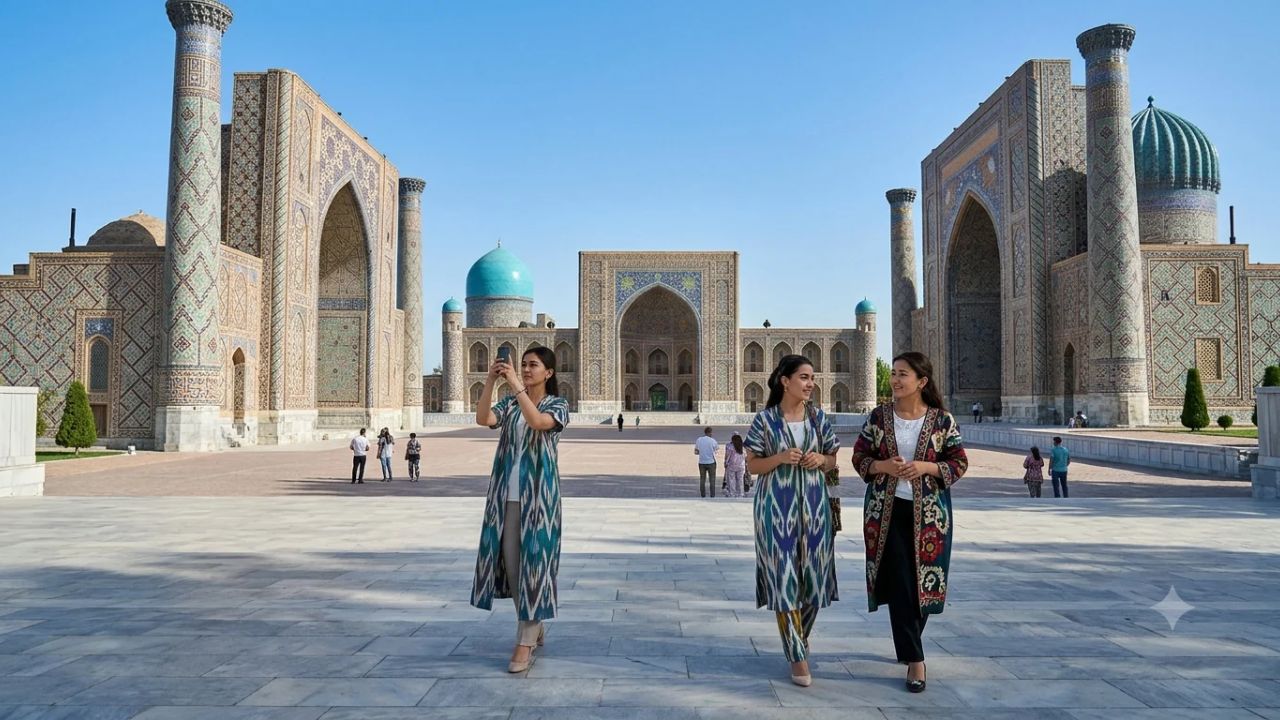
Historic Silk Road architectural complexes and visitor corridors across Samarkand, Uzbekistan
[TASHKENT, Oct 21, 2026] — Surpassing 10.3 million foreign arrivals within nine months, Uzbekistan recorded 10,306,786 international entries between January and September 2026, marking a 20.4% increase over the same period in 2025. Official national statistics released on 16 October 2026 confirm that cross-border mobility from three immediate neighbors—Kyrgyzstan, Kazakhstan, and Tajikistan—accounted for 7,523,127 visitors, representing 72.99% of total inbound travel. Concurrently, separate government economic disclosures published by the Tourism Committee of the Republic of Uzbekistan reveal that tourism-services export revenue jumped 51.2% to reach US$5.3 billion, outpacing arrival volume growth by 30.8 percentage points and signaling substantial financial expansion across Central Asia’s primary Silk Road transit hub.
[!NOTE] Quick Overview: Uzbekistan Tourism Expansion & Economic Evidence
- Record Volume: Uzbekistan registered 10,306,786 international arrivals during January–September 2026, up 20.4% YoY (approximately 1.7 million net additional travelers).
- Regional Dominance: Three immediate neighbors accounted for 72.99% of all entries: Kyrgyzstan (2,844,201), Kazakhstan (2,404,638), and Tajikistan (2,274,288).
- Export Revenue Outpacing Headcounts: Tourism-services exports surged 51.2% to US$5.3 billion, expanding 30.8 percentage points faster than physical arrival volume.
- Long-Haul Diversification: China expanded 2.1-fold (~110% growth) to 373,778 visitors, alongside rapid growth from Malaysia (1.9x), Egypt and Romania (1.8x), Indonesia (1.7x), Japan (1.5x), the US (1.4x), the UK (+25%), and Germany (+25%).
- Administrative & Civil Upgrades: A 15-day bilateral registration waiver took effect with Kyrgyzstan, while Samarkand advances a master plan targeting 20,000 hotel beds, 13 pedestrian promenades, and a four-lane Karadarya River bridge cutting airport transit by 30 minutes.
This dual acceleration in passenger numbers and foreign exchange earnings highlights an evolving cross-border travel economy. While state planning agencies target 20 million foreign tourists and US$10 billion in tourism exports over the longer term, the current intake reveals distinct commercial realities: regional cross-border family, commercial, and medical travel anchors the volume base, while long-haul cultural tourism from East Asia, Europe, and North America provides the high-margin spend driving service exports.
Core Evidence and Policy Context Behind the 2026 Growth
The rapid expansion of Uzbekistan's visitor economy is supported by sequential data releases and policy milestones published throughout 2026. The table below delineates the empirical foundations of this growth, categorizing verified government findings and their direct implications for international travelers and hospitality operators:
| Strategic Sector Dimension | Share of Story Analysis | Officially Verified Finding | Practical Relevance to International Travellers | Verified Source Document |
|---|---|---|---|---|
| Arrivals & Source Origins | 45% | 10,306,786 total arrivals; Kyrgyzstan, Kazakhstan, and Tajikistan supplied 72.99% | Regional land borders dominate volume; primary hubs manage heavy overland passenger flows | National Statistics Agency Release (16 Oct 2026) |
| Service Export Earnings | 30% | US$5.3 billion in tourism-services exports, expanding 51.2% year-on-year | Outpaces arrival growth (+20.4%) by 30.8 percentage points, reflecting higher per-visitor outlay | Tourism Committee Economic Disclosure (7 Oct 2026) |
| Visitor Infrastructure | 15% | Samarkand urban plan targets 13 pedestrian streets, 850 hotels, 20,000 beds, and $750M in services | Major civil works are underway; travelers must verify operational opening dates for new lodging | Ministry of Tourism Development Update (10 June 2026) |
| Entry & Registration Rules | 10% | Bilateral protocol provides a 15-day registration exemption between Uzbekistan and Kyrgyzstan | Simplifies short-stay transit; visa validity and local residence registration remain legally distinct | Intergovernmental Protocol Notice (31 July 2026) |
The chronology of these developments reveals systematic state coordination: urban infrastructure targets were published on 10 June 2026; the bilateral Kyrgyz registration protocol was finalized on 30 July and detailed on 31 July; third-quarter tourism export performance was confirmed on 7 October; the detailed national arrival breakdown appeared on 16 October; and progress on the Karadarya River airport bridge was documented on 18 October.
Dissecting the Central Asian Inbound Engine: 73% Regional Concentration
The operational reality of Uzbekistan’s tourism expansion remains anchored in Central Asian geographic proximity. Between January and September 2026, the nation added approximately 1.7 million net foreign arrivals over 2025 baselines, with September alone absorbing roughly 1.2 million crossings. Approximately 73 out of every 100 foreign arrivals entered from three bordering states operating under liberal visa-free arrangements.
Kyrgyzstan led all global jurisdictions with 2,844,201 travelers, followed closely by Kazakhstan with 2,404,638 and Tajikistan with 2,274,288. When combined with traditional trade partners Russia (983,407), Afghanistan (380,190), and Turkmenistan (256,546), regional states generated the overwhelming majority of border entries. Long-haul source markets expanded rapidly from smaller numerical baselines: China reached 2.1 times its 2025 volume (an approximate 110% increase) to deliver 373,778 visitors, while Türkiye added 148,772, India contributed 53,778, and Germany recorded 42,973. Together, the leading ten source nations generated 94.72% of all inbound traffic, leaving all other international markets combined to account for 544,215 arrivals.
| Inbound Source Market | 9-Month 2026 Foreign Arrivals | Share of National Total (10,306,786) | Documented YoY Growth Trajectory | Core Purpose of Entry & Border Dynamics |
|---|---|---|---|---|
| Kyrgyzstan | 2,844,201 | 27.60% | Leading volume contributor | Cross-border trade, family visits, medical travel; 60-day visa-free regime |
| Kazakhstan | 2,404,638 | 23.33% | Second-largest volume source | Rail and road transit, commercial commerce; open-ended visa-free status |
| Tajikistan | 2,274,288 | 22.07% | Third-largest volume source | Land border crossing, family ties, regional trade; 30-day visa-free status |
| Russia | 983,407 | 9.54% | Up 1.3x (~30% expansion) | Business travel, direct aviation corridors, heritage tourism |
| Afghanistan | 380,190 | 3.69% | Established southern border corridor | Cross-border trade, medical services, academic enrollment |
| China | 373,778 | 3.63% | Up 2.1x (~110% expansion) | Organized leisure groups, industrial investment, Silk Road rail tours |
| Turkmenistan | 256,546 | 2.49% | Regulated regional land transit | Commercial cross-border trade and specialized regional transit |
| Türkiye | 148,772 | 1.44% | Up 15% YoY | Cultural tourism, corporate ventures, direct air connectivity |
| India | 53,778 | 0.52% | Growing secondary market | MICE travel, leisure city breaks, direct scheduled charters |
| Germany | 42,973 | 0.42% | Up 25% YoY | Cultural heritage itineraries, European independent travel |
| All Other Markets Combined | 544,215 | 5.28% | Diverse global origins | Includes UK (+25%), France (+21%), Malaysia (up 1.9x), US (up 1.4x) |
Official classification frameworks indicate that foreign entries encompass multiple travel motivations beyond recreational leisure, including family visits, commercial trips, specialized medical treatment, and academic enrollment. For hotel operators and excursion providers, this distinction is fundamental: overland cross-border travelers from neighboring regions often lodge with extended family networks or return across border gates within 24 to 48 hours, whereas intercontinental travelers from East Asia, Western Europe, and North America require multi-night hotel reservations, domestic rail passes, and licensed guiding services.
Export Receipts Outpace Headcounts: Service Revenues Reach $5.3 Billion
While visitor arrivals grew by 20.4%, the financial yield generated by inbound travel expanded at more than double that pace. Official economic disclosures confirm that tourism-services exports reached US$5.3 billion through the third quarter of 2026. This 51.2% year-on-year increase exceeded arrivals growth by 30.8 percentage points, demonstrating that international visitors are spending substantially more on domestic accommodation, gastronomy, regional transit, and cultural admissions.
Geographic demand broadened across diverse international markets during the period:
- China: Arrivals surged 2.1-fold (up ~110%) to 373,778 travelers, propelled by direct air links and business trade delegations.
- Southeast Asia: Malaysia expanded to 1.9 times previous levels (a 90% increase), while Indonesia reached 1.7 times (a 70% increase), driven by interest in Islamic heritage and Silk Road pilgrimage routes.
- Eastern Europe & North Africa: Romania and Egypt each expanded to 1.8 times previous volumes (80% growth).
- Mature Long-Haul Markets: Japan grew to 1.5 times previous levels (50% expansion), the United States reached 1.4 times (40% growth), the United Kingdom and Germany each recorded 25% expansions, France advanced 21%, and Türkiye gained 15%.
This broadening distribution confirms that international travelers are exploring destinations beyond Tashkent, venturing into the architectural ensembles of Samarkand, Bukhara, Khiva, and the Fergana Valley. However, commercial gains remain unevenly distributed across property categories. While four-star and five-star boutique hotels along main tourist corridors report strong pricing power, budget guest houses in secondary districts operate with tighter margins.
Regulatory Protocols and Entry Rules for International Travellers
The growth in arrival numbers has been facilitated by streamlined border procedures. On 30 July 2026, authorities concluded a bilateral registration protocol with Kyrgyzstan, published officially on 31 July. Under this agreement, citizens of Uzbekistan and Kyrgyzstan traveling between the two republics receive a 15-day exemption from mandatory police residence registration, eliminating paperwork for short-stay travelers.
Immigration and registration regulations remain differentiated by nationality:
- Kyrgyz Citizens: Eligible for visa-free entry for stays up to 60 days, supplemented by the new 15-day registration grace period.
- Tajik Citizens: Permitted visa-free entry for up to 30 days, with standard municipal registration rules applying thereafter.
- Kazakh Citizens: Granted open-ended visa-free entry, though foreign registration obligations must be completed for extended stays.
- Third-Country Nationals: Travelers visiting under unilateral visa-free regimes (including EU, UK, and GCC passport holders) or eVisa systems must ensure their lodging providers submit electronic registration via the national E-Mehmon digital portal. Independent travelers staying in private rentals must verify that registration is filed within three working days of arrival.
These regulatory mechanisms facilitate border movement while maintaining immigration compliance. Travelers must verify that passport stamps are clearly affixed at overland border posts to avoid processing delays when exiting the country.
Samarkand Infrastructure Pipeline and Civil Aviation Upgrades
To support its long-term objective of welcoming 20 million foreign visitors and generating US$10 billion in tourism exports, the Uzbek government has committed significant capital to transportation and urban infrastructure:
- Samarkand Urban Master Plan: Announced on 10 June 2026, state plans designate 13 pedestrian-only streets across historic Samarkand. Regional development targets establish goals of 850 hotels, 20,000 guest beds, and US$750 million in localized tourism services across Samarkand city, the Nurabad district, and surrounding cantons.
- Karadarya River Bridge: Engineering updates published on 18 October 2026 confirmed steady progress on a major four-lane bridge across the Karadarya River. Engineered to accommodate 25,000 vehicles daily, the bridge will connect the settlement of Shirin directly with central Samarkand and Samarkand International Airport (SKD). Commissioning of the span will reduce the travel distance from 23 kilometers to four kilometers, cutting airport transit times by 30 minutes.
- Silk Road Rail Transit: Demand for high-speed Afrosiyob trains operated by Uzbekistan Railways (Oʻzbekiston Temir Yoʻllari) has reached historic peaks. The electric trainsets connect Tashkent, Samarkand, and Bukhara in under four hours, serving as the transit backbone for high-yield cultural tourists.
These infrastructure targets represent multi-year public works. Travelers must differentiate between planned capacity expansions and operational facilities, booking confirmed hotel space and train seats well before departure.
Practical Advisory: Due Diligence Checklist for Uzbekistan Travel
Navigating Central Asia’s fastest-growing destination requires practical planning. While headline growth confirms expanding service availability, high seasonal demand creates localized capacity bottlenecks:
| Planning Category | Mandatory Travel Action Item | Operational Guidance for Visitors |
|---|---|---|
| Visa & Entry Eligibility | Confirm visa-free duration or eVisa status before booking | Check passport validity (minimum 3 months beyond intended stay); verify single- vs. multi-entry terms |
| Residence Registration | Ensure registration slips are issued by hotels via E-Mehmon | Retain all paper or digital registration slips until departure; border guards verify records upon exit |
| High-Speed Rail Bookings | Book Afrosiyob train tickets 45 days in advance of travel | Rail tickets on the Tashkent–Samarkand–Bukhara route sell out rapidly; consider domestic flights if trains are full |
| Land Border Crossings | Verify operating hours and vehicle clearance protocols | Overland crossings with Kyrgyzstan, Kazakhstan, and Tajikistan can experience heavy commercial vehicle queues |
| Currency & Payment Systems | Carry clean, uncreased US Dollar cash alongside debit cards | While Visa and Mastercard acceptance is expanding in major hotels, local markets and taxis rely on cash Uzbek Som |
| Seasonal Climate Checks | Pack layered clothing appropriate for continental extremes | Shoulder seasons (April–May and September–October) offer ideal temperatures; winter brings sub-zero nights |
By completing registration checks and securing intercity transit reservations early, travelers can experience the Silk Road's architectural landmarks without administrative interruptions.
Structural Outlook: Managing the Transition from Transit Corridor to High-Yield Destination
Uzbekistan’s 20.4% surge in foreign arrivals demonstrates that the republic has successfully repositioned itself as Central Asia's primary tourism crossroads. The concentration of 73% of volume within three neighboring states highlights the strength of regional economic integration, while double- and triple-digit expansions from China, Southeast Asia, and Europe provide the foundation for sustained export revenue growth.
The strategic test facing national tourism planners is ensuring that transportation infrastructure, hotel inventory, and service standards keep pace with demand. Converting short-stay cross-border excursionists into multi-night leisure travelers will require expanding high-speed rail capacity, completing municipal road connections like the Karadarya bridge, and dispersing visitors into emerging destinations like Khiva, Nukus, and the Fergana Valley.
As public infrastructure programs advance toward the state's 20-million-visitor target, Uzbekistan is establishing a durable economic model that turns Silk Road heritage into an engine for national employment, regional integration, and foreign exchange earnings.
Frequently Asked Questions (FAQ)
What was Uzbekistan's foreign visitor arrival total for the first nine months of 2026?
Uzbekistan recorded 10,306,786 foreign arrivals between January and September 2026, representing a 20.4% increase (approximately 1.7 million additional travelers) compared to the same period in 2025.
Which countries generate the largest number of tourist arrivals in Uzbekistan?
Three neighboring Central Asian countries account for 72.99% of all foreign arrivals: Kyrgyzstan (2,844,201 arrivals; 27.60%), Kazakhstan (2,404,638 arrivals; 23.33%), and Tajikistan (2,274,288 arrivals; 22.07%).
How much export revenue did Uzbekistan's tourism sector generate in 2026?
Tourism-services exports reached US$5.3 billion during the first nine months of 2026, marking a 51.2% year-on-year increase that outpaced visitor volume growth by 30.8 percentage points.
What are the registration requirements for foreign tourists visiting Uzbekistan?
Kyrgyz citizens benefit from a 15-day registration exemption under a 2026 bilateral protocol. Most international travelers staying at licensed hotels are automatically registered digitally through the national E-Mehmon system, but visitors staying in private accommodations must register within three working days.
What infrastructure developments are underway in Samarkand to handle tourist growth?
Samarkand is implementing an urban master plan featuring 13 pedestrian streets, regional targets of 850 hotels and 20,000 beds, and a four-lane bridge across the Karadarya River that reduces airport transit times from Shirin by 30 minutes.
Related Travel Guides
China Expands Visa-Free Transit Privileges to Central Asian Routes
Uzbekistan Visa-Free Travel for Indian Citizens: 30-Day Itinerary Guide
10 Best Silk Road Cultural Itineraries in Uzbekistan, According To Reddit
This article is for informational purposes. Flight routes, passenger regulations, visa rules, and transit advisories are subject to change by airlines and aviation authorities. Readers are advised to verify schedules and travel documentation with relevant carriers and border agencies before departure.
Related Stories

Samarkand Marathon 2026: Uzbekistan Attracts 1,500 Athletes from 63 Nations for Sports Tourism
Vietnam and Laos Strengthen Cross-Border Tourism Ties as Laos Targets 6 Million Visitors by 2030