Middle East Aviation Gridlock as 1,133 Delays and 182 Cancellations Hit Dubai, Abu Dhabi, and Saudi Arabia Amid Escalating Regional Security Tensions: Passenger Travel Alert

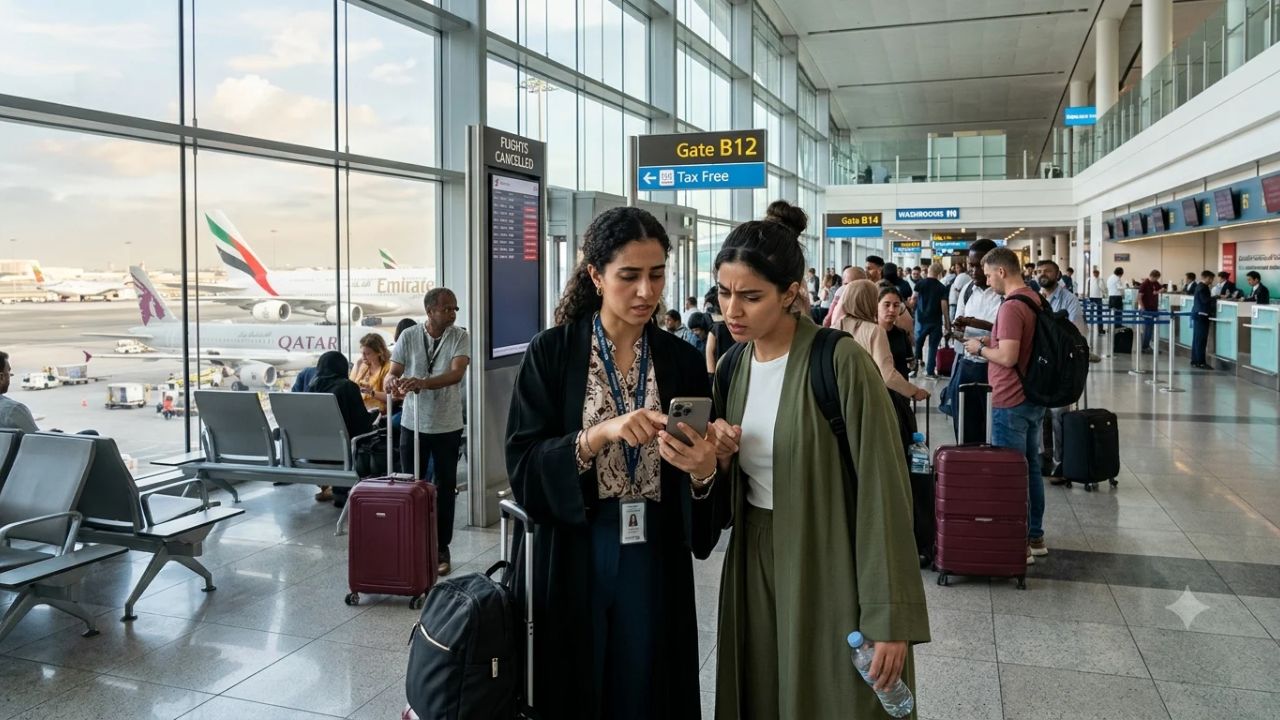
Image generated by AI
Commercial aviation across the Middle East is experiencing widespread schedule collapse as 1,133 flight delays and 182 outright cancellations ripple through critical transit hubs across the United Arab Emirates, Saudi Arabia, Turkey, and Egypt. Compounded by escalating regional security tensions, heightened air defense alerts, and ongoing safety reassessments following drone and missile strikes targeting Saudi Arabian aviation infrastructure, international carriers have implemented precautionary schedule curbs, emergency reroutings, and route suspensions. With international connecting passengers stranded across Dubai, Abu Dhabi, Riyadh, Jeddah, and Istanbul, global travelers face severe operational gridlock across Europe-to-Asia air corridors.
[!NOTE] Quick Summary: Key Developments at a Glance
- Regional Disruption Scale: Real-time tracking data logged at 7:32 pm ET on 20 October 2026 (3:32 am GST on 21 October 2026) documents 1,133 flight delays and 182 cancellations across 12 major Middle Eastern and regional gateway airports.
- UAE Hub Vulnerability: The UAE recorded 452 delays and 50 cancellations across Dubai International (DXB: 234 delays, 24 cancellations), Zayed International in Abu Dhabi (AUH: 127 delays, 18 cancellations), and Sharjah (SHJ: 91 delays, 8 cancellations).
- Saudi Ground Disruptions: Saudi airports logged 189 delays and 90 cancellations, led by King Khalid International in Riyadh (RUH: 45 cancellations, the highest among all surveyed hubs) and King Abdulaziz International in Jeddah (JED: 149 delays, 18 cancellations).
- Istanbul Delay Epicenter: Istanbul Airport (IST) recorded the highest individual airport delay count across the region, logging 246 flight delays alongside 14 cancellations.
- Hardest-Hit Airlines: Primary schedule casualties include FlyDubai (20 cancellations, 75 delays), Etihad Airways (18 cancellations, 92 delays), Saudia (17 cancellations, 66 delays), Turkish Airlines (211 delays), and Air Arabia (79 delays).
[DUBAI/RIYADH, Oct 21, 2026] — Global long-haul connectivity has ground to a near-standstill at several of the world's most critical transit hubs as commercial airlines respond to rapid geopolitical volatility across Middle Eastern airspace. FlightAware operational tracking snapshots taken on the night of 20 October 2026 confirm that schedule unraveling has extended beyond localized conflict zones, degrading operations at major global megahubs including Dubai International (DXB), Abu Dhabi (AUH), and Istanbul (IST).
The operational bottlenecks stem from a compounding cascade of geopolitical and structural constraints. Following recent drone and missile alerts directed at aviation infrastructure in Saudi Arabia, international civil aviation regulators and national defense ministries have enacted stringent airspace transit restrictions.
Air carriers operating single-aisle and wide-body fleets between Europe, Africa, North America, and the Asia-Pacific region are being forced to route around closed corridors, congesting narrow secondary airways over Egypt, Jordan, and eastern Turkey. These detours impose severe fuel penalties, lengthen flight times by up to 90 minutes per sector, exhaust flight crew operating duty limits, and leave aircraft out of position for scheduled turnaround flights.
The UAE Aviation Corridor: Dubai, Abu Dhabi, and Sharjah Squeezed
The United Arab Emirates represents the primary global connecting hinge between East and West. When flight schedules buckle across the Emirates, international travel networks experience immediate secondary shockwaves.
Across Dubai, Abu Dhabi, and Sharjah, real-time aviation logs recorded a combined 452 flight delays and 50 cancellations, leaving thousands of transit passengers facing missed intercontinental flight banks.
Dubai International Airport (DXB)—the world’s busiest airport for international passenger traffic—bore the brunt of the disruption in absolute volume. The megahub logged 234 flight delays and 24 cancellations, severely impacting short-haul regional links and long-haul departures heading to London, Frankfurt, Mumbai, and Singapore.
In Abu Dhabi, Zayed International Airport (AUH) recorded 127 delays and 18 cancellations, creating operational backlogs across Etihad Airways’ mid-evening and early-morning connection banks.
Sharjah International Airport (SHJ), the primary home base for low-cost carrier Air Arabia, registered 91 delays and 8 cancellations, as narrow-body regional services faced airspace sequencing delays across Gulf waters.
| UAE Airport (Code) | Recorded Delays | Recorded Cancellations | Primary Operational Bottleneck |
|---|---|---|---|
| Dubai International (DXB) | 234 delays | 24 cancellations | Regional holding patterns, congested airspace slots, and delayed inbound airframes |
| Zayed International, Abu Dhabi (AUH) | 127 delays | 18 cancellations | Missed connection banks, crew duty expirations, and delayed transit clearances |
| Sharjah International (SHJ) | 91 delays | 8 cancellations | Regional low-cost turnaround bottlenecks and single-aisle routing diversions |
| Total UAE Hub Impact | 452 delays | 50 cancellations | Widespread intercontinental transfer delays across Gulf transit gateways |
For travelers transiting through Dubai and Abu Dhabi on tight 60-to-90-minute layovers, these delays have led to systemic connection failures. Because connecting flights depart while inbound feeder flights remain queued on remote taxiways or holding patterns, transfer desks are facing surging queues for hotel vouchers, meal allowances, and rebooked itineraries.
Saudi Arabia's Airspace Challenge: Riyadh, Jeddah, Dammam, and Abha
Saudi Arabian aviation infrastructure registered the highest concentration of outright flight cancellations in the region, logging 189 delays and 90 cancellations across four primary airports.
The Kingdom's capital hub, King Khalid International Airport in Riyadh (RUH), registered 45 cancellations and 7 delays. Riyadh’s 45 cancellations represent the highest cancellation figure recorded by any individual airport in the regional dataset. Heightened air defense alerts and precautionary route suspensions enacted by international and regional carriers entering central Saudi airspace have curtailed daily operations.
In the Red Sea commercial gateway of Jeddah, King Abdulaziz International Airport (JED) faced widespread operational friction, logging 149 delays and 18 cancellations. Because Jeddah serves as the primary gateway for international pilgrimage travel and domestic north-south transit, ground holding delays quickly spread across the Kingdom’s domestic route network.
In the Eastern Province, King Fahd International Airport in Dammam (DMM) recorded 31 delays and 22 cancellations, while southern regional facility Abha Regional Airport (AHB) registered 2 delays and 5 cancellations.
| Saudi Airport (Code) | Recorded Delays | Recorded Cancellations | Origin Cancellation Rate | Destination Cancellation Rate |
|---|---|---|---|---|
| King Khaled Intl, Riyadh (RUH) | 7 delays | 45 cancellations | 5% cancelled | 7% cancelled |
| King Abdulaziz Intl, Jeddah (JED) | 149 delays | 18 cancellations | 2% cancelled | 2% cancelled |
| King Fahd Intl, Dammam (DMM) | 31 delays | 22 cancellations | 8% cancelled | 8% cancelled |
| Abha Regional (AHB) | 2 delays | 5 cancellations | 7% cancelled | 4% cancelled |
| Total Saudi Operations | 189 delays | 90 cancellations | Kingdom-wide defensive adjustments and route cancellations |
Dammam's origin and destination cancellation rate of 8% highlights the acute exposure of Gulf coastal airports located near sensitive regional shipping and energy infrastructure.
The low delay count in Riyadh (7 delays) paired with high cancellations (45) indicates that airlines chose to pre-emptively cancel flights to avoid stranding aircraft in the capital, whereas Jeddah operated near capacity under heavy delay conditions.
Broader Middle East and Transit Nodes: Istanbul, Cairo, Tel Aviv, and Amman
The operational shockwave extended well beyond the Arabian Peninsula, generating severe air traffic control flow restrictions across adjacent flight information regions (FIRs).
Istanbul Airport (IST) in Turkey registered 246 flight delays and 14 cancellations, logging the single highest airport delay tally in the entire survey. As European and North American carriers re-route flights south of the Black Sea and north of central Middle Eastern conflict zones, Turkish airspace has become a congested choke point, triggering ground holding delays for aircraft awaiting ATC departure slots.
Cairo International Airport (CAI) in Egypt recorded 97 delays and 15 cancellations. Cairo represents the critical alternative aerial routing bypass for flights circumventing regional airspace, resulting in crowded holding stacks and taxiway delays.
Ben Gurion Airport in Tel Aviv (TLV) registered 113 delays and 3 cancellations, as strict military airspace management protocols, security sweeps, and localized radar restrictions delayed commercial operations.
In Jordan, Queen Alia International Airport in Amman (AMM) recorded 15 delays and 3 cancellations, while Bahrain International Airport (BAH) in Manama documented 21 delays and 7 cancellations.
| Regional Airport (Code) | Recorded Delays | Recorded Cancellations | Regional Operational Role |
|---|---|---|---|
| Istanbul Airport (IST) | 246 delays | 14 cancellations | Airspace bottleneck for European–Asian diversions; heavy ground queues |
| Cairo International (CAI) | 97 delays | 15 cancellations | Critical western bypass corridor; heavy airspace congestion |
| Ben Gurion, Tel Aviv (TLV) | 113 delays | 3 cancellations | Heightened tactical air defense and localized airspace sequencing |
| Bahrain International (BAH) | 21 delays | 7 cancellations | Gulf transit operations impacted by regional airway restrictions |
| Queen Alia, Amman (AMM) | 15 delays | 3 cancellations | Trans-Levant air corridor adjustments and schedule re-timings |
Flight Disruption Matrix: Airport Origin and Destination Cancellation Percentages
To evaluate the relative disruption severity across different hubs, aviation analysts examine origin and destination cancellation ratios alongside gross flight counts.
A high percentage cancellation rate reveals that an airport's schedule integrity has suffered systemic damage, rather than simple operational variance.
| Airport Name | IATA Code | Origin Flight Cancellation % | Destination Flight Cancellation % |
|---|---|---|---|
| King Fahd International Airport | DMM | 8% | 8% |
| Abha Regional Airport | AHB | 7% | 4% |
| King Khaled International Airport | RUH | 5% | 7% |
| Zayed International Airport | AUH | 3% | 3% |
| Sharjah International Airport | SHJ | 3% | 2% |
| Bahrain International Airport | BAH | 2% | 3% |
| King Abdulaziz International Airport | JED | 2% | 2% |
| Dubai International Airport | DXB | 2% | 2% |
| Cairo International Airport | CAI | 2% | 1% |
| Queen Alia International Airport | AMM | — | 1% |
| Ben Gurion Airport | TLV | 0% | — |
| Istanbul Airport | IST | 0% | 0% |
Note: Percentage figures reflect FlightAware tracked flights recorded on 20 October 2026. Dash indicates negligible or unrecorded statistical values.
The data indicates that Dammam (8%), Abha (7%), and Riyadh (7%) experienced the sharpest proportional flight losses, demonstrating how localized security precautions directly constrain departure schedules.
Conversely, mega-gateways like Dubai (2%) and Istanbul (0% rounded) managed to preserve gross flight schedules, but suffered immense friction in on-time reliability, evidenced by their triple-digit delay numbers.
Airline Impact Analysis: Schedule Performance Across Flag Carriers and LCCs
The disruption has strained commercial balance sheets across both state flag carriers and low-cost regional airlines.
With aircraft rotations disrupted across dozens of international outstations, airline dispatch centers have been forced to cancel flights, delay rotations, and swap aircraft models to maintain schedule integrity.
| Operating Airline | Cancelled Flights | % of Tracked Flights Cancelled | Delayed Flights | % of Tracked Flights Delayed | Operational Impact |
|---|---|---|---|---|---|
| FlyDubai | 20 | 6% | 75 | 25% | Heavy regional network cuts across Gulf and Levant destinations |
| Etihad Airways | 18 | 4% | 92 | 25% | One-quarter of scheduled flights delayed; long-haul banks disrupted |
| Saudia | 17 | 3% | 66 | 12% | Domestic and regional flights cancelled out of Riyadh and Dammam |
| EgyptAir | 10 | 3% | 42 | 16% | Delays on flights linking Cairo with Gulf destinations |
| Air Arabia | 7 | 2% | 79 | 33% | One-third of tracked flights delayed out of Sharjah hub |
| Gulf Air | 5 | 3% | 11 | 8% | Controlled cancellations to protect regional schedule integrity |
| Turkish Airlines | 4 | 0% (rd.) | 211 | 14% | Massive delay volume at Istanbul hub; over 200 flights delayed |
| Pegasus Airlines | 1 | 0% (rd.) | 118 | 16% | Low-cost transit delays at Istanbul Sabiha Gökçen and Antalya |
| Qatar Airways | 1 | 0% (rd.) | 80 | 12% | Delays linked to regional re-routings around Gulf corridors |
| Royal Jordanian | 3 | 2% | 7 | 4% | Selected schedule trimmings on neighboring sectors |
| Fly Baghdad | 2 | 100% | 0 | 0% | Total cancellation of tracked operations |
| Syrian Arab Airlines | 2 | 16% | 1 | 8% | Severe operational curtailment on tracked sectors |
| Israir | 1 | 1% | 23 | 31% | Nearly one-third of flights delayed due to tactical air operations |
Regional low-cost carrier FlyDubai reported the largest single cancellation volume among tracked operators, dropping 20 flights (6% of operations) while delaying 75 services (25%).
Abu Dhabi's Etihad Airways experienced an equally severe operational bottleneck, with 18 cancellations (4%) and 92 delays (25%), meaning one out of every four flights failed to depart on schedule.
Flag carrier Saudia cancelled 17 flights (3%) and delayed 66 (12%), while Air Arabia saw 33% of its tracked schedule delayed (79 flights).
In Turkey, Turkish Airlines maintained its scheduled flights with only 4 cancellations, but experienced staggering delay figures, recording 211 delayed services (14%) as air traffic controllers managed congested northern flight corridors.
Fly Baghdad recorded a complete suspension of its tracked flight program (100% cancellation rate), while Syrian Arab Airlines saw 16% of flights eliminated.
The Operational Mechanics of the Crisis: Airspace Avoidance and Fuel Penalties
The current aviation crisis is driven by operational realities that cannot be resolved through routine dispatch measures:
- Narrow Airway Corridors: As large swathes of regional airspace face temporary military restrictions, civilian airliners are funnelled into narrow flight corridors. This concentration forces air traffic management authorities to enforce extended separation intervals between aircraft, creating airborne holding patterns and long ground holding queues.
- Fuel and Payload Penalties: Bypassing conflict-adjacent airspace requires airliners to fly wide arcs around the Arabian Peninsula. These extended flight paths consume thousands of kilograms of additional jet fuel. On ultra-long-haul sectors—such as flights from the Gulf to the US West Coast or Australia—airlines must sometimes offload cargo or block passenger seats to maintain regulatory minimum landing fuel reserves.
- Flight Crew Duty Expirations: Civil aviation safety regulations mandate strict maximum flight duty periods for pilots and cabin crew. When an aircraft sits on a remote taxiway in Dubai or Istanbul for three hours awaiting clearance, the flight crew's legal duty day often expires before takeoff. Airlines must then cancel the flight or return to the gate to find relief crew members, compounding delays across the fleet.
Actionable Passenger Protocol: What Travellers Must Do Now
With Middle Eastern aviation conditions remaining volatile, travelers holding bookings on flights departing from, arriving into, or transiting through Dubai, Abu Dhabi, Doha, Riyadh, Jeddah, or Istanbul must take immediate precautions:
- Verify Flight Status Digitally Before Airport Arrival: Do not travel to the airport without actively confirming that your flight is operating. Utilize your airline’s mobile application or official website, as electronic boards at departure terminals may not reflect rapid schedule shifts in real time.
- Expand Minimum Connecting Times (MCT): If you are booking or rebooking an itinerary transiting through Gulf hubs, ensure you have a minimum connecting window of three to four hours. Standard 60-minute connections carry a near-certain risk of misconnection under current delay patterns.
- Understand Rebooking and Refund Entitlements: If your flight is cancelled by the airline, international air passenger regulations—as well as individual carrier conditions of carriage—entitle you to free rebooking on the next available flight, re-routing via alternative partner airlines, or a full cash refund of unused ticket segments.
- Preserve Documentation for Travel Insurance: Retain digital copies of your original e-ticket confirmation, boarding passes, cancellation emails, and SMS alerts from the airline. If you incur out-of-pocket expenses for airport hotels, ground transport, or meals, save every physical and digital VAT receipt to substantiate travel insurance delay claims.
- Register With Consular Smart Traveler Programs: Overseas travelers visiting or transiting through the region should register their travel plans with their respective national consular registry (such as the US STEP program or the UK FCDO travel alert registry) to receive real-time security alerts and crisis support.
Frequently Asked Questions (PAA)
Why are so many flights delayed and cancelled across Middle East airports right now?
Flight disruptions are driven by heightened regional security tensions, precautionary airspace closures, and safety reassessments following drone and missile attacks targeting aviation infrastructure in Saudi Arabia. These factors force commercial airlines to detour around standard air corridors, generating massive air traffic congestion, ground delays, and crew duty expirations.
Which Middle Eastern airports have the highest number of cancellations and delays?
King Khalid International Airport in Riyadh (RUH) recorded the highest number of cancellations (45 cancellations), followed by Dubai (24), Dammam (22), and Abu Dhabi and Jeddah (18 each). For flight delays, Istanbul Airport (IST) recorded the highest tally (246 delays), followed closely by Dubai International (DXB) with 234 delays and King Abdulaziz International in Jeddah (149 delays).
Which airlines are most affected by the current Middle East aviation disruption?
FlyDubai (20 cancellations, 75 delays), Etihad Airways (18 cancellations, 92 delays), Saudia (17 cancellations, 66 delays), and Air Arabia (7 cancellations, 79 delays) have experienced substantial disruption. In terms of delays, Turkish Airlines recorded the highest volume with 211 flights delayed.
What rights do passengers have if their flight is cancelled in the Middle East?
Under standard international airline conditions of carriage and regional consumer protection frameworks (including General Authority of Civil Aviation regulations in Saudi Arabia), passengers whose flights are cancelled are entitled to complimentary rebooking on the next available flight, re-routing to their final destination, or a full refund of the ticket price. Depending on circumstances, airlines must also provide hotel accommodation, meals, and airport transfers during prolonged disruptions.
Is it safe to transit through major Gulf airports like Dubai and Abu Dhabi?
Aviation authorities and international airlines continue to operate international flights through major Gulf hubs like Dubai and Abu Dhabi under active monitoring and safety assessments. Flight operations are adjusted, rerouted, or suspended whenever security conditions warrant. Travelers should maintain direct contact with their operating carriers and check official government travel advisories for real-time safety directives.
Related Travel Guides
This article is for informational purposes. Flight routes, passenger regulations, visa rules, and transit advisories are subject to change by airlines and aviation authorities. Readers are advised to verify schedules and travel documentation with relevant carriers and border agencies before departure.
Related Stories
Gulf and Türkiye Aviation Turmoil: 832 Delays and 62 Cancellations Snarl Dubai, Riyadh, and Istanbul