Croatia and Cambodia Open Landmark Ministerial Talks to Unlock Tourism and Investment as 30-Year Diplomatic Ties Align Post-War Recovery

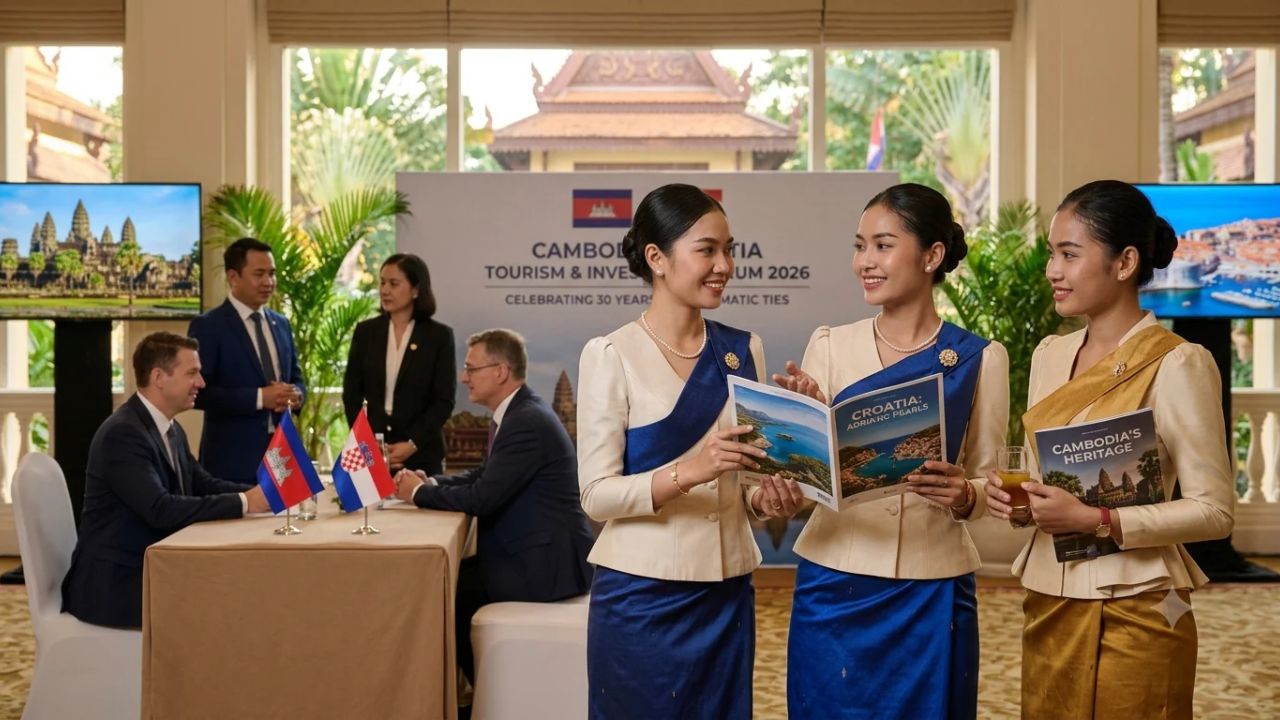
Diplomatic and governmental institutions hosting bilateral discussions in Phnom Penh
[PHNOM PENH, Oct 21, 2026] — Marking exactly thirty years of formal diplomatic ties and following Croatia’s milestone March 2026 declaration of nationwide landmine eradication, the first-ever official ministerial delegation from Zagreb to Phnom Penh on 19 and 20 October has initiated bilateral talks to link Adriatic and Indochinese tourism corridors. Led by Croatian Minister of Foreign and European Affairs Gordan Grlić-Radman, the historic two-day mission engaged Cambodia’s King Norodom Sihamoni, Prime Minister Hun Manet, National Assembly President Khuon Sudary, Senate President Hun Sen, and Deputy Prime Minister and Foreign Minister Sok Chenda Sophea. The discussions focused on expanding bilateral cooperation across tourism promotion, international air connectivity, capital investment, and post-war reconstruction technologies.
[!NOTE] Quick Overview: Croatia-Cambodia Landmark Bilateral Talks
- Historic Milestone: The 19–20 October 2026 visit represents the first-ever official journey by a Croatian Foreign Minister to Cambodia, coinciding with the 30th anniversary of diplomatic ties (established 1996).
- Multilateral Agenda: Talks spanned tourism development, bilateral trade, transport connectivity, capital investment, demining innovation, and EU-ASEAN regional alignment.
- Demining Technology Transfer: Following Croatia's March 2026 milestone of achieving 100% domestic mine clearance, Zagreb shared technical blueprints on automated robotic clearance and explosive detection to open rural Cambodian land for safe eco-tourism.
- Historical Memory and Justice: The delegation paid solemn visits to the Tuol Sleng Genocide Museum and the UN-assisted Extraordinary Chambers in the Courts of Cambodia (ECCC), drawing parallels with Croatia's peaceful Danube reintegration under UNTAES.
- Commercial Reality Check: No immediate visa-waiver treaties or direct air service agreements were signed; passenger travel remains dependent on two-stop itineraries via Gulf or Asian gateways.
The diplomatic mission reflects a broader foreign policy pivot as Croatia expands partnerships across Southeast Asia following its complete integration into the European Union's core structures, including the Schengen Area and the Eurozone. Having resolved its own post-conflict recovery challenges from the 1991–1995 Homeland War, Croatia is leveraging its specialized demining engineering, coastal tourism management, and heritage preservation capabilities as diplomatic assets. For tourism operators and international travelers, however, the talks serve as an exploratory framework rather than an immediate catalyst for mass travel, with air connectivity and visa hurdles remaining significant practical bottlenecks.
Post-Conflict Reconstruction and Mine Clearance as Tourism Enablers
The central pillar distinguishing this bilateral dialogue from conventional diplomatic exchanges was the shared emphasis on humanitarian demining, post-war reconstruction, and their direct contribution to tourism safety. In March 2026, Croatia announced the formal conclusion of its nationwide mine-clearance program, completing over three decades of systematic field operations that cleared hundreds of thousands of explosive remnants left behind from the 1991–1995 Homeland War.
Over those three decades, Croatia evolved from a recipient of United Nations demining assistance into a world leader in robotic clearance machinery, advanced sensory detection hardware, and certified explosive-detection canine teams. Croatian defense enterprises have exported specialized remote-controlled clearance vehicles to war-affected nations worldwide, including Ukraine.
| Bilateral Engagement Dimension | Historical Baseline (1996–2025) | 2026 Ministerial Milestone (19–20 October) | Practical Relevance to International Travellers |
|---|---|---|---|
| Bilateral Diplomatic Relations | Established in 1996; coordinated via non-resident embassies | First-ever visit by a Croatian Foreign Minister to Phnom Penh | Establishes direct ministerial channels for future tourism and investment pacts |
| Humanitarian Demining & Safety | Independent national programs managing post-conflict land | Formal Croatian-Cambodian demining innovation dialogue | Transfers tech to clear rural Cambodian acreage for safe hiking and eco-tourism |
| Commercial Aviation Corridors | Zero direct flights; multi-stop routing via Gulf or Asian hubs | Air connectivity formally placed on bilateral economic agenda | Creates framework for future interline and bilateral air service agreements |
| Visa & Immigration Controls | Full consular visas required for both nationalities | Preliminary discussions on bilateral administrative facilitation | Travelers still require standard Schengen visas (for Croatia) or e-Visas (for Cambodia) |
| Historical & Justice Exchange | Separate national reconciliation and war-crimes tribunals | Official delegation visits to ECCC tribunal and Tuol Sleng | Fosters shared educational and memory tourism initiatives between both nations |
| Multilateral Trade Integration | Minimal bilateral trade volume; limited private investment | Alignment within broader EU-ASEAN commercial frameworks | Encourages European private-sector investment in Cambodian hospitality supply chains |
In Cambodia, the legacy of the Khmer Rouge regime and decades of civil war left millions of landmines and pieces of unexploded ordnance (UXO) buried across rural provinces. Land contamination has historically constrained the development of community-based eco-tourism, trekking circuits, and cultural expeditions across northwestern provinces such as Battambang, Banteay Meanchey, and the Cardamom Mountains.
During the bilateral technical session on demining innovation, Croatian specialists presented operational case studies demonstrating how certified terrain clearance allowed Croatia to convert former frontline zones into internationally acclaimed cycling routes, national parks, and agritourism estates. By transferring technology and clearance methodologies, Croatia is actively supporting Cambodia’s ambition to declare itself mine-free, directly expanding the geographic footprint available for sustainable adventure tourism.
Historical Memory, Transitional Justice, and Destination Confidence
Beyond commercial and technical discussions, the official itinerary placed significant emphasis on historical remembrance, institutional accountability, and peaceful reconciliation:
- Tuol Sleng Genocide Museum (S-21): Minister Grlić-Radman toured the former security prison and interrogation center in Phnom Penh. The visit underscored mutual commitments to preserving historical memory, educating future generations, and preventing totalitarian atrocities.
- Extraordinary Chambers in the Courts of Cambodia (ECCC): The Croatian delegation held discussions at the UN-assisted tribunal established to prosecute senior leaders of Democratic Kampuchea. The exchange examined legal mechanisms for holding perpetrators accountable while delivering justice to victims.
- The UNTAES Reconciliation Blueprint: Croatian diplomats shared insights from Croatia’s successful peaceful reintegration of Eastern Slavonia, Baranja, and Western Sirmium under the United Nations Transitional Administration (UNTAES) between 1996 and 1998. The model demonstrated how establishing rule of law, protecting minority rights, and rebuilding civic infrastructure create the stability required to restore international traveler confidence.
These engagements highlight an emerging trend in international tourism: the rise of memory and educational travel. As travelers seek meaningful cultural immersion, destinations that transparently confront difficult historical legacies establish high levels of institutional trust and international respect.
The Connectivity Gap: Aviation Logistics and Visa Hurdles
While the ministerial talks placed tourism and economic connectivity on the bilateral agenda, travelers and tour operators face formidable logistical barriers that currently restrict mass travel between the two nations:
THE ADRIATIC-INDOCHINA TRAVEL CONNECTIVITY GAP
| Column 1 |
|---|
| CURRENT TRAVEL ROUTING (18 - 26 HOURS ELAPSED TIME) |
| =================================================== |
| Zagreb (ZAG) / Split (SPU) |
| │ |
| ▼ [Short-Haul European Connection] |
| Vienna (VIE) / Frankfurt (FRA) / Istanbul (IST) |
| │ |
| ▼ [Long-Haul Intercontinental Leg] |
| Doha (DOH) / Dubai (DXB) / Bangkok (BKK) / Singapore (SIN) |
| │ |
| ▼ [Regional Southeast Asian Feeder Flight] |
| Phnom Penh (PNH) / Siem Reap–Angkor (SAI) |
| PRIMARY LOGISTICAL BOTTLENECKS: |
| ------------------------------ |
| • Absence of Bilateral Air Services Agreements or Direct Flights |
| • High Multi-Sector Airfares ($900 - $1,600 Economy Round-Trip) |
| • Asymmetric Visa Policies: Strict Schengen Visa vs. Cambodian e-Visa |
| • Lack of Coordinated Tour Operator Marketing and Packaged Group Itineraries |
Currently, no commercial airline operates nonstop flights connecting Croatian airports—such as Zagreb Franjo Tuđman (ZAG), Split (SPU), or Dubrovnik (DBV)—with Cambodian gateways like Phnom Penh International (PNH) or the newly opened Siem Reap–Angkor International Airport (SAI). Travelers must book multi-stop journeys via Middle Eastern transit hubs (Doha, Dubai) or Asian gateways (Bangkok, Singapore, Ho Chi Minh City), resulting in travel times exceeding 18 to 24 hours.
Immigration requirements represent an additional hurdle:
- Cambodian Citizens Visiting Croatia: Must obtain a standard Schengen short-stay visa. This requires in-person biometric appointments at designated visa application centers, comprehensive financial documentation, travel health insurance, and multi-week processing windows.
- Croatian Citizens Visiting Cambodia: Can easily obtain an electronic visa (e-Visa) online or purchase a 30-day visa-on-arrival at international airport checkpoints for a standard statutory fee ($30–$36 USD).
Until bilateral negotiations establish air services agreements, code-share partnerships, or visa facilitation protocols for business travelers and tour groups, independent leisure travel between the two nations will remain concentrated among adventurous long-haul backpackers and cultural specialists.
EU-ASEAN Cooperation and Expatriate Business Networks
The bilateral meetings in Phnom Penh carried broader geopolitical relevance within the evolving partnership between the European Union and the Association of Southeast Asian Nations (ASEAN). As small, export-oriented nations, both Croatia and Cambodia emphasize the importance of multilateralism, maritime security, and adherence to international law.
Expanding diplomatic engagement allows Croatia to broaden its diplomatic presence in Southeast Asia following decades of inward-focused European integration. Conversely, Cambodia gains a sympathetic partner within the European Council, helping facilitate dialogue on international trade standards and sustainable development assistance.
During his visit, Minister Grlić-Radman also met with members of the Croatian expatriate community resident in Cambodia. Though small in size, this diaspora comprises professionals operating across boutique hospitality management, international development agencies, diving centers, and logistics enterprises. These individuals serve as vital cultural bridges, offering local commercial intelligence for Croatian enterprises exploring Southeast Asian market entry.
Cooperation between national tourism authorities represents another promising avenue. The Croatian National Tourist Board (HTZ) has developed advanced expertise in destination branding, seasonal dispersal, and high-yield cultural tourism. Sharing these best practices could assist Cambodia's Ministry of Tourism in diversifying its visitor marketing beyond Angkor Wat, spotlighting pristine coastal getaways in Sihanoukville, Koh Rong, and Kep to European travelers seeking uncrowded winter sun destinations.
Practical Advisory: Due Diligence Checklist for Travelers
For travelers evaluating itineraries between Southeastern Europe and Cambodia, planning requires careful attention to visa rules, transit connections, and regional public health standards:
| Travel Planning Category | Due Diligence Action Item | Practical Guidance for International Visitors |
|---|---|---|
| Visa & Entry Formalities | Verify entry visa rules based on your specific passport | Croatians should apply online for a Cambodian e-Visa (Type T) at least 7 days before departure |
| Aviation Route Selection | Book single-ticket multi-airline itineraries | Routing via Bangkok (BKK) or Singapore (SIN) provides the most reliable feeder links to Phnom Penh and Siem Reap |
| Health & Travel Insurance | Ensure policy covers medical evacuation and adventure activities | Comprehensive travel insurance is essential; verify coverage for rural treks in demined nature reserves |
| Currency & Payment Norms | Carry clean, undamaged US Dollar notes alongside local currency | Cambodia operates a dual-currency system (USD and Cambodian Riel); cards are accepted in major urban hotels |
| Historical Site Etiquette | Observe dress codes and conduct rules at memorial venues | Respectful attire (covered shoulders and knees) is strictly enforced at Tuol Sleng, the Royal Palace, and Angkor |
| Demining Zone Awareness | Stay on marked trails when trekking in remote rural provinces | In peripheral provincial areas, always use licensed local guides and never venture off established pathways |
Following these practical guidelines ensures a smooth and enriching journey through Cambodia's cultural and historical landscapes.
Structural Outlook: Translating Diplomatic Goodwill into Commercial Tourism
The 30th-anniversary ministerial visit between Croatia and Cambodia illustrates how shared historical challenges can provide the foundation for modern international cooperation. By linking diplomatic discussions with technical demining expertise and post-conflict recovery, the two nations have established a substantive framework that extends beyond symbolic ceremony.
However, transforming high-level goodwill into tangible tourism numbers requires sustained follow-through. Both governments must work toward reciprocal visa facilitation, encourage commercial aviation partnerships, and foster private-sector joint ventures in eco-tourism and hospitality.
As Croatia expands its footprint in Southeast Asia and Cambodia continues to modernize its international tourism infrastructure, this landmark diplomatic engagement marks an important first step toward building enduring cultural, educational, and commercial bridges between the Adriatic Sea and the Mekong River.
Frequently Asked Questions (FAQ)
What was the purpose of the Croatian Foreign Minister's visit to Cambodia in October 2026?
The official visit by Minister Gordan Grlić-Radman marked the 30th anniversary of diplomatic relations between Croatia and Cambodia, focusing on expanding bilateral cooperation in tourism, trade, air connectivity, capital investment, and post-conflict demining innovation.
Did the talks introduce visa-free travel between Croatia and Cambodia?
No. Existing immigration frameworks remain in place. Cambodian citizens require a Schengen visa to enter Croatia, while Croatian travelers can obtain a Cambodian tourist e-Visa or visa-on-arrival for stays up to 30 days.
What demining expertise did Croatia share with Cambodian authorities?
Croatia shared technical methodologies and operational models from its 30-year national mine-clearance program—completed in March 2026—demonstrating how automated robotic equipment and certified detection dogs rehabilitate rural terrain for safe eco-tourism and agriculture.
Are there direct commercial flights between Croatia and Cambodia?
There are currently no nonstop flights connecting Croatia and Cambodia. Travelers must book connecting flights via major Middle Eastern hubs like Doha and Dubai or Southeast Asian gateways like Bangkok and Singapore.
What historical memorial sites were included in the official diplomatic itinerary?
The Croatian delegation visited the Tuol Sleng Genocide Museum (S-21) and the UN-assisted Extraordinary Chambers in the Courts of Cambodia (ECCC), emphasizing transitional justice, accountability, and the role of memory tourism in post-conflict recovery.
Related Travel Guides
Thailand Advances Dual Tourist Fee and Departure Tax Review as 24.4M Arrivals Expose 4.1% Slump
China Expands 240-Hour Visa-Free Transit and 30-Day Hainan Entry to Vietnam and Kyrgyzstan
10 Essential Cambodia and Southeast Asia Border Travel Tips from Reddit Explorers 2026
This article is for informational purposes. Flight routes, passenger regulations, visa rules, and transit advisories are subject to change by airlines and aviation authorities. Readers are advised to verify schedules and travel documentation with relevant carriers and border agencies before departure.
Related Stories


Canada Inbound Travel from India Falls 7.8% in 2026: Gateway Analysis for Toronto, Vancouver, and Montréal